After putting Jaipur on the global literary map with the Jaipur Literature Festival, Sanjoy Roy’s Teamwork Arts is now successfully taking similar cultural festivals to smaller cities.
The festivals emphasise understanding the language, history, heritage, and spiritual essence of each place literature, mystic poetry, and local culture.
Events like the Sacred Amritsar Festival have become multi-layered experiences featuring Sufi music, Gurbani, classical performances, and storytelling, drawing large audiences and helping heal historical traumas.
‘Jaipur was quite a small town when it was decided as the venue for the Jaipur Literature Festival’, says Sanjoy Roy, the live wire Managing Director of Teamwork Arts that handles the nitty-gritties of the JLF, now touted as the ‘world’s biggest literature festival.’
If JLF has put Jaipur on the literary map, Sanjoy and his team are ensuring their forays into literature and culture spread out to other ‘small towns’ or two-tier cities and take root there.
‘The strategy was about exploring language’ Roy adds. With that end in mind, the Avakai Festival, named after the pungent mango pickle the Telugu speaking people love, was held in Vijayawada, on the banks of the Krishna river.
To the organisers surprise, the Festival proved to be a showcase of rich stories about civilisations, heritage, and languages. As Roy discovered,‘Once you understand the sense of the language of a place, the place reveals its identity, that goes back into history.’



One idea linked with another, resulting and the Sacred Amritsar Festival, was launched.
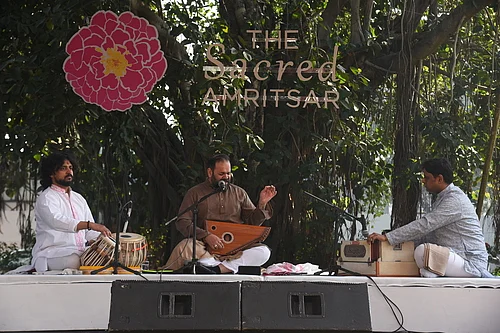
The Sacred Amritsar Festival, held for the third successive year in the city of the Golden Temple proved that music and literary conversations could draw audiences anywhere.
This year the festival celebrated mystic poets and Sufi music, including songs from the Punjab, Rajasthan and Maharashtra, along with performances by the Aniruddh Varma Collective singers Usha Uttup and Kailash Kher.
Mornings were ushered in to the sound of the Gurbani sung with passion and piety by Tarandeep Singh, the strings of the sarod played by Soumik Datta, or classical music by Aaastha Mandle. The leaves of the ancient banyan tree in the courtyard of the heritage building now turned into a hotel also quivered to the sound of Kartikya Vashiht and Makarand Sanon as they played fast-tempo classical melodies on flute with percussion.
‘We had no idea there was so much of built heritage in this city,’ Roy says, ‘ the Gobindgarh Fort, the Khalsa College, the newer Partition museum, the old hospital, the Earth heritage Museum… we use these as a base to discover the culture, food, the craft and heritage of the place. As part of our series on Mind Body Soul, we also wanted to help heal the traumas the city had experienced, through music and understanding.’
Realising that Amritsar was rich in both cultural and literary history, loaded with cross-border stories, the idea grew that the festival should be a ‘multi-layered experience with a strong spiritual connect.’
The ‘experience’ that evolved out of this idea, proved enriching for both, the performers and the audience.

For musician and composer Soumik Datta, playing to new audiences was exciting. ‘ How do I adapt myself to Punjab or any other state?’ he said, repeating a question. ‘I think the first thing is when you get to a place that you haven't been to even though it is within India, you try to understand the cultural specificity. What does the landscape look like? What do people eat? What does the language sound like? What are people wearing? And even though we all collectively call ourselves Indian it's wonderful to see the diversity of cultures this country has to offer. So I came to the state with a lot of humility and curiosity.
‘I think if one is open to absorbing that energy then the performance also changes and I’m able to offer something to the people of that place, but one has to feel present in that place.’
Composer, singer Kutle Khan added that understanding and internalising the energy of the audience in a city that was new to his work was an important extention of his performance. ‘Like the merging of two rivers, the folk and the classical merge in my musical heritage,’ he said, ‘but keeping the audience, especially the youngsters of a new city I am performing in, in mind, I do experiment a little. It extends my vocabulary, and gets me acceptance from a new generation. I think that is what playing in Sacred Amritsar achieved.’
‘When I was invited to play for Sacred, and play morning ragas, I had to create music to get them into the day , so it was slow, organic. I chose bhairavi, which the Punjabis are familiar with; it’s used in Heer compositions… and as I played I could see the audience leaning into it, assimilating it. It is a fulfilling experience for both sides.’
Eric Chopra who was invited to Sacred Amritsar to share stories from his book, ‘Ghosted: Delhi’s Haunted Monuments’, felt that each city brought into play its own sensibilities.
‘One of the most revelatory aspects of carrying otherworldly stories from one geography to another is witnessing how differently they are received. In my book, I explore the ghosts, jinn, and spirits said to inhabit Delhi’s historic sites, always situated within a layered historical backdrop. When I’ve taken these stories to cities like Amritsar, I’ve been struck by a shared sensibility: places shaped by dense, often turbulent histories seem especially receptive to the supernatural. Delhi and Amritsar, both marked by historical upheavals, hold within them the tremors of the past that are registered in the subconscious and linger in collective memory.
‘ In Mumbai, which is being reimagined through relentless infrastructure projects, I found myself being asked questions such as where do the ghosts go when the grounds all around are being dug up? I keep discovering that these otherworldly tales are never static; they travel, transform, and re-root themselves within the emotional and historical landscapes of different places.’
‘Conversations and songs, stories on the Partition have all been a part of this experience ,’ says Minal Hasan, of Teamwork Art. ‘. Delegates from outside Punjab found these enlightening and for those from outside India, it proved an exotic experience and led to a deeper understanding.’
The Mahindra Kabira Festival that was started 10 years ago, could well be called an experiment that held the seeds of the idea of the Mind Body Soul Series.
Benaras seemed the most obvious location for the two-and-a-half day fest of music and culture, as Kabir was born there. Building the events about stories, songs and the pithy couplets of Kabir, singers and speakers were invited to share their knowledge of the saint poet with delegates from all over the country and beyond. The result was an experience that took them back in time, as they sat on the steps of the ghats with the silver carpet of the river Ganga spread out in front of them. Adding food, shopping, the famed Ganga Aarti and early morning boat rides made the festival a 360 degree portal to experience Benaras in all her mystical and historic richness.
The spreading tree also cast its shade over Jaigarh last year.
‘It's a huge learning for us,’ says Nita Raheja, co-founder of Longform PR, of this attempt to encompass smaller cities.
The learnings included the fact that smaller cities still hold on to their culture protectively, and did not take kindly to ‘outsiders’ telling them about themselves.
The only way to ensure a fest would succeed was to integrate with the locals. It included reaching out to social groups, asking them for ideas, participation and thus helping to spread the buzz.
‘Advertisements in newspapers do not have any effect, it has to be a feeling of acceptance spread through word of mouth,’ Raheja says.
And so, to ensure the Sacred Amritsar Festival grew into a sought after event in the second year, the Phulkari Association, Amritsar’s Punjab Kesari, a local reporter from the Tribune and many other groups were all drawn into the circle and made a part of the festival.
‘We celebrate India’s diversity, culture and root the event in the classical but include the contemporary for a 360 degree experience,’ Roy explains.
The success of these initial forays has spurred Roy to train his binoculars at places like Madurai, Pondicherry, Ladakh and Gangtok, places ‘rich in stories and history.’
The fact that musicians, literary giants, performers are eager to be included in the shade of this spreading tree proves that the roots of the idea are strong.
And the audience, is waiting!