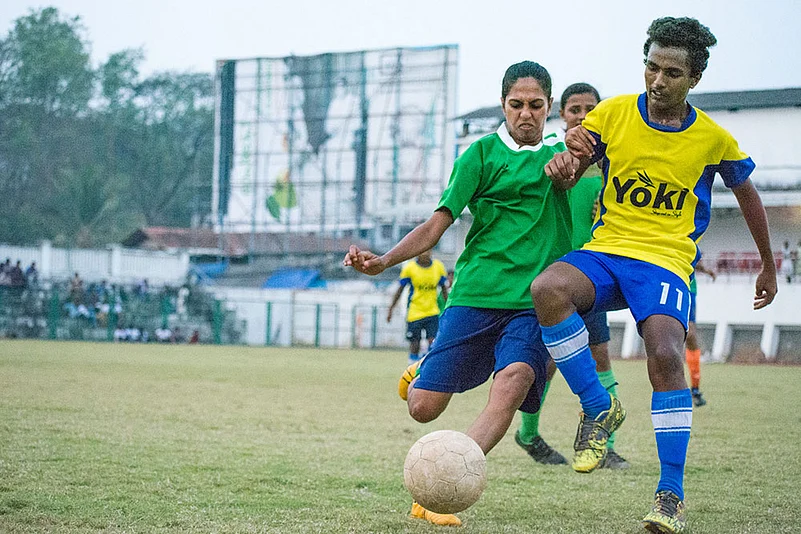

In the Malappuram district of Kerala, if you ask the people on the roadside the directions to a village called Thootha, they just blink and stare. But if you were to ask about the Darul Uloom Higher Secondary School (DUHSS), you are sure to get a nod of acknowledgement at the least. The reason why the only school in Thootha is known to the locals of Malappuram, state-level footballers as well as the players of the Indian Super league alike is because it created, in its own quiet way, a history of sorts recently by participating in the ‘gender-neutral’ football tournament (GNFT), a first for the state or, perhaps, even for the country. Students FC Thootha, a mixed-gender football team from the school, was one among the four teams that participated in the tournament organised by the Kerala Sashtra Sahithya Parishad at the Kottappadi Football Stadium in Malappuram on February 10. The matches that made up this tournament were devoid of the usual ‘normal’ and accepted biases, which make up most sports; the participating teams had no gender criteria whatsoever, they comprised of male, female as well as third gender players.
Football is one of the most popular sports in Kerala and Mallapuram is crazy about it. The 20-30 football teams from each village of the district are testimony to its obsession with the sport. But there are only three all-girl’s football teams in the entire district. So, when the organisers approached two of these teams to play in the gender-neutral tournament, they were keen to participate in it.
The Darul Uloom itself has an illustrious list of students and alumni—ex-student Abdul Salim V. picked up the ISL golden glove award this year; then there is Usman Asiq, who played in the Santosh Trophy and Divya Krishnan, who plays on the Kerala state girls’ (under 17) football team.



Last year, the KSSP had experimented with a gender-inclusive model for training in their football camp, where gender identity and dynamics vis-a-vis the sport were topics of discussion. It was a huge success. “So sometime in November, we came up with an idea of organising a gender-neutral tournament,” says Sreejith K., who is a member of Yuvasamithi, the youth wing of the KSSP. “We have a film festival every year called Scribe, so this year, we decided to combine the GNFT (gender-neutral football tournament) with it. We approached the women’s football teams and asked them if they would be interested in this kind of a tournament. The teams then went about selecting the boys they wanted to include in their team.”
Ask the female footballers of the DUHSS about how the experience of the tournament was and they shrug it off, saying they are accustomed to playing with boys, although they agree that the tournament was tough and competitive. “I make the girls team practise with the boys, so it wasn’t difficult to form a team,” says Muneer M., the sports teacher of the DUHSS. Faced with the same question, most of the boys who participated put up a shy smile and say it was fun. “It was exciting because the boys play with a lot of power,” quips 16-year-old footballer Archana P.K. while Disha C.P, only 12-years-of-age, says she was scared of getting hurt before the game. “But I ended up learning a lot of tricks from it,” she adds.
Rahmathullah K.A., the principal of DUHSS, is all praise for coach Muneer: “It is he who made it possible.” He mentions that he and the headmistress had just mentioned in private the hope of having a girls’ football team in the school. This was somewhere in 2013. What followed was an all girls exhibition match in the school playground, and ever since, there has been no looking back.
“The children are from very poor backgrounds and they cannot afford football boots and jerseys, but both Munnermash and Hamza K.K. do everything to teach these children,” says Rahmathulla. “They even took the students to watch the ISL in Kochi. This is a Muslim minority school and though not many girl are playing from the community yet, the locals have been very supportive.”
Despite the direction the school is heading in, some feel there are problems as well. Harikumar P., coach of the Soccer Football Academy, Vallikunnu—the other team from Malappuram to participate in the tournament—says funds for the present UDF panchayat of Vallikunnu have been chocked. He blames the Muslim League for it. “A few years ago, the funds coming for the football camps had completely dried up,” says Harikumar. “Thus, we cannot afford to provide the girls with a sports diet or conduct an elaborate camp. I have to beg my friends for funds to get them boots and jerseys.”
Among the other teams which played in the tournament are the Kozhikode Women’s Academy, which had a transwoman on the team, and the Kadapanda Raja Academy from Vadakara, which had an intersex person on board.
“We conducted the tournament as an experiment and got a very positive response,” says Chinchu C., a research scholar with the Cochin University of Science and Technology and a Yuvasamithi activist. “Now we hope to reach out to other places in Kerala and organise similar events,” He believes in the potential for change that such a tournament may usher in. “We are conditioned not to question many things. The segregation in the sports field is a normal exclusion. It is not something that people are bothered about. Even when a boy and girl are small their gender identity is imposed on them to think and behave differently,” he adds.
Football has always been seen as an ultra-masculine sport. The symbolism around it that we see through advertisements—players being equated to gladiators, the focus on ‘brawn’, international football players being seen as masculine icons—has done a great deal to re-enforce popular views with regard to the game. In this context, an event such as the GNFT has come out to break stereotypes, that too at a grassroots level. “Playing mixed football is very radical. In a sense, it is breaking the gender stereotypes imposed on women by a patriarchal society. We see women negotiating their freedoms on a daily basis. This has to happen more often so that it gets normalised,” says K.M. Sheeba, professor gender, ecology and Dalit studies, Sree Sankaracharya University. Feminist writer Sarah Joseph believes that a game like football, which is a very physical game, will condition society in a healthy manner. And it should result in a change of mindsets, not just among the players, but the viewers too.
By Minu Ittyipe in Kochi