Josy Joseph reconstructs India's final weeks before Independence through declassified records, revealing the complexities of accession.
The book chronicles negotiations, resistance and political intrigue surrounding over 550 princely states joining the Indian Union.
It argues Nehru, Patel and unsung officials prevented India's fragmentation despite formidable political, diplomatic and royal opposition.
Josy Joseph's book places you at an epochal moment in history — one that many Indians have cross-examined and debated at one time or the other. It traces the pivotal twenty-one days to Independence, a gripping countdown to the zero hour when India gained its sovereignty on 15 August 1947. Reading it, there is an inherent eagerness to jump into the narrative — an itch to time-travel to July 1947, place yourself in those deliberations and offer solutions with the hindsight we now possess.
The riveting narrative brings to life a step-by-step account of the inner workings of the accession of over 550 princely states to the Dominion of India. The book opens with the Dewan of Travancore, Sir C.P. Ramaswamy Iyer — lawyer, administrator and chief advisor — whose dream of Travancore attaining the status of an independent nation was cut short by an attempted assassination on 25 July 1947, the very day he decided to skip the last meeting of the Narendra Mandal (Chamber of Princes), the official gathering of Indian rulers under British protection, housed in the Council House, today's Parliament complex.


It describes how Lord Louis Mountbatten, the last Viceroy of India, representing the Crown, and Jawaharlal Nehru, along with Sardar Vallabhbhai Patel, V.P. Menon and a tireless team, worked against the clock to establish the Dominion of India. It wasn't just freedom from the Empire but also liberation from within — from hundreds of mini-empires and princely states that were reluctant to give up their power and riches, and that did everything in their might to resist accession: underhanded manoeuvres, deliberate conspiracies, undercover operatives, spies with premeditated machinations and fuelled communal uprisings.
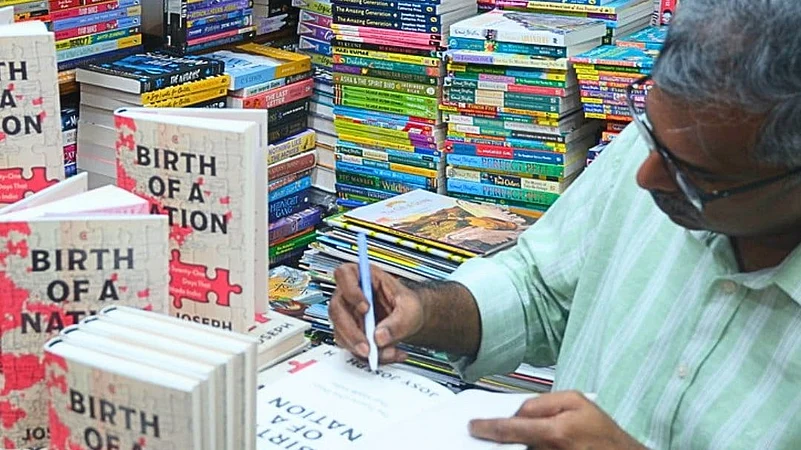
Josy is a renowned investigative journalist with a stellar career of over three decades covering corruption, defence and national security, and the acclaimed author of several books, including The Silent Coup: A History of India's Deep State (2021), which examines the systemic issues in present-day India that increasingly threaten its democracy, shaped by the ruling elite. Birth of a Nation comes full circle, asking whether the privileged nobility and princely states have merely been replaced by a new set of present-day elites, threatening the very fabric of the nation that Nehru and Patel, along with countless others, valiantly fought for, both against the Crown and against the nobility within. A decade-long effort, the book draws on countless recently declassified documents and files, personal papers, and official and private correspondence between the Congress, the Crown and the princely kingdoms, pieced together into an honest chronology of events that resists depicting anyone in a coloured light.
Partition itself is not detailed comprehensively; Jinnah's stance on a Muslim nation receives only a brief mention, and Gandhi's hard stand against Partition is alluded to in passing. The loose idea of Partition, the book notes, had taken shape years before 1947: Hindustan or India with Hindu-majority provinces, Pakistan with predominantly Muslim provinces, and the princely states to be offered dominion status. But when and how exactly the two-nation theory was conceived is left a little ambiguous, and one does miss the perspective from Jinnah's side of the correspondence: whether by the constraint of sources or by design is hard to tell. As the date inched closer, the conviction of Nehru and his team intensified: India would be united under one dominion alongside Pakistan, and they stood rigidly against the fragmentation — the "Balkanisation" — of India, an adamancy for which Gandhi and Nehru drew criticism even from The Hindu.
Once Sir C.P. is introduced, the book follows a non-linear structure, travelling back and forth through this crucial period while briefly sketching the backstories of key stakeholders and power brokers, united by a common theme: the desperation of the princely states to draft themselves as independent countries. There is the flamboyant Nawab of Bhopal, Hamidullah Khan, an old acquaintance of Mountbatten from his days as aide-de-camp to the Prince of Wales during the 1921 visit to Bhopal, and his backchannel negotiations with Muhammad Ali Jinnah, president of the All-India Muslim League, to stall accession while dreaming of an independent “Princestan”. There are the idiosyncrasies of Hyderabad's Nizam, Mir Osman Ali Khan, who used the Jacob Diamond as a paperweight and had featured in Time magazine as the world's richest man, trying to anchor his dream of an independent sovereign state through negotiations steered by his chief advisor, the insightful legal expert Sir Walter Monckton. Unbeknownst to the Nizam, one of Menon's informant in Hyderabad was sending daily intelligence to Delhi at great peril to his own life. The nobility found many sympathisers in the power corridors of Britain: Sir Conrad Corfield, a loyalist of the elite class, advocated and lobbied on behalf of many Nawabs and Maharajahs and, much to Nehru's chagrin, destroyed confidential files and records of the Indian princely states held as part of the imperial archives. Maharajah Yeshwant Rao Holkar II of Indore, Maharajah Hari Singh of Kashmir, the rulers of Dholpur, Patiala, Dungarpur and Bilaspur, and Junagadh's Nawab Muhammad Mahabat Khanji III with his dewan Shah Nawaz Bhutto — the sheer number of negotiations and resistance movements makes us wonder whether the freedom struggle and the partition have been viewed reductively over the past 78 years.
With its hundreds of plots, sub-plots and chance encounters — some set in motion a quarter-century earlier — it is nearly impossible to absorb this book in one sitting. But it makes a compelling argument that it was Nehru's doggedness, together with a network of known and unknown unsung heroes, that accomplished the herculean task of uniting a nation against formidable odds. Everything was muddled, living up to the title of one of its chapters — Muddled Plans — and the book leaves you with a lot of what-ifs. What if they had deliberated longer? Would it have been Balkanisation or Europeanisation? That we will never know. What we are left asking instead is whether one can ever bring order to a quagmire — and whether, at times, that quagmire is still sinking.