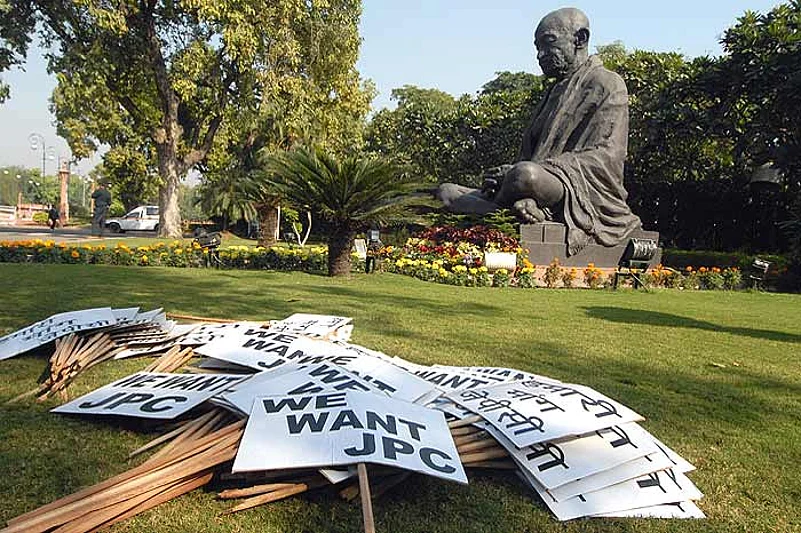
At least for now, the investigation into the 2G scam has an unstoppable momentum. With some arrests and many high-profile corporate “visitors” to the CBI offices, there is a sense (even if premature) of retribution in the works. Fuelled by the naked display of patronage politics served up in the Niira Radia tapes, immense public anger has been pivotal in “keeping the story alive”. The flip side of this emotional outburst against corruption is cynicism that the guilty will never be brought to justice.
That’s why there is a growing debate on making the public a ‘participant’ in the joint parliamentary committee (JPC) set up to investigate the scam. With sweeping investigative powers, a JPC can, and does, amass a wealth of facts, submissions, interviews and findings. What finally reaches the public, however, is a truncated report. JPC proceedings, just like the deliberations of all parliamentary committees, are held in camera. Now, questions are being raised. Why shouldn’t the entire process be transparent, so that all the information is available to the public at large? “The whole JPC transcript must be released. After all, they are meeting on our behalf and at our expense,” says RTI activist Arvind Kejriwal.
But that doesn’t cut much ice with many political players. Opinions vary on whether public participation helps in putting more pressure on parliamentarians to get to the root of the scam or only ends up derailing proceedings by getting everyone to play to the gallery. Nilotpal Basu, member of the central secretariat of the CPI(M), says this question has been debated before—and he’s not in favour of changing the rules. He says opening the proceedings to public scrutiny would lead to public posturing by JPC members along party lines, replicating what happens during televised Parliament proceedings. “That’s a sure recipe to prevent the JPC from functioning in a bipartisan manner and giving unanimous recommendations,” he says.





| “There isn’t anything wrong in an open JPC as public participation helps in effective checks, functioning.” Arun Jaitley, BJP MP |

| “We’re not talking about a kangaroo court. Whatever happens should be in the public domain.” Harsh Mander, Member, NAC | ||

| “There may be pressures (on JPC members) but I don't know instances where it’s led to corruption.” V. Kishore Chandra Deo, Congress MP |

| “If the JPC is open, it will lead to a clear divide along party lines and members playing to the gallery.” Nilotpal Basu, CPI(M) secretariat | ||

| “If secrecy must fall on ongoing deliberations of a JPC, then the veil can be lifted once the discussions are over.” C.V. Madhukar, Director, PRS |

| “It was believed that government officers won’t talk freely. But the House can change the rules if it wishes.” Subhash Kashyap, Constitutional expert |
Similarly, Congress MP and member of the JPC on the office of profit issue, V. Kishore Chandra S. Deo, stresses that “many bureaucrats depose before the JPC in confidence. Opening up the JPC may adversely affect the quality of the probe.” Despite fears of bureaucrats clamming up, experiences the world over show a growing trend towards public scrutiny to cleanse government functioning, including in public appointments. On fears that public scrutiny would repress witnesses, especially public servants, C.V. Madhukar, director, PRS Legislative Research, suggests full transparency once proceedings are over, if not during deliberations. “Once an investigation is over, a JPC must reveal every single detail of transactions—the full transcript,” he says.
The JPC can be as open or as closed as Parliament wishes. Its functioning is determined by the Lok Sabha Speaker and the chairman of the Rajya Sabha, just like the parliamentary standing committees, or the public accounts committee, each of which has members from both houses. The difference in case of a JPC is its investigative powers, which allow it to summon even the prime minister. Since JPCs were born during the late ’80s, as a sort of grandchild to other parliamentary committees, they have continued to follow the same procedures of transparency as the other bodies—they do not reveal all even though there is no express law or regulation saying they must not reveal this or that information.
Simply put, if the two houses of Parliament decide, a JPC can be made more transparent. Releasing the entire deliberations of a JPC is against the practice so far. “But the House can take a decision, they can change the rules,” says constitutional expert Subhash Kashyap.
Though the JPC meets at least once a week, its chairman or a spokesperson briefs the media infrequently. Sucheta Dalal, managing editor, Moneylife, feels the briefings (generally by the chairman) have no relevance, as it is pre-decided what is to be told to the press. Though some of JPC proceedings are often leaked to the press beforehand, authentication of these “official versions” of proceedings cannot replace transparency. Sometimes, the proceedings are “recorded and sent to those who were questioned to verify accuracy, but those papers have rarely made it to the public domain. All else is openly available and in the past, many brokers have alleged that it was available for a price”, says Dalal.
Games played within the JPC too are a concern. Going by her personal experience in reporting on two JPCs examining the Harshad Mehta and the Ketan Parekh scams in the financial sector, Dalal does not paint a reassuring picture. “JPCs in the past have been driven by a cabal of friends of players—many members have ‘allegedly’ been on the take and there were constant rumours about deals. You have no idea how politicians fight and lobby to be in JPCs.”
Political parties seem aware of concerns that influential corporate houses will try to WOO JPC members to their side. Leader of the Opposition in the Rajya Sabha and BJP member Arun Jaitley supports the view that opening up the JPC deliberations to public scrutiny may help check any malpractice and ensure effective functioning. To pre-empt any charge of “sleaze” or pressure on members, the BJP and its NDA allies have “made a conscious selection of seniors and people with good record”, says Jaitley.
Social activists feel that may not be enough. National Advisory Council member Harsh Mander, for instance, says it would be right to adopt a system and procedure to facilitate people’s involvement in the JPC probe. After all, it can only benefit the probe. “At least in a televised JPC hearing, the members will pretend to ask tough questions and will be forced to act neutral,” says Dalal. Given that there are global precedents—like the US public inquiry into the causes behind the 2008 meltdown—a public commission will provide much-needed answers for the public. As Kejriwal put it, “A JPC will not punish the guilty—that’s a court’s job. It will only fix political liability.” So, it needs to address wider issues related to corruption in full public glare. Or, what’s the point?