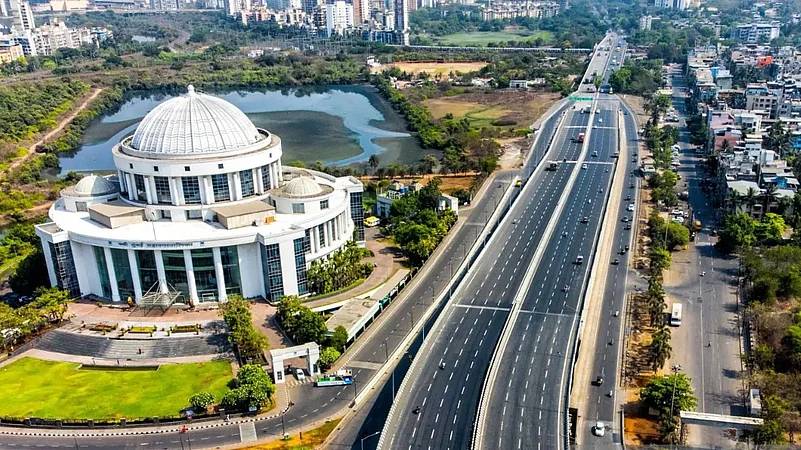
Navi Mumbai, once seen as Mumbai’s quieter cousin, has rapidly become a preferred base for large enterprise operations and technology centres. Global and Indian companies such as Accenture, IBM, Cognizant, L&T, IDFC, UBS, HDFC Bank, Princeton Digital, Verizon, Qualcomm, among others, along with a growing roster of IT, engineering and financial services firms, have expanded here to tap into a deep talent pool, stronger connectivity and significantly more economical rentals compared to traditional business districts. With ongoing infrastructure upgrades and a more predictable, less congested urban environment, the city is steadily consolidating its position as a high-value and cost-efficient hub for modern businesses.
Multiple reports by prominent IPCs consistently endorse this significant growth of Navi Mumbai driven by its increasing popularity attributed to talent availability, preference among corporates, continuously improving infrastructure and exceptional liveability indices.
Highlighting the talent availability aspect, a KPMG Talent Feasibility Report stated that Navi Mumbai is viewed as a high-potential talent catchment. Navi Mumbai produces approximately 1.5 lakh graduates every year and ranks alongside Mumbai, Pune, Gurugram and Bengaluru as a preferred location for talent in IT, BFSI, telecom, media, professional services and e-commerce. Reflecting this shift, 90% of companies viewed tapping talent from satellite cities like Navi Mumbai as a strategic advantage. Complementing this strong talent pool, the city offers cost efficiencies with average office rentals around ₹70 per sq ft (approx. 57% lower than Mumbai).
Key insights from the report:
Navi Mumbai is attracting diverse skilled talent beyond traditional metro hubs.
It is among the safer cities to live in, which strengthens employee preference.
Connectivity is set to improve sharply with MTHL, metro expansion and the airport.
The city ranked among the cleanest in India in recent Swachh Survekshan surveys.
Competitive commercial rentals and lower attrition make it a cost-efficient location for businesses.
With this momentum, businesses are expanding beyond saturated metros. Among these, Navi Mumbai has attracted Global Capability Centres (GCCs) and innovation-focused companies due to its proximity to Mumbai’s established business ecosystem.
According to the report by Cushman & Wakefield titled Navi Mumbai: The Next Growth Corridor, the transport infrastructure of Navi Mumbai is witnessing massive transformation.
The report stated:
The metro network is expanding rapidly, with each line equivalent to more than a dozen bus lanes or 39 vehicle lanes.
Travel time is expected to reduce by up to 75% across major corridors.
Upcoming projects such as the Vikhroli–Badlapur metro and the proposed Kalwa–Airoli elevated rail line will further strengthen intra-city and regional connectivity.
As quoted in the report, Gautam Saraf, Executive Managing Director, Mumbai & New Business, Cushman & Wakefield, had said, “With Mumbai’s infrastructure push unlocking new corridors, Navi Mumbai’s integrated and scalable urban framework is perfectly positioned to absorb the next wave of real estate growth.”
According to City and Industrial Development Corporation’s (CIDCO) public updates,^ The Navi Mumbai International Airport (NMIA), which has already begun initial operations, is set to significantly strengthen the city’s connectivity. It will start with a 20 million passenger capacity per annum, with the ability to scale up to 90 million passenger capacity per annum by 2036, which is higher than the combined capacity of Mumbai’s existing terminals. The project is expected to catalyse substantial economic activity and create large-scale employment across the region.
Quality of life is another major draw. As per the Ministry of Housing and Urban Affairs’ Swachh Survekshan 2023 rankings, Navi Mumbai ranked third among the cleanest cities in India and continues to outperform most metros on safety and urban liveability indices.
As per a report by Liases Foras titled Airoli - Epicenter of a Prospering Enclave, the housing market around key employment hubs in Navi Mumbai, such as Airoli, is also expanding steadily, with over 1,100 active projects and nearly two lakh units in supply, about half of which have already been absorbed. The depth of housing options at accessible price points further strengthens the city’s attractiveness for both talent and employers.
Key housing insights from the Liases Foras study:
The Airoli catchment has 1,100+ active projects with about 1.94 lakh units in supply and steady absorption.
Carpet prices typically fall in the ₹15,000–20,000 per sq ft range, with both affordable and premium options in nearby micromarkets.
Average rents of ₹19,000 for 1 BHKs and ₹29,000 for 2 BHKs support workforce accessibility.
Referencing the report’s findings, Pankaj Kapoor, Managing Director, Liases Foras, pointed out that “The area in and around Airoli presents as a goldmine for home seekers, investors and businesses as the housing stock is expected to nearly double to 1.85 lakh units by 2030. Separately, the seamless connectivity with 30-40% less travel time to important business hubs and the upcoming Navi Mumbai International Airport, positions Airoli as a prime destination and solidifies it as a growth driver of Navi Mumbai.”
With its powerful blend of infrastructure, talent, and liveability, Navi Mumbai is fast positioning itself as India’s next major corporate and technology hub, a vibrant alternative to the country’s traditional metros.
The above information does not belong to Outlook India and is not involved in the creation of this article.