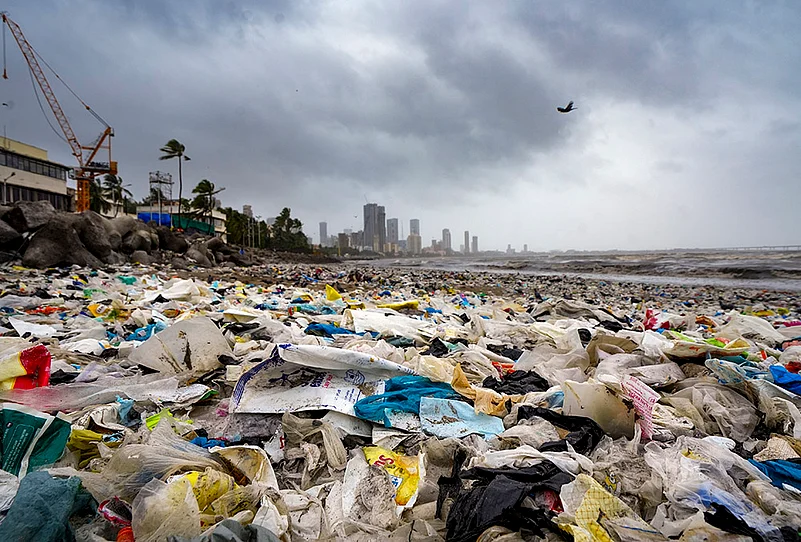
Nearly 2,500 tonnes of garbage washed up on Mumbai's beaches after heavy rain and high tides.
Most of the waste entered the Arabian Sea through drains and was pushed back onto the coastline during the monsoon.
Experts say beach clean-ups help, but preventing waste from entering drains is key to reducing marine pollution.
The nearly 2,500 metric tonnes of garbage cleared from Mumbai’s beaches this month did not appear there overnight. It was waste generated across the city, dumped into drains and nullahs, carried into the Arabian Sea by monsoon rain and then pushed back onto the shoreline by high tides. The scale of the clean-up has once again exposed the link between Mumbai’s waste management system, its drainage network and its coastline.
Between July 9 and 19, the Brihanmumbai Municipal Corporation (BMC) removed 2,498.66 metric tonnes of waste from beaches across Mumbai during a special clean-up drive launched ahead of a forecast period of high tides between July 14 and 18, when waves exceeding 4.5 metres were expected to bring marine debris ashore. While the operation cleared accumulated waste from the city’s beaches and ensured it was scientifically disposed of, it also highlighted a recurring problem. Civic officials and environmental experts say beach clean-ups address the waste after it has already reached the sea. Preventing garbage from entering drains in the first place remains the larger challenge.


How did 2,500 tonnes of garbage end up on Mumbai’s beaches?
The BMC organised the special campaign under the guidance of Municipal Commissioner Ashwini Bhide and the leadership of Additional Municipal Commissioner (Western Suburbs) Dr Vipin Sharma. Multiple civic departments worked together, deploying additional machinery, vehicles and manpower to remove waste during the monsoon.
According to the civic body, more than 1,000 mm of rainfall recorded in early July carried plastic waste, thermocol, wooden debris, aquatic vegetation and other refuse from drains and natural waterways into the Arabian Sea. High tides then washed much of that floating waste back onto Mumbai’s beaches, prompting the large-scale clean-up.
The waste collected over the 11-day drive was scientifically disposed of after being removed from the coastline.
Why is Juhu Beach the worst affected?
Juhu Beach accounted for the largest share of the waste collected during the campaign. Deputy Municipal Commissioner (Solid Waste Management) Kiran Dighavkar said 1,825 metric tonnes of garbage were removed from Juhu alone, nearly three-quarters of the total collected across Mumbai.
The remaining waste was spread across other beaches, with 277.60 metric tonnes collected from Versova, 152.10 metric tonnes from Dadar-Mahim beach, 127.20 metric tonnes from Chimbai-Waringpada in Bandra, 44.28 metric tonnes from Madh-Marve, 38.82 metric tonnes from Gorai and 33.66 metric tonnes from Chowpatty.
According to civic officials, Juhu receives a disproportionate share of the debris because several stormwater drain outfalls discharge directly into the sea near the beach. Officials also pointed to the dense residential catchment across the western suburbs, where large quantities of waste enter drains and canals before eventually reaching the coastline.
How Mumbai’s drains are carrying waste into the sea?
The garbage washing up on beaches begins its journey inland.
According to BMC officials, plastic waste, thermocol, clothes, wooden debris and other household refuse dumped into open drains and nullahs is carried through the city’s stormwater drainage network into the Arabian Sea. The waste does not sink but continues to float on the water's surface until changing tidal conditions move it back towards the shore.
To intercept at least some of this waste before it reaches open waters, the BMC has installed trash booms at 21 stormwater drain outfalls, including along the Dahisar, Poisar and Mithi rivers. These floating barriers, fitted with submerged nets, are designed to trap floating debris before it enters the sea. Officials say the civic body plans to expand the network to all 82 stormwater drain outfalls over the next five years.
Why monsoon tides are pushing the garbage back?
The monsoon changes the movement of floating waste along Mumbai’s coastline.
According to civic officials, floating waste would normally drift away from the mainland. During the monsoon, stronger and more frequent high tides prevent that dispersal, pushing the debris back onto beaches where it accumulates in large quantities.
This year, forecasts of waves exceeding 4.5 metres prompted the BMC to begin the special clean-up before the peak high-tide period. The civic body said dedicated beach-cleaning teams remain deployed during the monsoon to remove plastic, thermocol, wooden debris, aquatic vegetation and other waste washed ashore by tidal activity.
What plastic, thermocol and household waste reveal about Mumbai’s waste problem?
The type of waste collected from Mumbai’s beaches points to the source of the problem.
Much of the debris removed during the campaign consisted of plastic, thermocol, clothes, wooden debris and other household refuse, showing that significant quantities of everyday waste continue to enter the city’s drainage system after being dumped into drains and nullahs.
The scale of the problem extends beyond what is visible on the beaches. According to The Ocean Cleanup, nearly 5,000 metric tonnes of plastic waste enters the Arabian Sea every year through around 50 drains across Mumbai, affecting 220 kilometres of coastline, 152 square kilometres of mangroves and 107 protected species.
Marine ecologist Shaunak Modi said plastic waste disrupts coastal ecosystems by preventing crabs and other organisms that burrow beneath the sand from emerging. He also warned that plastic does not decompose. Even after beach clean-ups, waste transported to landfills near mangroves can generate leachate during the monsoon, creating another source of pollution when it enters adjoining mangroves and water bodies.
How polluted are Mumbai’s coastal waters?
The waste returning to Mumbai’s beaches reflects wider concerns about the condition of the city’s coastal waters.
A study carried out by the BMC’s sewerage department as part of its Sewage Treatment Plant project found Biochemical Oxygen Demand (BOD) levels of around 100 mg per litre in seawater samples from Bandra and Versova and nearly 50 mg per litre at Juhu. Both figures are well above the Central Pollution Control Board’s prescribed limit of 10 mg per litre for coastal waters.
BOD measures the amount of oxygen required by aerobic microorganisms to break down organic matter in water. Higher BOD levels indicate greater organic pollution, making it one of the most commonly used indicators of water quality.
Why beach clean-ups cannot solve the city’s larger waste crisis?
The BMC’s campaign removed nearly 2,500 metric tonnes of waste from Mumbai’s beaches in less than two weeks, but environmental experts say the exercise addresses the consequence rather than the cause.
Rahul Ahir, professor of wastewater engineering and former adviser to the Maharashtra government, said intercepting floating waste downstream cannot replace stronger waste collection and better enforcement against dumping into drains. Unless waste is prevented from entering the drainage network, marine litter will continue to reach rivers and the sea despite measures such as trash booms and repeated beach clean-ups.
The BMC has appealed to residents to support efforts to keep Mumbai’s beaches clean, safe and pollution-free, stressing that public participation is essential. This year’s clean-up demonstrates that the garbage accumulating along the city’s coastline is not simply a monsoon problem. It is the result of waste entering Mumbai’s waterways throughout the year, with the sea returning what the city continues to throw away.