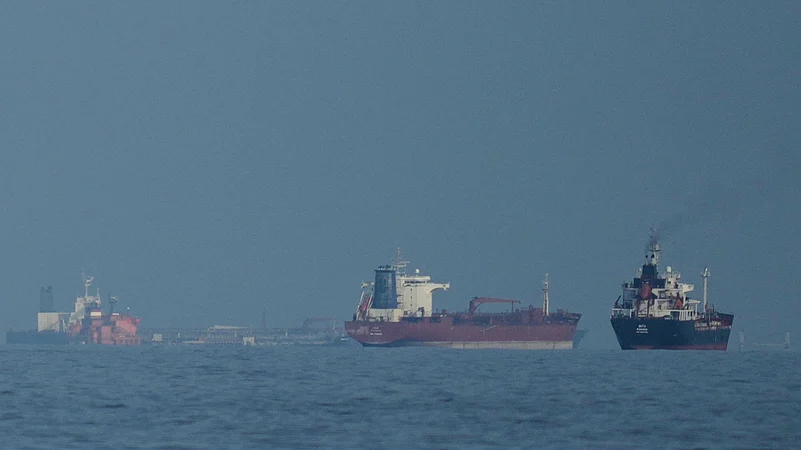
The United States and Iran halted military strikes for a second consecutive day on Sunday to facilitate diplomatic talks.
The pause aims to revive negotiations under a 60-day interim ceasefire agreement signed by Washington and Tehran in mid-June.
US Ambassador to the UN Mike Waltz stated that President Donald Trump is giving the negotiations room to progress.
The United States and Iran paused military strikes for a second consecutive day on Sunday, halting a two-week escalation sparked by Tehran firing at vessels in the Strait of Hormuz, the Associated Press reported.
The pause aims to revive negotiations. A 60-day interim ceasefire agreement signed by both nations in mid-June has now entered its second half. The Pentagon did not respond to questions Sunday, AP reported.
US Ambassador to the United Nations Mike Waltz told Fox News, as reported by AP, that President Donald Trump is "giving talks some space. He's giving it a little bit of room." Waltz dismissed the idea that the US stockpile of interceptors crucial in defending against Iranian attacks is running low, but experts have questioned how long both the US and Iran can afford to keep up attacks, according to AP.
Diplomacy And Transit Compromise
An unnamed regional official involved in mediation informed AP that the diplomatic pause is a "positive signal that helps their efforts to de-escalate".
The negotiated compromise centres on permitting Iran to operate vessel transit through the Strait of Hormuz with fewer maritime restrictions. Iran's Foreign Ministry spokesperson Esmail Baghaei told AP that talks with Oman regarding the safe passage of ships have made progress.

The preceding conflict caused immediate regional casualties. Iranian counterattacks targeted nations hosting American military personnel, resulting in the deaths of three US service members in Jordan and one in Iraq. Iran's army spokesperson told state TV on Sunday that since the US halted attacks, Iran has as well, AP reported.
Shipping And Blockade Pressures
The volume of commercial vessels navigating the Strait of Hormuz has dropped to its lowest point in three weeks, AP reported. A maritime monitoring body overseen by the US Navy informed AP on Sunday that no new attacks occurred in the past 72 hours, adding that traffic remained steady through the Bab el-Mandeb.
The US military updated its operational status on Saturday. The military confirmed its renewed maritime blockade of Iran is ongoing, having diverted 12 merchant vessels, disabled two and boarded another pair, AP reported. US forces "remain highly vigilant, focused, lethal and ready," it added to AP.
Iranian-backed Houthi rebels in Yemen threatened a blockade of Saudi shipping in the Bab al-Mandeb strait last week. The threat raises global energy concerns.
Netanyahu Backs Trump Strategy
Israeli Prime Minister Benjamin Netanyahu will meet Trump in Washington on Tuesday, his office informed AP.
The two leaders last met in Washington in February. This occurred weeks before they launched a war on Iran that killed Supreme Leader Ayatollah Ali Khamenei.
Speaking to Fox News, Netanyahu said, according to AP, he "fully" backs Trump's efforts to weaken Tehran and press it to end its nuclear programme. On avoiding conflict, he added to AP: "If he can do so without returning to intense military fighting, that's fine. Why not?"
Netanyahu indicated he would not present new information to "our good friend" Trump and instead would listen to "what he has in mind, because I think in many ways, it's his decision," AP reported.
Netanyahu warned to AP that if Iran or its armed proxies attack Israel again, "it will make a terrible mistake."