- For the first time in 20 years, protests in the Valley were on issues of development-power, roads, colleges, hospitals, etc.
- These were spearheaded by civil society-former officials, teachers, orchard owners.
- Till now all bandhs were pro-azadi called by separatist groups.
- The new mood in the Valley has forced even separatist groups to shun violence.
- The Hurriyat is now trying to become a mass-based outfit.
***
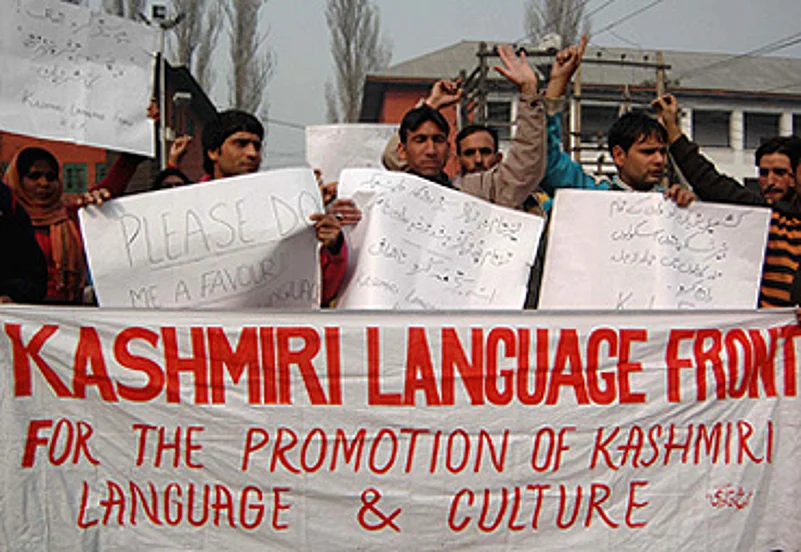

Kahsmiri bolo: Youth agitate for making Kashmiri compulsory in schools and colleges
And the Kashmiri is not just stopping at badgering politicians of mainstream parties to deliver on their promises. They are also rejecting the cult of violence that has disrupted life in the Valley for over two decades. Any killing of civilians by militant outfits now is opposed by the people. Sensing their complete alienation perhaps, the separatists have been quick to reinvent themselves. The first to do so was the pro-azadi Syed Ali Shah Geelani of the Jamait-e-Islami who a few weeks ago advised militant groups against killing informers. "Although anti-movement activities are intolerable for us, death cannot be the punishment. Killing someone by slitting his throat goes against the teachings of Islam. Sometimes exhortation and social pressure is a better weapon to keep a man from erroneous activities," he said after four civilians were killed by alleged militants in his own home turf of Sopore.
More interesting is the latest fiat from the United Jehad Council headed by the PoK-based Syed Salahuddin. While urging pro-freedom groups to step up their campaign to ensure the boycott of assembly elections scheduled later this year, Salahuddin clarified that the council was against the use of the gun in the campaign. "The gun will be used only if troops coerce people to vote. But if someone comes out to vote willingly, we won't stop him," he said in a press note released in Srinagar. Significantly, the number of civilians killed by militants in j&k has seen a sharp drop from 371 deaths in 2006 to 151 last year.
Is azadi off the mind of the Kashmiri then? "Make no mistake, the desire for azadi remains as strong as before," says Dr Rekha Chowdhury of Jammu University. "But people have realised that it is unachievable in the near future. So, they have become reconciled to the fact and are now clamouring for development." Adds Gul Mohammed Wani: "The end of violence does not mean that the sense of alienation will go. There is a sense of deep sacrifice for something. That something need not necessarily be azadi, it could also be a grand reconciliation package."
And elections are a good time to make fresh beginnings. The political space in Jammu and Kashmir is fast getting cluttered by a number of smaller parties which earlier had no presence in the state. The mainstream parties are still dominating the agenda but the smaller players too want to make their mark. "Even the Hurriyat is feeling the challenge of electoral politics," says Dr Rekha.
And it's not all for azadi. The constant refrain across the state—whether from academics or political representatives—is that the institution of the state government has failed to usher in development and provide good governance. Points out Abdur Rahim Rather, senior National Conference legislator from Magam: "No one from the government is responding to the genuine demands being made by the public. People are therefore justified in taking to the streets. Even after five days of shutdowns, no one from the government came to meet the agitators in my area. How can you expect peace if elected representatives think only of themselves?" Indeed.