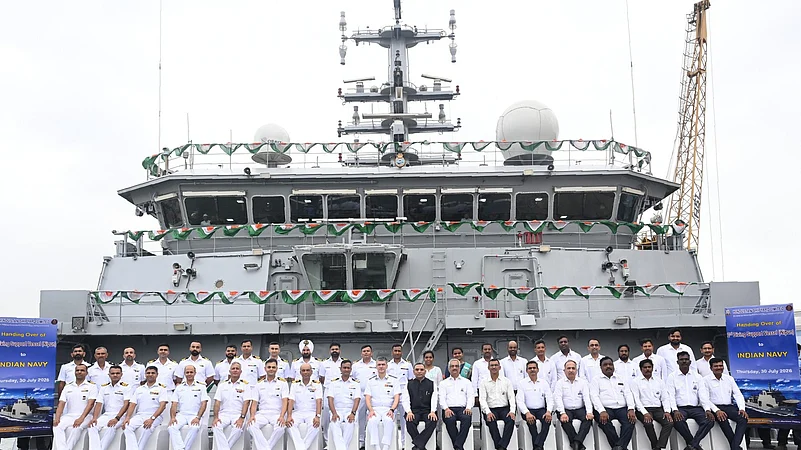
India has added another critical asset to its naval fleet with the delivery of 'Nipun', the second indigenous Diving Support Vessel (DSV), to the Indian Navy on July 30, at Visakhapatnam.
Hindustan Shipyard Limited (HSL) built the ship with about 75 per cent indigenous content, marking another milestone in India's efforts to reduce dependence on foreign defence platforms while enhancing specialised underwater operational capabilities.
Nipun was built to Indian Register of Shipping (IRS) classification standards and it follows in the wake of its sister vessel, INS Nistar, which joined the fleet last year.
Importance of DSV Nipun
The name itself - Sanskrit for someone skilled, capable and accomplished, hints at the job description. Nipun is built for deep-sea diving, submarine rescue and salvage operations that most navies simply don’t have dedicated hardware for.
Onboard, the ship carries advanced saturation diving systems that let divers work at serious depths for extended stretches without the usual physiological limits. There’s also a side diving stage for launching operations, plus Remotely Operated Vehicles (ROVs) that help monitor divers and assist with salvage work below the surface.
Perhaps its most critical function, though, is acting as the mother ship for the Navy’s Deep Submergence Rescue Vessel (DSRV). If a submarine were ever disabled or stranded underwater, the DSRV would launch from Nipun to reach and evacuate the crew.
Speaking to Outlook India, former Indian Navy officer Captain Sarabjeet S Parmar (Retd) said:


“The induction of Nipun, following INS Nistar last year, significantly strengthens the Indian Navy’s underwater rescue capability. With Nistar deployed on the western seaboard and Nipun on the eastern coast, the Navy will have dedicated diving support assets on both fronts, enhancing operational readiness as India’s submarine fleet continues to expand. Equally important is the fact that both vessels have been indigenously built by Hindustan Shipyard Limited, marking a major milestone for India’s defence shipbuilding industry, particularly in the specialised domain of deep-sea support vessels.”
He also flagged where the work isn’t finished yet: “However, India must now focus on overcoming existing limitations in deep-sea operating depths, as expanding these capabilities will be the next frontier in achieving true self-reliance in this niche sector.”

Why Does This Matter For India’s Maritime Strategy?
The Navy has been steadily building out its underwater warfare and rescue capabilities as competition in the Indian Ocean Region intensifies. Diving support
vessels like Nipun are genuinely scarce assets worldwide — beyond submarine rescue, they handle underwater repairs, wreck clearance, salvage and search-and-recovery work, whether in peacetime or during a conflict.
The official acceptance document (D448) was signed by Rear Admiral Arvind Rawal, VSM, Chief Staff Officer (Technical) at Western Naval Command and Chairman of the D448 Committee, alongside Rear Admiral Chandrasekhar Raghuram (Retd.), VSM, HSL’s Chairman and Managing Director.
Between Nipun and Nistar, the Navy now has genuine indigenous capacity for deep-sea diving, underwater rescue, and submarine emergency response. Until recently, such capability didn’t really exist domestically.
For HSL, it’s another data point that proves the yard can reliably deliver complex, strategically important naval platforms.
By The Numbers
Nipun measures 118 metres and displaces over 8,560 tonnes, with indigenous content of about 70 per cent.
It’s fitted with Dynamic Positioning, Saturation Diving, Submarine Rescue, and Deep-sea Intervention systems — effectively a complete underwater operations platform in one hull.
For reference, when INS Nistar was commissioned last year, Chief of the Naval Staff Admiral Dinesh K Tripathi described it as “a crucial operational enabler” that could help India become a “Preferred Submarine Rescue Partner” for other navies in the region.
About The Shipbuilder
Hindustan Shipyard Limited is a Miniratna Defence PSU under the Ministry of Defence, headquartered in Visakhapatnam.
With more than eight decades of shipbuilding history, HSL has built and maintained vessels for the Navy, Coast Guard, and merchant marine, and has also handled submarine construction and refit projects.
“Delivering two DSVs within the same year says a lot about the yard’s growing ability to execute technically demanding naval projects on schedule,” the company stated.