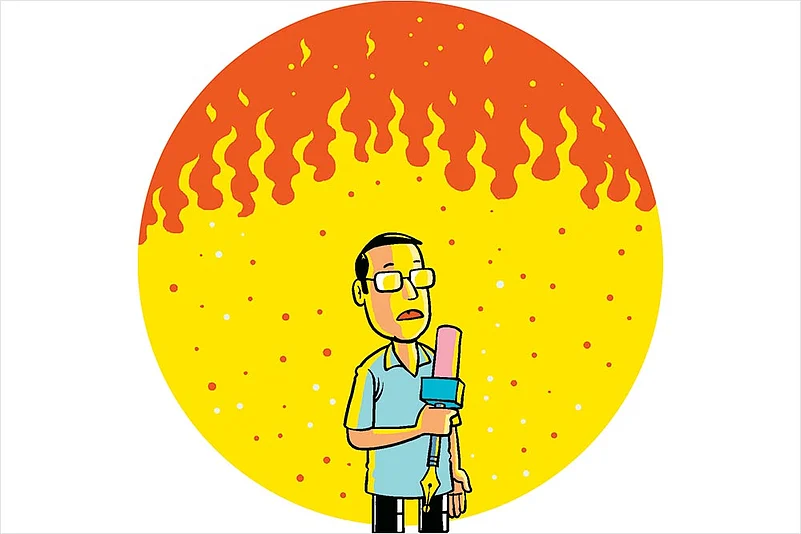

Congrats! You have been immortalised. The unsolicited message on Twitter from a stranger had a mere mortal such as me stumped. I was clueless, but my curiosity was whetted as subsequent queries revealed that the compliment coming my way was from a gentleman who had just watched the movie The Least of These: The Graham Staines Story.
To cut a long story short, the film that released in India last week narrates the story of Staines, an Australian missionary who had made Baripada in Odisha’s interior Mayurbhanj district his home. He ran a hospital and a shelter for leprosy patients and was generally regarded highly by the local community. But Staines also faced accusations of covertly proselytising tribals and attracted the ire of Hindu fundamentalists. In January 1999, a mob led by a self-proclaimed zealot, Ravindra Kumar Pal, who took the name Dara Singh to portray a he-man image, attacked Staines and his two children, Philip, 10, and Timothy, 6, as they slept out in the open in a van. The three died a gruesome death as the mob set their vehicle ablaze.
I haven’t watched the film, but what I gather is that it narrates the Staines story through the eyes of a reporter named Manav Banerjee, essayed by actor Sharman Joshi of 3 Idiots (2009) fame. I can’t vouch for who inspired the character. But the choice of a Bengali with Banerjee as the surname for a reporter in Odisha is curious indeed. I can’t remember any other journalist by the name Banerjee besides me, based in Bhubaneswar and covering the Staines murder back then.
With the filmmakers not forthcoming, the lack of clarity has evidently caused some confusion. My fawning daughter, however, is convinced that Manav is me. Having Google searched all my Staines reports and after having watched the film trailer, she has even found a similarity in appearance between me and Joshi. Now, that surely is a compliment.

Twenty years have gone by since the killings, and the movie—that has already received some positive media reviews—hopefully serves as a grim reminder to the fanaticism that afflicts us even today. Having murdered Staines and his children, Dara went on to kill some more in the name of religion, pitchforking an otherwise peaceful Odisha to the frontlines of a fight over faith. That the same unwanted battle is still being fought across much of the nation is beside the point.
The havoc wrought by Dara made for international headlines then. Fortunately though, the hospital that Staines founded in Baripada is continuing to function and remains a beacon of hope for the poor requiring medical treatment. In my own way, I too have tried to keep myself updated with whatever has happened to the other principal characters of one of the biggest stories of my professional career. Staines’s widow Gladys moved back to Australia some years later where Esther, the couple’s only surviving child, is now married. R. Balakrishnan, the then Mayurbhanj collector, retired last year while the district police superintendent, Pradeep Kapur, who was tasked with tracking down Dara, is still in service and posted in Delhi. Dara, meanwhile, is rotting in jail.