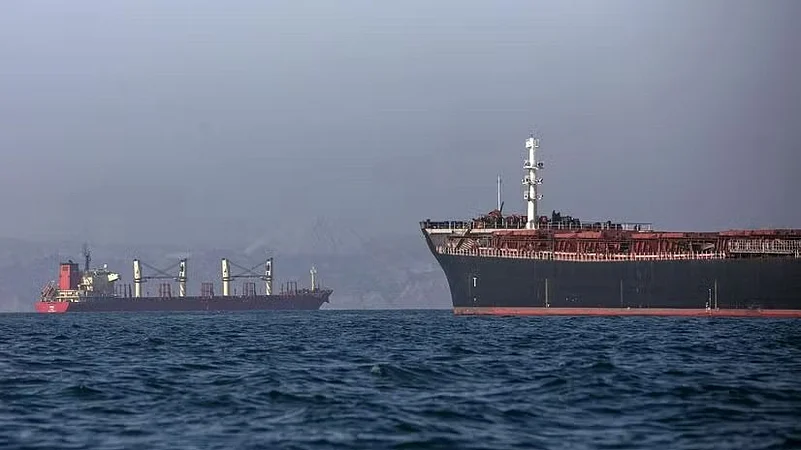
Iran has rejected an Oman-backed proposal for joint management of the Strait of Hormuz, saying it does not serve Tehran's interests
Fresh military exchanges in the Gulf, including attacks on oil tankers and regional strikes, have renewed fears of wider escalation
The developments pushed global oil prices more than $3 a barrel higher as markets weighed the risk of further disruption to one of the world's busiest energy shipping routes
Iran has ruled out Oman's proposal for regional joint management of the Strait of Hormuz, saying it has no chance of success, even as the Islamic Revolutionary Guard Corps (IRGC) Navy struck three oil tankers in the strategic waterway on Wednesday, according to a Reuters report.
Oman had presented Iran with a plan backed by Gulf states to manage the waterway, which would include collecting voluntary fees from ships modelled on Asia's Strait of Malacca, a Gulf source and a Western diplomat told Reuters on Tuesday. Under the proposal, Iran would not exercise sole control and fees would be voluntary.
An Iranian official told Reuters that the US and Saudi Arabia are trying to pressure Oman to advance their "unrealistic plans" regarding the strategic strait. The official said a 50-50 joint control arrangement with Oman would not serve Iran's interests, though Tehran considers Oman a valuable neighbour. Iran insisted the entire inbound route through the strait and part of the outbound route must be under Iranian control.




Regional Military Escalation Resumes
The US and Saudi Arabia launched strikes on Iran-backed groups in Iraq on Wednesday, stating they were responsible for drone attacks on Saudi oil facilities. US Central Command and Saudi Arabia's Defence Ministry stated that they hit multiple sites across eastern Iraq used by Iran to direct drone attacks. These strikes occurred just hours after the US military stated its air defences had averted a surprise Iranian attack on US troops in the region.
Iraq's Popular Mobilisation Forces (PMF) stated that US and Saudi forces attacked several of its headquarters on Wednesday, killing and wounding several people. Saudi Arabia stated on Tuesday that its air defences destroyed several drones targeting oil facilities in the Eastern Province. Saudi Defence Ministry spokesperson Turki al-Maliki said Iran-backed militias launched the attacks from Iraqi territory.
An Iranian defence official strongly denied any connection between projectiles fired from other countries toward Saudi targets, saying attributing attacks on US interests in the region to Iran was a "major miscalculation".
The IRGC stated on Wednesday it had fired several ballistic missiles at US military installations in Jordan. Jordan's military stated its air defences intercepted and shot down five Iranian missiles targeting the kingdom on Wednesday.
These back-and-forth attacks ended a brief pause in the fighting that began after President Donald Trump abruptly called off a two-week US bombing campaign and Iran appeared to follow suit.

History of Strait Blockade
Iran effectively shut the strait after the US and Israel attacked Iran on February 28, 2026. Before the attack, about 20% of global oil and liquefied natural gas flowed through the critical waterway. A deal in June 2026 between the US and Iran partially reopened the strait, but the agreement collapsed in early July after Iran fired on vessels using a shipping channel that it does not recognise.