- For the 2009 Lok Sabha polls, the party will become an umbrella for more allies
- Hindutva having been overplayed, it now wants to take a centrist position
- The party hopes to occupy thecentrestage Congress has dominated
- All effort will be directed at raising its acceptability quotient so that it can get more regional allies in its fold
- The party won't give up on internal security, terrorism and minorityappeasement as issues. But it will nuance these positions more carefully.
***
- Karnataka Hindutva took a backseat and the development/good governance plank instead helped the BJP win its first state in the South.
- Bihar Nitish Kumar too kept Hindutva off his campaign. His JD(U) is the dominant force here.
- Rajasthan Was won via conventional approach based on seat management rather than Hindutva.
- Madhya Pradesh Uma Bharati's oratorial skills and Hindu passions landed this state into the BJP kitty. The state's underdevelopment was another campaign issue.
- Gujarat Pride of Gujarat/good governance was what Modi started to renew his innings with. But Hindutva slipped in after the Congress raised the communal pitch.
- Himachal Pradesh Hindutva was never needed here. The good governance plank was enough.
- Uttarakhand CM B.C. Khanduri's moderate, honest image proved to be BJP's trumpcard.
- Chattisgarh Congress corruption and sleaze became the BJP's gain. The latter did use the Hindu card against Christians in tribal areas.
- Orissa Naveen Patnaik doesn't believe Hindutva is an election plank. His clean image is enough for his BJD to call the shots here in alliance with BJP.
***



"We’ve been part of the NDA for years without subscribing to the BJP ideology. Now I hope the BJP-led NDA adopts policies that attract all sections of society."
Nitish Kumar,Chief Minister, Bihar

"When we take ideological postures, you say why not development? When we focus on development, you ask whatever happened to ideology?"
Ravi Shankar Prasad, Party spokesperson
"Anti-Muslim? There’s no question of that happening. The difference is, we want equal treatment for all, other parties want special treatment for Muslims."
Venkaiah Naidu,Former BJP president

"As we head towards a national election, great care will be taken to see that we follow the common minimum programme of the NDA."
Mukhtar Abbas Naqvi, BJP vice president

***
Strong Regional Leaders Are EncouragedIn The BJP...
- Narendra Modi, Gujarat
- Vasundhararaje, Rajasthan
- B.C. Khanduri, Uttarakhand
- P.K. Dhumal, Himachal Pradesh
- Raman Singh, Chhattisgarh
And In The NDA too...
- Nitish Kumar JD(U), Bihar
- Naveen Patnaik BJD, Orissa
- Parkash Singh Badal, Punjab
***
As the results of the Karnataka polls came in, BJP leaders knew that the political chemistry of the country was once again changing. A floundering UPA government, hit by the price rise, had received another body blow. The BJP/NDA's prime ministerial candidate L.K. Advani lost no time in declaring that the results were an indication that this would be a year of change. "The geographical expansion of the BJP and the simultaneous shrinkage of the Congress shows the shape of things to come in the run-up to the next parliamentary elections," he said.
But even though the Karnataka win has provided the party a fillip, its leaders know that to return to the Centre they need more allies and must also help strengthen the hands of existing ones. Advani was quite categoric when he declared that the next government would be an alliance. Not even the most optimistic in the party of the faithful has any illusions about making it alone. Be it the hawks or the liberals, all alike feel that allies hold the key to recapturing Delhi.
And so the BJP's efforts now will be directed towards presenting itself as a grand umbrella for more allies and the centrist alternative to the Congress. It will posit a face that is somewhat softer and less inclined to take up shrill ideological postures. Turning more pragmatic, it will focus on bread-and-butter issues, price rise and development. Of course, if more bombs explode and terror strikes continue, the party will talk tough. But the positions at all times will be tempered by concern for allies.
The allies, on their part, are quite clear about their expectations. Bihar chief minister Nitish Kumar told Outlook: "We have been part of the NDA for several years without ever accepting any of the BJP's ideology. Now my hope would be that the BJP-led NDA should adopt policies that attract all sections of society. The JD(U)-BJP government has done so in Bihar; all communities support us. I'd like to see the NDA do the same across the country." Does he think that more regional parties will drift towards the NDA in the aftermath of the Karnataka polls, where the BJP desisted from playing the communal card? "It is premature to talk of new allies," the Bihar CM said. "These things will happen when the elections are actually announced or post polls when the numbers come in. But yes, if the BJP sticks to the NDA position, then more parties would be inclined to join."
It's not just in states ruled by NDA partners that the BJP has been downplaying ideology. In some of the recent elections it has won, like in Himachal Pradesh or Uttarakhand, it has done so on the basis of conventional anti-incumbency against the ruling Congress rather than Hindutva. Gujarat may appear to have been an exception. But there too you could say it was actually Narendra Modi's larger-than-life persona and his record in development that swung the vote to the BJP.
Yet today, BJP strategists say that if they have to replicate a "Gujarat model", it would extend only to development. Given our fractured polity, the "Karnataka model" might prove better. There are differences between the two approaches. Chief minister B.S. Yediyurappa, for instance, may have declared in the midst of the campaign that he had not given any tickets to Muslims because they could not win on a BJP ticket. But he promised there would be a Muslim cabinet minister. And at the time of writing, Outlook was told that the health portfolio was likely to be given to a member of the minority community once Yediyurappa is sworn in on Friday, May 30.
Clearly, this is just tokenism. For, as the saying goes, the leopard doesn't really change its spots. There is no denying the strong anti-minority underpinning to many BJP state governments or the anti-Muslim subtext in the speeches of many BJP leaders. The party has certainly had great success in putting the Congress in a bind over so-called "minority appeasement". That is why even the smallest gesture by them is significant.
It is the political realities of India that are compelling the BJP to play down or even alter its core identity. L.K. Advani has for years argued that the RSS/VHP should not impose their views on the BJP and the party has to become the centrist alternative to the Congress. Former party president Venkaiah Naidu is quite blunt about the calculations: "Our line today is clear. We know we are leading the NDA that will contest the elections. We have committed ourselves to a coalition before the general elections. We believe the Congress does not understand the meaning of coalition dharma." What about the anti-minority image of the BJP? His reply is quick: "There is no question of the BJP being anti-Muslim today. The difference is, we want equal treatment of all and other parties want separate treatment for Muslims."
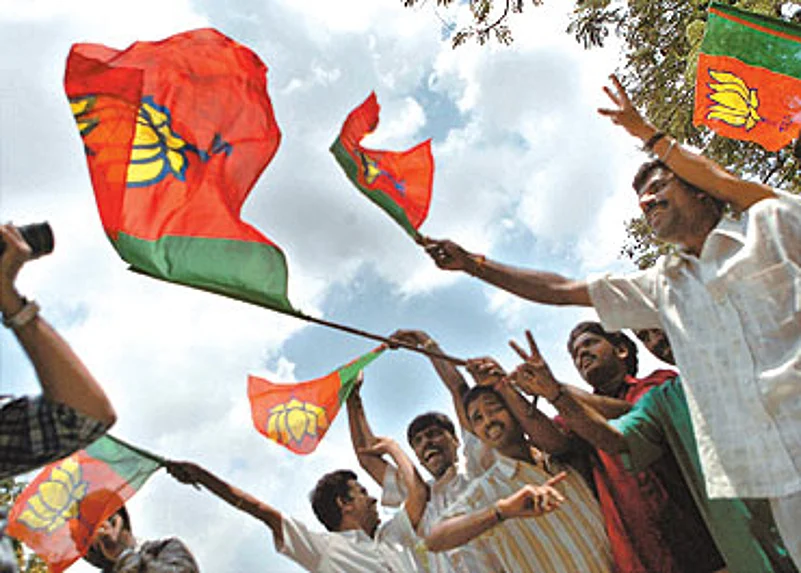
Saffron flag over the south: BJP workers celebrate in Karnataka
Such nuances in BJP posturing would count for little had the party not shown some mastery over election management. Post-Karnataka, there is no denying that Arun Jaitley has honed this skill to perfection. Almost all the elections he has been in charge of have been won by the party on its own or in alliance—be it Madhya Pradesh, Bihar, Punjab, Gujarat or Karnataka. Unlike the power point manager that the late Pramod Mahajan was, Jaitley's style is more laidback. His "magic touch" instead is based on his ability to process information at various levels. His Man Friday and political assistant Om Prakash Sharma shepherds visitors in and out all day, adding his two bits of native wisdom to the proceedings. Jaitley also gets a lot of surveys done. As national executive member Siddharth Nath Singh, part of Jaitley's team in Gujarat and Karnataka and who has handled both the media and the campaign, puts it: "There is a certain methodology. A huge information base that helps him set parameters for candidate selection. But he does not involve himself in the local lobbying for seats or politicking."
Jaitley himself does not address rallies unless targeted at a specific urban group. He sits back and runs the show, giving advice on how to nuance the campaign, make it local or national, shrill or low-key. He has another key aide in Delhi-based advertising executive Sushil Pandit. Jaitley gives him the campaign line, and Pandit tweaks it around to produce different slogans for print and TV. If the BJP team came up with 'Jeetega Gujarat' for that state, the pitch for the Karnataka campaign was 'The answer is BJP'. Although Jaitley has many detractors in the party, Advani has for a while wanted to hand him charge of handling the entire general election. It now appears the only possible course for the BJP.
Jaitley himself sees the national elections as a strategic exercise. "Every party has to expand its vote base, including the BJP. A stronger BJP will attract more allies." Does this mean that Hindutva issues will be dropped? The reply is concise: "There is no Hindutva in the abstract. Today no such issue dominates. If we take a strong line on internal security and terror, that is not Hindutva, it is the stand of a strong nationalistic party. But tomorrow if the Ram Setu bridge is demolished, Hindutva will again be there." Then, on a lighter note, he adds: "I will tell my friend Kapil Sibal to ensure that any demolition of the bridge is telecast live on all TV channels."
But the serious calculation Jaitley has done is about the bleak future of the UNPA, intended to be the third alternative. According to him, if the SP honeymoon with the Congress continues, it will mark the end of the UNPA. The TDP would then again be inclined towards the BJP, even if after the general election.
The most senior Muslim in the BJP, Mukhtar Abbas Naqvi, sees the Karnataka result as "a national highway to victory in the general elections". He agrees there'll be a softening of ideological stands. "As we head towards a national election, great care will be taken to see that we follow NDA's common minimum programme. Unless something happens and forces the party to change posture, the main thrust will be to position ourselves to get regional parties to back us after the results."
Party spokesperson Ravi Shankar Prasad replies with a query: "When we take ideological postures, you say why not development? When we focus on development, you ask what happened to ideology? The Karnataka poll's a benchmark. No one can accuse us of being a cowbelt party again. We'll break other barriers. The key to victory will be allies and an expanded social base."
The BJP has broken many barriers in the past, gradually expanding its appeal to new sections of urban and rural India. Today the party is planning a grand national resurrection. In Karnataka, it has demonstrated that it has the structure to expand, the worker to spread the message, the tactician to think through the spin.
Between May 3 and June 2, the party will hold a national executive meet in Delhi. Outlook has learnt that it has already decided to make some leadership changes in the Uttar Pradesh state unit. Jaitley will again be handling the changes and the executive will devote considerable time and energy to come up with at least a strategy for the crucial state. The party is clearly preparing for Mahayuddh 2009.
In the meanwhile, the party has become the sum of strong leaders who have been allowed to flourish in the states, be it Narendra Modi in Gujarat or even B.C. Khanduri in Uttarakhand. The party clearly has greater comfort with the federal system than the Congress. That could be its biggest asset.