Rajiv Bhatia says India wants BRICS to remain “not anti-Western but non-Western”.
The Iran war is testing consensus among BRICS members including Iran, Saudi Arabia and the UAE.
Bhatia says India should focus on cohesion rather than further expansion of BRICS.
The expansion of BRICS and the US-Iran war are putting the grouping’s ability to build consensus under strain, with Iran, Saudi Arabia and the UAE now part of the same bloc despite their conflicting positions in the conflict.
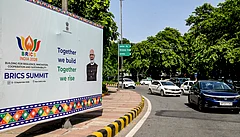
For India, which is hosting the BRICS summit in New Delhi, the immediate challenge is to hold together an expanded grouping whose members have increasingly divergent geopolitical interests.
In a conversation with Outlook, Former ambassador and Gateway House Distinguished Fellow Rajiv Bhatia says India should focus on building greater cohesion among existing members rather than pushing for further expansion.
“BRICS has expanded and is changing,” Bhatia said, pointing to the decision at Johannesburg to invite six countries to join. Argentina later declined the invitation, while Saudi Arabia did not formally accept it but continues to participate in BRICS meetings. Egypt, Ethiopia, the UAE and Iran joined the grouping, while Indonesia subsequently became a member.
BRICS also created its partner-country mechanism at the 2024 Kazan summit, with the first partner countries joining in 2025. Their first meeting was held in Rio de Janeiro in 2025, Bhatia said.

Bhatia said the expansion had brought countries belonging to different geopolitical groupings into BRICS, making it harder to manage the bloc and build consensus.
He said this was one reason India had not been keen on further expansion.
“At this stage India's approach is please no more expansion,” Bhatia says. “We would focus on creating greater coherence and coordination among the entire BRICS family.”
As chair, India was trying to ensure the summit's success despite the challenges posed by the grouping's expansion and internal differences, Bhatia said.
BRICS decisions are made by consensus, Bhatia noted, while some members had supported expansion because countries wanted to join a grouping they viewed as successful.

Iran War Tests BRICS Cohesion
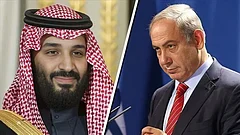
The US-Iran war has brought those differences into sharper focus because Iran is a BRICS member, while Saudi Arabia and the UAE are also part of the grouping and have faced Iranian counter-strikes.
Bhatia said the conflict had created a difficult situation for BRICS diplomats, with Iran facing US and Israeli attacks while Saudi Arabia and the UAE had faced Iranian counter-strikes. The challenge, he said, was how to build an agenda of cooperation when members were directly affected by the conflict.
The difficulty in finding common language was already visible at the BRICS foreign ministers’ meeting in New Delhi in May, when members failed to agree on a common formulation on the Iran war.
“They tried last time, but they failed in the foreign ministers’ meeting in May to come up with a common formulation. But optimists are hopeful that this time they may succeed,” he says.
Bhatia said BRICS was established in 2006 to advance the interests of emerging markets and developing countries and is primarily focused on financial, political and cultural issues. The responsibility for settling wars, he said, lies with the UN Security Council rather than BRICS.
“At the same time, the presence of major leaders means the Iran war will inevitably be discussed at the summit,” he says.
Bhatia said BRICS remains largely an economic and financial forum but has to navigate geopolitical issues because of the positions and relationships of its members.

India’s BRICS Approach Is ‘Non-Western’, Not Anti-Western
The Iran war has also highlighted differences between India’s approach to BRICS and that of Russia and China.
“There is a divergence of approach, no doubt about that,” Bhatia said.
He said Russia and China were aligned in opposing Western policy, particularly that of the US, while India wanted BRICS to remain non-Western rather than anti-Western.
India’s multi-alignment policy, he said, allows New Delhi to maintain ties with Russia and other BRICS members while retaining its relationship with the US.
“India believes in multi-alignment policy. India has good relations with the US despite all the tensions in the last two years. And India wishes to maintain it that way,” Bhatia said.
Bhatia said India was not alone in maintaining close ties with Washington, pointing to Saudi Arabia, the UAE, Egypt and Brazil.
“Saudi Arabia, UAE, Egypt, even Brazil on economic issues, they are very much with the US,” he said.
“So overall I think India is in a good place. There is no need to worry too much about that score.”
“My point is that we should avoid both romanticism about BRICS and also deep-seated scepticism about BRICS,” Bhatia said.
Bhatia also played down the significance of the Makkah pact involving Saudi Arabia, Pakistan and Türkiye for BRICS.

“The MECA pact does not have much impact on BRICS,” he said.
“In this only one country is a member of BRICS and that too half-heartedly,” Bhatia said.
“A realistic perspective indicates to us hope that India and the friendly countries will find a way to come up with a diplomatic formulation on the Iran conflict and insulate BRICS from its impact,” Bhatia said.