



On April 16, 2026, Tamil Nadu watched as the then chief minister of the state, M. K. Stalin, stood before the cameras and set fire to a copy of the delimitation bill introduced in Parliament. “Poradavom, Velvom Ondraga” (let us struggle, let us win together), he declared, accusing the Union government of pushing a measure that would reduce Tamilians to the status of refugees in their own state. It was vintage Stalin: combative, confident and seemingly in command of the political narrative.
Much water has flowed down the Cauvery since then. In a political reversal few could have anticipated, Vijay Joseph, the cine superstar who had recently entered electoral politics, emerged as the single-largest political force and eventually formed the government, bringing down the Dravida Munnetra Kazhagam (DMK)-led political edifice. The party that had positioned itself as the principal bulwark against the Bharatiya Janata Party’s (BJP’s) centralising politics suddenly found itself without major allies. The Congress, the Left and other former partners of the INDIA bloc moved towards Vijay, leaving the DMK increasingly isolated. Now, as the Union government reportedly prepares to reintroduce the bill, the DMK remains the cynosure of all eyes—but for very different reasons. Will a party smarting from an electoral setback and political isolation look back to the Vajpayee years, when the DMK had an electoral alliance with the BJP, and contemplate another rapprochement with its former ally?
No one can say with certainty which way the DMK will turn. But one thing is clear: the political tsunami unleashed by the election results is still sweeping across Tamil Nadu and its full consequences are yet to unfold. “Though the DMK appears less aggressive now, it seems to be speaking in multiple voices on delimitation,” says former BJP state president and former Telangana Governor Tamilisai Soundararajan.
The DMK’s “multiple voices” on delimitation became evident when the party began laying down conditions for supporting the bill, amid reports that it could back the measure if its demands were met. Its principal demand is that the 1971 Census be used as the basis for any increase in the number of Lok Sabha seats, along with a 25-year freeze on the revised allocation. The Union government had earlier proposed using the 2011 Census as the basis for delimitation. The DMK reportedly demanded a 50 per cent increase in seats for every state, arguing that this would ensure each state’s share of the total Lok Sabha representation remains unchanged. Another condition is that the proposed legislation should clearly specify the number of Lok Sabha seats to be allocated to each state.

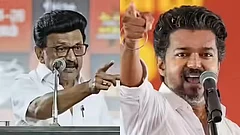
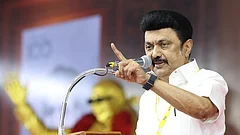

With its traditional allies moving away and Vijay emerging as a new political pole, the DMK finds itself in an unenviable position.
The shift from outright rejection to conditional acceptance has triggered intense speculation about a possible realignment of political forces in Tamil Nadu. The DMK, however, denies any talks with the BJP. The DMK’s 22 Lok Sabha members give the party considerable leverage as the government seeks to secure the numbers required to pass the constitutional amendment bill. But that parliamentary arithmetic comes at a time when the DMK’s political equations in Tamil Nadu have shifted dramatically. After the Congress walked out of the DMK-led Secular Progressive Alliance following the election, the DMK has, for all practical purposes, also distanced itself from the INDIA bloc.
A constitutional amendment bill such as the proposed delimitation bill requires the support of two-thirds of the members present in Parliament. Since April, however, the political arithmetic has shifted significantly. Defections in parties such as the Trinamool Congress and the Shiv Sena (UBT), coupled with the DMK’s estrangement from the Congress-led bloc, appear to have renewed the Union government’s efforts to reintroduce the bill. The DMK’s position on delimitation has been consistent,” says Vignesh Karthik, a political scientist. “The party wants to maintain Tamil Nadu’s proportional share of Lok Sabha seats at 7.18 per cent. But under the present political circumstances, even if the BJP agrees to this demand and the DMK supports the constitutional amendment bill, it will be interpreted as the DMK softening its stand and moving towards the BJP camp,” says Karthik.
“However, with Udayanidhi Stalin, a vehement critic of Sanātana Dharma leading the party, there is little likelihood of the DMK and the BJP working together. The political circumstances of 1999, when the DMK aligned with the BJP, no longer exist,” he adds. It is not just the DMK that appears to be sending mixed signals on delimitation. At the southern zonal council meeting chaired by Union Home Minister Amit Shah, Chief Minister Vijay’s position triggered a political slugfest. After the Tamil Nadu assembly passed a resolution demanding a complete freeze on the existing number of seats, Vijay struck a more conciliatory note at the meeting. He said the Union government should ensure that no state suffers a reduction in its percentage share of representation in Parliament.
Coming soon after the assembly resolution calling for a complete freeze, Vijay’s formulation was seen by some as a recalibration of the Tamil Nadu government’s position. His party, the Tamilaga Vettri Kazhagam (TVK), however, rejects that interpretation. “Our stand was made clear through the Assembly resolution moved by the chief minister. At the southern zonal council meeting, the chief minister spoke on behalf of all the southern states. We do not want the representation of the southern states to go down. There is no confusion about our demand—we are for a total freeze,” says Felix Gerald, TVK’s national spokesperson.
Gerald says it is the DMK, rather than the TVK, that has diluted its position. “The DMK is creating confusion now. They have already watered down their position and are now talking about maintaining the proportion rather than demanding a total freeze. This change in stance was necessitated by the DMK’s isolation after the election,” he says. “The DMK needs an ally if it wants to remain a political force in Tamil Nadu. The party gets only around 25 per cent of the vote. Its allies helped it to win the elections. Now that many of them have left, the party is desperately looking towards the BJP as a potential ally,” he adds.
The DMK’s aggressive opposition to delimitation has now given way to a more measured position following its severe electoral setback. Its shift from outright opposition to a more conditional approach has fuelled speculation about its next political move, even as the party denies any talks with the BJP. With its traditional allies moving away and Vijay emerging as a new political pole, the DMK finds itself in an unenviable position. How it navigates this difficult phase could have far-reaching consequences, not just for Tamil Nadu’s political landscape, but for the broader national political equation as well.
MORE FROM THIS ISSUE

N K Bhoopesh is a senior journalist














