On August 30, in Bihar’s Patna district, Shashi Kumar, Vikas Ram, Pankaj Singh and Nishu Kumar fell ill and were taken to a hospital where they died during treatment. While the case is still being investigated, the police found a liquor bottle at the spot where these men had gathered. The police are yet to establish whether liquor caused the deaths, but the presence of the bottle raises a question that Bihar has grappled with for a decade: how does alcohol continue to reach consumers in a state where its manufacture, sale, transport and consumption have been prohibited since April 5, 2016? In April, at least 10 people died in East Champaran after allegedly consuming spurious liquor. The deaths point to a contradiction at the heart of Bihar’s decade-long experiment: a state can be legally dry without becoming free of alcohol.
How Bihar Went Dry
About a decade ago, the women of Bihar demanded a policy change that seemed almost unimaginable to sustain in a state of this size. Their protests against alcoholism culminated in one of independent India’s most ambitious social reforms: a complete ban on liquor.
“What sets the liquor prohibition apart is that no one in the past has been able to deliver it totally. I’m determined to change this track record of public policy. In Bihar, there will be no half measures. I will stand my ground,” then Chief Minister Nitish Kumar had said after he announced the ban a decade ago.


The decision was born in the courtyards of Bihar’s villages. For countless women, liquor had become synonymous with empty kitchens, shrinking household incomes, domestic violence and fractured families. Their demand for prohibition emerged from one of India’s poorest states, where more than half the population was living in multi-dimensional poverty, making every rupee spent on alcohol a direct blow to household survival.
Ten years on, the data tells two different stories.
The Numbers that Changed
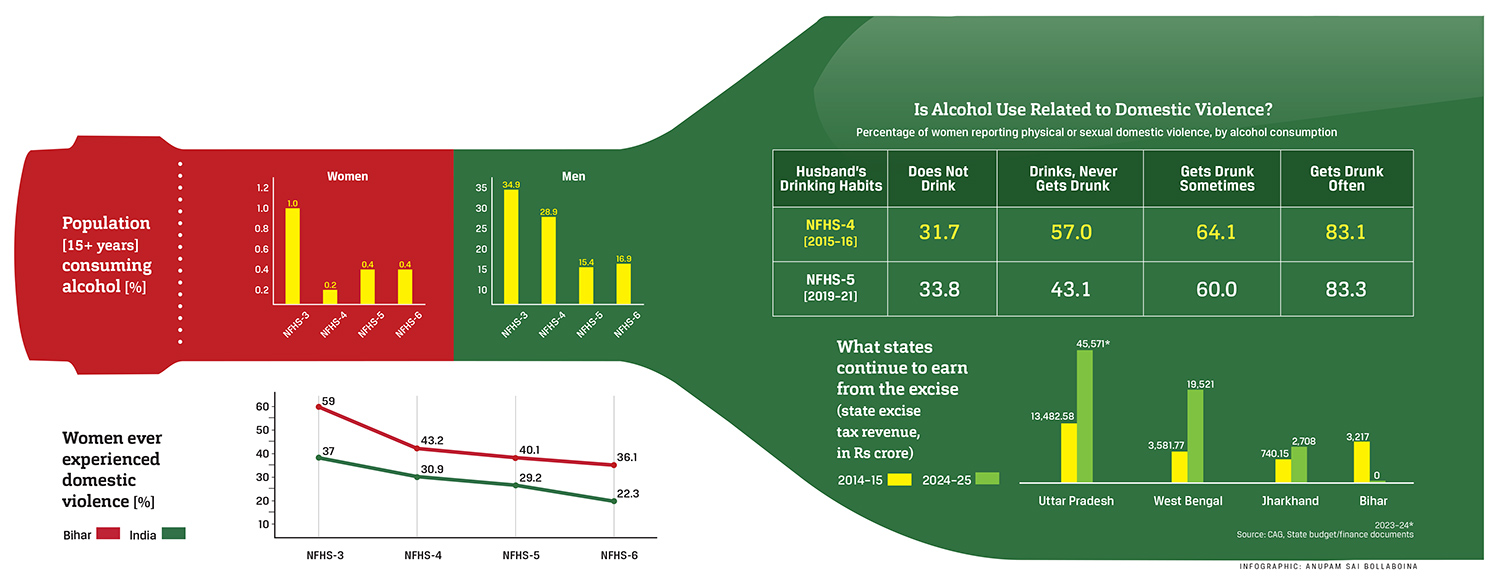
In 2015–16, nearly three in 10 men in Bihar were consuming alcohol and almost half of them drank at least once a week. Among women who reported physical or sexual violence by their husbands, more than eight in 10 said their husbands consumed alcohol, data from the National Family Health Survey (NFHS) shows. By 2019–21, just a few years into prohibition, the picture changed a little. During NFHS-5, self-reported alcohol consumption had nearly halved to about one in six men. About one in every three people in Bihar were multi-dimensionally poor, down from more than one in two in 2015.
Did drinking less make homes safer? The answer is less straightforward. During NFHS-5, 40 per cent of women said they have experienced any form of physical or sexual violence from their husband, down from 43 per cent in 2015–16. By 2023–24, the share dropped to 36.1 per cent. But the link between drinking and violence proved harder to break. Among women who reported physical or sexual violence, 83.3 per cent said their husbands often got drunk in 2019–21, almost the same as 83.1 per cent in 2015-16. The finding suggests that the association between husbands’ drinking and domestic violence persisted despite the decline in reported alcohol consumption.
For women married to occasional drinkers, by contrast, the picture improved. From 57 per cent in NFHS-4 to 43 per cent in NFHS-5, the sharpest drop is reported in the category where the ‘husband used to drink but never got drunk’. While in the cases where the ‘husband gets drunk at times’, the drop is from 64 per cent to 60 per cent.
Bihar had tried banning liquor in the 1970s too but that lasted only for a few months. Whereas as Kumar had promised, prohibition completed a decade this year, at least on paper.
Alcohol Never Disappeared
Several official records suggest that alcohol never entirely disappeared from Bihar. The state has reported close to 300 deaths in hooch tragedies since 2016.
During NFHS-6, released over a decade after the ban, 16.5 per cent men above the age of 15 years said they consume alcohol, about a percentage point more than in 2019–21 (15.4 per cent). The proportion was higher in rural Bihar (at 17.1 per cent), than in urban areas, at 12.8 per cent. The southern districts, mostly bordering Jharkhand, had the highest share of men consuming alcohol. Nine of the ten districts with Bihar’s highest drinking rates in 2019–21 remained on that list during 2023-24, too: Gaya, Jehanabad, Nawada, Arwal, Jamui, Aurangabad, Sheikhpura, Nalanda and Patna.
A senior police officer from Gaya says that while there was no laxity in enforcement against trafficking, the district’s geography posed a challenge. “Gaya shares a border with Jharkhand, but not every inch of the border is covered or monitorable.” They add that while the police conduct drives regularly throughout the year, they have “little to no control over people crossing the border and consuming liquor on the other side”.
The liquor bottle found in Patna at the place the four men had gathered was not the first sign that prohibition has failed to make alcohol disappear. Three years earlier, researchers had found evidence of its presence in Patna’s drains. A study titled “Impact Of Alcohol Prohibition In Bihar : A Case Study Of Patna Municipal Corporation”, published in Geographical Perspective in October 2023, found that close to six out of 10 of the respondents reported access to alcohol despite prohibition while nearly 64 per cent of the total respondents consumed alcohol despite the prohibition. The study also mentioned the recovery of liquor bottles by municipal employees in the Kankarbagh colony drainage system.
The study, conducted by academics from Patna University, covered 102 respondents divided equally between Patliputra and Kankarbagh under the Patna Municipal Corporation area. So, even in the heart of the state capital, where all the main government agencies are located, prohibition does not mean the absence of access.
The state’s prohibition story is equally visible in traffic records. After Bihar reported zero drunk-driving cases for a couple of years, the category reappeared with 71 accidents and 40 deaths in 2022, indicating that alcohol-related road offences continue to be officially recorded.
In 2026, up to May, more than 17.5 lakh litres of alcohol worth nearly Rs 141 crore were seized by the state police with 56,904 people apprehended in connection with the seizures.
The Ban is Under Question
The debate on whether the ban should continue has not been settled. The authorities have also been questioned about its implementation. In 2024, the Patna High Court said that while the law was passed with the objective of improving public health, “for several reasons, it finds itself on the wrong side of history”.
The court added that “the number of cases registered is few against the kingpin/syndicate operators in comparison to the magnitude of the cases registered against the poor who consume liquor and those poor people and are prey of hooch tragedy.”
But the state has its own evidence for continuing the ban. In 2022, the state government conducted a study that found that the majority (80 per cent) of respondents agree with the liquor prohibition law. “There is consensus among women beyond caste and class to continue this prohibition. It is a fact that the liquor prohibition was a main demand of struggle for women’s organisations. They bear the brunt of liquor consumption,” the report said.
“Temperance Movement: The Impact of Liquor Prohibition on Socio-Economy and Livelihood in Bihar” also noted that women want this law to be executed more efficiently. The government survey found that around 91 per cent of respondents think domestic violence has reduced following the liquor ban.
Outlook reached out to the chief minister’s office, superintendent of police (prohibition) and the senior superintendent of police Gaya. Their responses are awaited.
A senior government official says on condition of anonymity, “The issue is not that the agencies are not able to implement the ban, but the evolving nature of the black market. The arrests that were made every year tell the battle the police are fighting. In 2025 alone, over 36 lakh litres of liquor were seized and 1.25 lakh people were arrested for violating the prohibition law, up from 1.21 lakh in 2024.”
A government record Outlook went through tells a different story from the enforcement side. Between April 5, 2016 and December 31, 2025, about 10 lakh prohibition cases were registered in the state apart from 1.60 lakh vehicles confiscated. A total of 4.50 crore litres of liquor were seized, an average of about 3.85 lakh litres every month, while nearly 16 lakh people were arrested, taking the monthly average to 13,700 arrests.
The enforcement effort has also extended beyond alcohol, reflecting the state’s broader push against intoxicants. Between 2016 and 2025, close to 16,000 kg of ganja, 240 kg of opium, 3.5 kg of charas and 40,000 litres of cough syrup were also seized.
Prohibition also changed the economics of alcohol, pushing a market that once operated legally in the shadows. With the ban, the legal liquor market had disappeared and with it a major source of state revenue. The government, however, argued that the social gains justified the fiscal cost.
The women who marched for prohibition wanted a state that drank less and hurt less. A decade on, Bihar can claim to have fulfilled part of that promise: fewer men report drinking and the state’s overall fiscal health has improved despite the loss of excise revenue. But the persistence of illicit supply and the continuing association between husbands’ drinking and domestic violence show the limits of what a ban can achieve on its own.

MORE FROM THIS ISSUE




Nivedita Singh is senior correspondent, outlook