When photographer Suresh K. Pandey and I landed in Kathmandu on August 28 to cover the Nepal floods, it was a new experience for me on several counts: my first international assignment, my first time covering a natural disaster of this scale and the pressure to prove myself in a new job.
I had an idea of what to expect even before I landed: WhatsApp videos had shown entire marketplaces washed away, collapsing bridges, homes buried under mud, families desperately searching for their loved ones...Some of the calls I had made to friends and locals in Nepal painted a picture of fear, uncertainty and a desperate struggle to locate those still missing.
But, as I was soon to learn, watching a disaster on a screen and experiencing it firsthand were two entirely different things.

Kathmandu, where we landed, was surreally normal. Cafes were open, traffic was moving, people went about living their ordinary lives. It was hard to believe that just a few hours away in Rasuwa and Nuwakot districts, entire communities had just been erased by nature’s fury.
However, before reaching there, we had to clear our first obstacle: finding transport. No taxi driver would head towards the disaster zone—the roads were damaged and landslides kept threatening the route. I called an old friend in Kathmandu, now a prominent businessman. He somehow arranged a sports-utility vehicle for us.

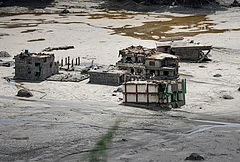


Our first stop was Dhunge Bazar in Nuwakot, among the worst-hit places. Rows of houses and shops had been reduced to rubble. Families stood outside what used to be their homes, staring blankly at the wreckage. Many had lost parents, children, siblings or neighbours. They were traumatised beyond words.

What moved me most was their generosity despite unimaginable loss. A few families apologised because they had nothing to offer us. Then they plucked guavas from the trees standing beside their ruined homes and insisted we eat. They had lost their homes, shops, savings, clothes, everything–most were still wearing what they had on the day the floods came. I remember thinking how dignity survives even when everything else is washed away.
At the Trishuli army camp, we watched Team Nepal in action—the Nepal Army, Nepal Police and Armed Police Force working shoulder to shoulder, risking their own lives to save others. Every time a helicopter appeared in the sky, survivors rose with hope in their eyes, perhaps this one would bring back their son, their daughter, their husband.
As a journalist, my instinct was to ask questions. As a human being, it felt almost cruel. Some conversations never became interviews. They became moments of shared silence. We tried to comfort grieving families, urging them to keep faith, even as all of us silently feared what the outcome might be.

The Smell I Will Never Forget
On August 30, we travelled to Devighat, where the Trishuli meets another river, Tadi, before taking a sharp turn. The devastation was overwhelming. As we walked through submerged settlements, a strong smell hung in the air: that of decomposing bodies, still trapped inside collapsed houses.
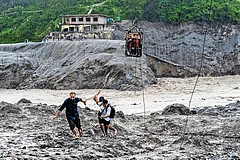
The mud was waist deep, making retrieval of bodies extremely dangerous. Every step felt uncertain. Suresh, determined to capture the scale of destruction, entered one of the damaged houses, ignoring my protests. Within seconds, his legs sank into the mud almost to his knees. Hidden beneath the sludge were sharp rocks, broken glass and twisted debris. When he finally pulled himself out, his legs were covered with cuts.
A day earlier in Dhunge Bazar, he had jumped across to a newly constructed building for a better angle. Had he slipped, I genuinely don’t know what would have happened. In disaster reporting, the story often demands risks. That day reminded me how thin the line is between documenting tragedy and becoming part of it.

The Afternoon that Changed Me
Around 3 pm, we returned to the Trishuli army camp. This time, the mission had changed. The helicopters were no longer bringing only survivors; they had begun bringing the dead. Bodies arrived wrapped in blue plastic sheets, carried carefully by security personnel and placed in rows before identification.
I had never seen so many bodies in my life. Looking at their sizes, I realised many of them were children. For a few moments, Suresh and I simply stood there. Cameras hung around our necks. Neither of us reached for them.
We looked at each other and came to an unspoken decision: not every image needs to be published. The pain of parents waiting to identify their children, the cries echoing through the camp, the dignity the victims deserved—all of it mattered more than an exclusive photograph. It was the most difficult editorial decision I have taken in the field.

What Nepal Taught Me
People in Rasuwa and Nuwakot had lost the earnings of a lifetime. Their homes had disappeared, their businesses washed away, their future painfully uncertain. Yet, their resilience was humbling: They thanked rescue workers, they greeted us with folded hands despite having every reason to curse their fate.
As journalists, we are trained to observe, verify and report. But this assignment reminded me that long before we are journalists, we are human beings. We wanted to do more than tell their stories. Even though Suresh quietly extended help to people we met on the ground, in the end, it was difficult to avoid feeling that our contribution was minuscule.
Before leaving Nepal, we decided to donate to the Prime Minister’s Relief Fund. It was a modest gesture, but it was our way of standing with our brothers and sisters in Nepal.
I travelled there to cover a tragedy. I returned carrying stories of unimaginable grief, extraordinary courage and a lesson I will never forget: sometimes the most powerful thing a journalist can do is not just report suffering, but preserve the humanity and dignity of those living through it.
(We are holding back Editor’s Note for this issue. Given Nepal’s tragedy, we think the reporter’s first-person account holds more salience)
MORE FROM THIS ISSUE

Anish Kumar is strategic affairs editor, Outlook
Suresh K. Pandey is photographer, Outlook