When the BRICS leaders signed the New Delhi Declaration on September 13, they did so unanimously—11 governments, sharply different in politics and worldview, agreeing on one text. For India, chairing the intergovernmental organisation for the fourth time, this was a diplomatic win. But what was left unsaid?
The 18th BRICS Summit capped over 400 meetings across 30 Indian cities. Nearly 140 points were negotiated among 11 members—five founding and six new—accounting for close to 40 per cent of the global GDP. Holding them together amid Moscow’s war in Ukraine, the upheaval in West Asia and an unpredictable Washington was never going to be easy.
On two questions touching India’s interests—US tariff pressure and China’s grip on critical minerals—the declaration falls short of New Delhi’s language in Parliament and private briefings. It condemns unilateralism, calls for resilient supply chains and warns against weaponising minerals without naming either power. That vagueness was probably the price of consensus.
Former diplomat and foreign affairs expert, Anil Trigunayat, says that omitting a country’s name while referring to it implicitly is a strategic choice: the declaration’s references to unilateral US measures were clear.
New Delhi wants room to resist coercion, but its coalitions include the very powers applying it.
Washington’s Tariffs


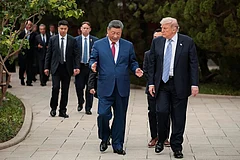
Paragraph 21 records serious concerns over unilateral tariff and non-tariff measures, which distort trade and sit uneasily with the World Trade Organisation rules. Yet it names neither the US nor its president, Donald Trump, whose administration uses tariffs as foreign-policy leverage.
“BRICS was never designed to function as an anti-American alliance,” says Abhishek Pratap Singh, who teaches international relations at the University of Delhi. Its members’ differing ties with Washington preclude such alignment, he argues; general language lets India oppose coercive trade practices without turning BRICS into a vehicle for confrontation.
Swaran Singh, a foreign-affairs expert and former professor at the Jawaharlal Nehru University, says that even the North Atlantic Treaty Organisation has internal differences. “The real question is how those differences are managed.”
The compromise, particularly for New Delhi, is uncomfortable: BRICS can denounce tariff coercion, but India must rely on bilateral negotiations to confront the powers applying it. Throughout 2025, Washington pressured New Delhi over trade and strategic autonomy. Trump claimed credit for the post-Sindoor India-Pakistan ceasefire, a claim the Narendra Modi government repeatedly rejected; his administration raised tariffs on Indian goods to 50 per cent, linking part of the pressure to Russian oil purchases. Naming Washington would have turned a broader statement against coercion into direct confrontation.
The paragraph on minerals is more revealing. It calls for reliable, diversified and resilient supply chains, but offers no binding protection against coercion and consultation mechanism before export curbs or monitoring bodies. China is not named.
Beijing dominates mining, refining and permanent-magnet manufacturing for electric vehicles, wind turbines and defence platforms. Industry estimates put its share of mined rare earths at roughly 60 per cent and refined output and magnet production above 90 per cent each. Chinese magnet export curbs disrupted India’s car production in 2025.
“China’s weaponisation of rare earths similarly exposes vulnerabilities within global supply chains,” says Singh. India is working with western countries and companies on alternative processing capacities, he notes. “Sometimes, the emphasis can remain on the structural problem and on building resilience against it,” he says.
Modi warned at the summit against the weaponisation of technology and critical minerals without naming China. The wording, echoed in the declaration, was mild enough for Beijing to accept, but clear enough for others to recognise the warning about dependence becoming strategic pressure.
Loophole in the Fine Print
Paragraph 67 preserves each country’s sovereign right over mineral resources and its right to pursue legitimate public-policy objectives. A country can therefore champion diversification while retaining wide latitude over exports. The declaration sets out a principle without a rule preventing members from choking supplies for strategic advantage.
In May 2026, India, the US, Japan and Australia launched the Quad Critical Minerals Initiative Framework, committing close to $20 billion towards mining, refining and recycling across the Indo-Pacific. A bilateral minerals framework with Washington followed the same day.
At home, the National Critical Mineral Mission, backed by more than Rs 16,000 crore, targets exploration, overseas acquisition and the refining capacity India lacks almost entirely, while a state-run vehicle established in 2019 seeks assets abroad. India’s 2023 entry into the US-led Minerals Security Partnership completes the hedge.
These initiatives cannot replace a multilateral guarantee, and refining capacity takes years to build. But New Delhi is not betting its mineral security on BRICS’ goodwill. The silence on China acknowledges that this fight is being fought elsewhere.
Strategic autonomy means preserving freedom of action and BRICS offers India a forum outside the western-led institutions. But China seeks greater influence over economic governance, Russia focuses on western sanctions, Iran resists US pressure and the Gulf members balance Washington and Beijing.
India’s simultaneous participation in BRICS, the Quad and partnerships across Europe and the Indo-Pacific brings leverage and limits. It can register displeasure with Washington through BRICS, while pursuing practical bargains through the Quad and bilateral channels. The consensus is useful, but it is transactional rather than binding.
The summit exposes the difficulty of maintaining that autonomy. US’ tariff threats disregard India’s energy security and defence needs, while trade with China has risen despite tensions along the line of actual control since the 2020 Galwan clashes, reaching around $150 billion with a $112 billion deficit. Dependence extends to active pharmaceutical ingredients, electronics, heavy industrial equipment, power infrastructure, rare earths and critical technologies.
“In an emerging bipolar world, where the US and China are the two supreme powers, it will not be easy for India to protect its interests just by joining multiple camps,” says Major General Sudhakar Jee (retd), a strategic expert. “India needs to focus on becoming more competent domestically.”
India now passes the gavel to China, the host of the 19th summit in 2027, with different priorities. Whether the language on tariffs and minerals hardens, softens or repeats itself, will test what the Delhi Declaration settled and what it postponed.
India leaves with a unanimous text that keeps the door open to the Global South. The real measure is whether its mineral mission and the Quad framework deliver refining capacity before another supply shock and whether tariff talks produce more than a shared paragraph of principle.
The declaration was never the instrument meant to solve India’s problem. It was meant to buy time while the harder work happens elsewhere.

MORE FROM THIS ISSUE




Anish Kumar is strategic affairs editor, Outlook