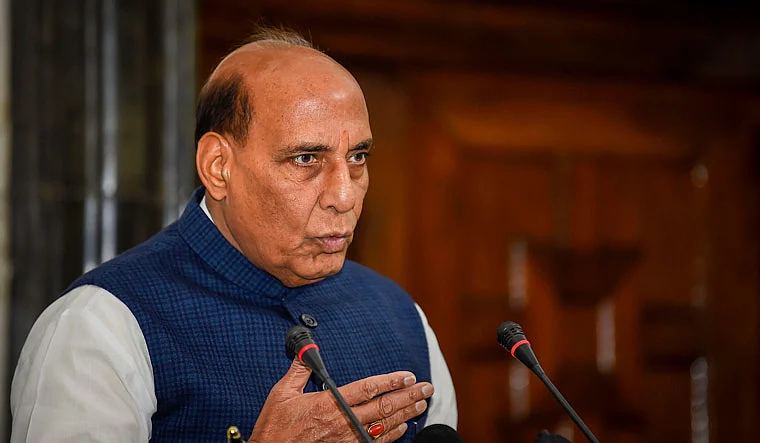
Rajnath Singh flagged HAL over persistent LCA Mk1A delays, warning that missed timelines create capability gaps and increase costs.
HAL’s first 83-jet Mk1A contract was signed in 2021, while deliveries remain pending amid engine, radar, weapons and software issues.
A second order for 97 jets takes the contracted Mk1A fleet to 180 aircraft, worth around ₹1.1 lakh crore.
With the Indian Air Force's (IAF) fighter squadron strength down to 29 against a sanctioned 42 following the retirement of its last MiG-21 units, Defence Minister Rajnath Singh on Friday flagged Hindustan Aeronautics Limited (HAL) over persistent delays in delivering LCA Mk1A fighter jets.
Speaking at the handing over ceremony of 2 LCA Mk1 trainer aircraft, 2 HTT-40 basic trainer aircraft to IAF and 4 Dhruv NG helicopters to Pawan Hans at Bengaluru, Rajnath Singh told HAL that delays create military capability gaps, leave force requirements unmet and push up costs.
On several counts, the IAF has raised the issue of delay in delivery of platforms . This was the first time that the defence minister publicly directed the state-owned aerospace company to “keep the timelines realistic.”
“There are some issues on which we have to work. Among them, delay is one of the most important issues. We face delays because of many technological issues, projects and we need to take these delays seriously,” Rajnath Singh said.
“Because of these delays the military capability gaps created and the force’s requirement couldn’t be met. These delays also force us for cost escalation.”
He noted that by the time new technology reaches the forces, the world has often moved to a better one, and urged HAL to keep project timelines realistic.


“Several times we have observed that by the time we acquire that technology, the world has already moved on to a better one,” adding that “We all know about technology obsolescence. It means what we have built and by the time it reaches us that becomes obsolete. Keeping all these in minds, we must keep the timelines realistic.”

Focus on R&D
He also asked young scientists, engineers, designers, test pilots and technicians to work towards capabilities that do not exist today, saying this would help India lead in global aerospace technology in the coming decades.

Timeline Of Missed Deadlines
HAL signed the first Mk1A contract for 83 jets in February 2021 worth around Rs 46,000 crore, with deliveries originally due by mid-2024.
In February 2026, HAL said five Mk1A aircraft were ready for delivery but were awaiting GE F404 engines from the US.
In May 2026, HAL’s chairman and managing director, Ravi Kota, said deliveries were expected to begin in August or September, a target that also passed.
In June 2026, in a review meeting between the defence ministry, the IAF and the HAL the issue of aerospace company’s project delays dominated the discussion, with the ministry noting the urgency of strengthening the IAF's depleted fighter squadron strength.
As of this week, in an interview with Outlook, HAL CMD Ravi Kota has said radar and weapons integration issues, along with software modifications, still need to be resolved before deliveries can start, even as it handed over the last two Mk1 trainers and the first HTT-40 aircraft to the IAF.
A second Mk1A order for 97 jets was placed in September 2025 worth over ₹62,000 crore, taking the total contracted fleet to 180 aircraft, valued at about ₹1.1 lakh crore.
With three MiG-29 squadrons and six Jaguar squadrons also due to be phased out towards the end of the decade, the IAF's capability gap is expected to widen further unless deliveries pick up pace.
Public-Private Partnership Synergy
Rajnath Singh also stressed the need to not view public and private sectors as competitors, but collaborators.
“There is a need for enhanced public-private synergy to build next-gen indigenous aerospace capabilities.”
“By working together, we can accelerate the growth of India’s aerospace sector. We must prepare for the sector’s transformation through Artificial Intelligence, autonomous systems, unmanned aerial systems, electronic warfare, cyber technologies, and next-generation propulsion, with a strong focus on their indigenous development and integration.”
“Let us all resolve to make India not only self-reliant in the field of aerospace technology but also a global leader,” he said.