
An IAF S-400 unit destroyed a Pakistani special mission aircraft from a distance of 314 kilometres during Operation Sindoor.
India struck Lashkar-e-Taiba and Jaish-e-Mohammed headquarters in Muridke and Bahawalpur using precision-guided weapons.
Pakistan responded with coordinated drone and missile attacks, prompting India to deploy layered air defence systems.
The killing of 26 tourists in Jammu and Kashmir's Pahalgam on April 22, 2025, set off a military escalation that ended with Islamabad seeking a ceasefire within 88 hours. During the operation, an IAF S-400 unit destroyed a Pakistani special mission aircraft from a distance of 314 kilometres, according to a report by Ministry of Defence.
The attack was carried out by an off-shoot of Lashkar-e-Taiba, after which Indian armed forces struck terror targets in Pakistan. The Indian Air Force hit two key sites- Lashkar-e-Taiba's headquarters in Muridke and Jaish-e-Mohammed's headquarters in Bahawalpur.
Initial Terror Strikes
The Indian Air Force used precision-guided weapons based on intelligence inputs to hit the Lashkar-e-Taiba and Jaish-e-Mohammed headquarters in Muridke and Bahawalpur. The strikes destroyed infrastructure used for recruitment, training and planning, without causing civilian or military collateral damage.
The operation did not stop there. The remaining nine terror targets were struck by the army using artillery and loitering munitions, extending the response beyond the two high-value headquarters.



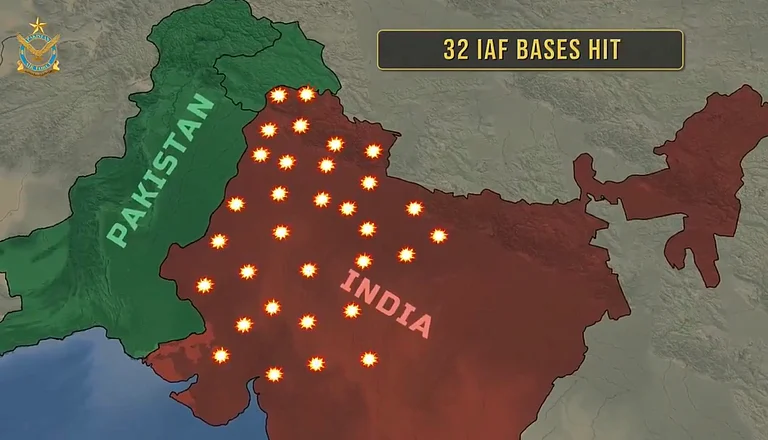
Pakistan then escalated. Its military launched coordinated drone and missile attacks on military installations from Jammu and Kashmir in the north to Gujarat in the south, opening a broader front after the initial Indian strikes.

Air Defence Response
India switched to air defence mode. The Indian Air Force's Integrated Air Command and Control System, or IACCS, coordinated different air defence assets to intercept drones, missiles, UAVs and loitering munitions. The system linked multiple platforms into one response network as the attacks spread across a long stretch of Indian territory.
Between May 8 and 10, Pakistan expanded attacks beyond military assets to civilian infrastructure, places of worship, schools and medical centres.
India defended its airspace with a layered grid. That included the indigenous Akash air defence system along with Pechora and OSA-AK platforms, all coordinated in real time through the Integrated Air Command and Control System.
Pakistan kept its civil airspace open during the hostilities and reportedly used civilian flights as shields. India ensured there was no risk to international air traffic while IACCS operators identified and classified aerial targets through the fighting.

Pakistani Air Bases
The Indian response then deepened. The IAF struck Pakistani air defence radars, command centres and military infrastructure at Chaklala, Rahim Yar Khan, Sukkur, Murid, Sargodha, Jacobabad and Bholari. It also hit Pakistani air bases including Nur Khan and Rahimyar Khan as the conflict widened.
Six radars and two Surface to Air Guided Weapon locations were successfully targeted using a mix of air-launched weapons and loitering munitions. These attacks were aimed at weakening Pakistan's air defence network and its ability to respond.
On May 10, the IAF struck four hangars housing fighter aircraft, AEW&C platforms and UCAVs. According to a defence ministry report, the strikes destroyed or damaged multiple F-16s at Jacobabad, one Airborne Early Warning & Control aircraft and several Akinci and TB-2 class drones, with reported Pakistan Air Force casualties.
The damage extended to airfield infrastructure. Runways at Sargodha and Rahim Yar Khan were damaged, while command centres at Chaklala—described in the brief as the headquarters of Pakistan's Air Defence Command and Murid were also destroyed.

IACCS And Awards
The network stayed central throughout. The IAF's IACCS fused military and civil surveillance sensors into a single recognised air picture. Through networked tactical nodes across multiple locations, it coordinated operations during both the defensive and offensive phases.
One strike stood out. An IAF S-400 unit destroyed a Pakistani special mission aircraft from a distance of 314 kilometres. The brief said the strike redefined assumptions around stand-off air defence range and showed that no target, in the air or on the ground, was beyond the IAF's reach.
The operation also brought formal recognition. A total of 219 gallantry awards were conferred on Air Force personnel for their role during Operation Sindoor.