Xi’s five initiatives seek deeper BRICS cooperation in AI, trade and investment, the digital economy, smart manufacturing and science and technology talent.
Experts say Xi offered little clarity on how Beijing plans to lead the grouping.
Experts urge caution on expansion and Chinese influence, warning that a larger BRICS could complicate consensus-building.
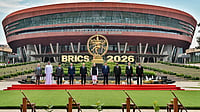
As China prepares to take over the BRICS presidency, President Xi Jinping has sought to put technology, trade and development at the centre of the grouping’s next phase. But experts say the proposals also underline the competing visions within the expanded grouping, with China seeking to deepen its economic outreach while India has positioned BRICS as a stronger voice for the Global South.
Xi unveiled the proposals on the second day of the 18th BRICS Summit in New Delhi, while also using his address to underline the recent thaw in China-India relations. He said the two countries should view each other as partners rather than rivals and work together within the expanded BRICS framework.
China will assume the rotating presidency of BRICS next year and host the 19th summit. It has previously hosted the summit in 2011, 2017 and 2022. This year marks the 20th anniversary of BRICS cooperation, which was created to give emerging economies greater weight in global affairs.



Xi said the expanded grouping, or ‘Greater BRICS’, should convert its growing presence across emerging markets and the Global South into greater economic impact and practical cooperation. He called for an open and mutually beneficial approach, with members working to maintain stable industrial and supply chains, build integrated markets and use new technologies to drive shared prosperity.
Professor Swaran Singh, a China expert, said Xi’s emphasis on development and outreach fitted closely with Beijing’s broader approach to BRICS.
“The one point I noticed is that China has reached zero tariffs with 53 African nations. Second, its Global Development Initiative has allowed China to complete 2,000 projects in partnership with other countries. This has helped China train 200,000 professionals from 120 countries,” said Singh.
He said the emphasis reflected China’s effort to use BRICS to widen the reach of its Belt and Road Initiative, while India has sought to make the grouping a stronger platform for the Global South.
“This fits in with China’s approach to BRICS as a platform to enhance its Belt and Road Initiative outreach, much like India’s primary motive is to make BRICS the voice of the Global South,” said Singh.
Prime Minister Narendra Modi, Singh noted, had also stressed the need to make the Global South a stronger global force, including through greater attention to climate concerns and reforms in institutions representing developing countries.
Yet Singh said Xi’s address did not offer a sufficiently clear picture of how Beijing intended to shape BRICS when it assumes the chair.
“I did not see a clear indication of where China wants to take BRICS. What he said is a repeat of all that China has been doing,” said Singh, pointing to the absence of a strong endorsement of the New Delhi Declaration or a detailed roadmap for the grouping’s next phase.
This assumes added significance as India has proposed a TROIKA mechanism under which the previous, current and incoming BRICS chairs would work together. Modi also suggested creating a repository that would allow members to access information on how issues had been handled during earlier presidencies.
“China’s nod is critical,” Singh said, noting that there was no clear indication of Chinese endorsement of the mechanism. Such continuity, he said, would allow India to track developments beyond the immediate transition and across the following year.
Singh also questioned whether Xi’s remarks sufficiently reflected the collective character of the expanded grouping.
“It doesn’t seem like China is speaking as one of 21, as part of the full BRICS family, because the tone is singular as to what China has done. From a country like China, which has 58 per cent of the BRICS GDP, one would expect a leadership vision outlined,” he said.
Xi said “Greater BRICS” should build innovation incubators, modernise traditional industries, develop emerging sectors and plan for industries of the future. He also highlighted China’s expanding economic engagement with the developing world.
“China is opening its door ever wider to the world,” Xi said, pointing to Beijing’s decision to grant zero-tariff treatment to the 53 African countries with which it has diplomatic relations. He said China would continue to widen unilateral opening-up, implement the Global Development Initiative and promote high-quality Belt and Road cooperation.
His five proposals were aimed at giving this approach a more institutional framework within BRICS.
The first focuses on artificial intelligence. China has proposed taking the lead in creating a BRICS AI open-source community, encouraging cooperation on large language models, organising specialised seminars and training programmes, and building what Xi described as an open ecosystem for AI.
The second seeks to facilitate trade and investment. China proposed a BRICS special economic zone partnership, with members developing an intelligent portal, coordinating policies and creating new platforms for open economic development. Beijing will also host a BRICS Forum on Trade in Services next year.
The third initiative centres on the digital economy, including a BRICS digital ecosystem cloud platform, digital skills training, technological exchanges and closer alignment between industries.
Under the fourth, China offered to help BRICS members develop smart factories and establish standards for intelligent manufacturing, with the stated aim of accelerating the transformation of manufacturing across the grouping.
The fifth focuses on science and technology talent. China proposed a BRICS engineer cultivation alliance to develop engineering skills jointly and work towards mutual recognition of competency standards. It also plans to launch a BRICS youth exchange programme focused on scientific and technological innovation.
Suresh Goel, a former diplomat with experience on China, said the proposals appeared attractive on the surface but would need closer scrutiny, particularly given the expanding role China is likely to play in BRICS.
“For me, the issue is not what they sound like; the issue is the content,” said Goel.
He drew a parallel with China’s Belt and Road Initiative, which was initially presented primarily as a connectivity and trade project but, he argued, also came to serve wider strategic interests through infrastructure projects. Ports and roads, including the Hambantota port in Sri Lanka, illustrated the need, he said, to examine the wider implications of such initiatives.
Goel also cautioned that the financing of large Chinese-backed infrastructure projects could create vulnerabilities for recipient countries if investments failed to generate sufficient returns to service the associated debt.
“The Chinese projects tend to put countries into a debt trap,” he said, citing Sri Lanka as an example.
Against this backdrop, Goel said BRICS members should examine the economic viability and long-term implications of Chinese-backed initiatives rather than assessing them only on the basis of their stated objectives.
The question becomes particularly relevant as BRICS continues to expand. Goel said the enlargement of the grouping should be seen as a gradual process, with some of its 10 partner countries potentially becoming full members over time. But he warned against expanding simply to increase the bloc’s size.
“We should not rush into the process or expand just for the sake of expansion,” underscored Goel.
A larger grouping could make consensus-building more difficult, said Goel, pointing to the adoption of the New Delhi Declaration as an example of how the existing members were able to arrive at common ground. As membership grows, reaching agreement on contentious issues could become more complicated.
He argued that expansion should therefore be undertaken “deliberately and carefully”, with greater attention to how new members could affect the organisation’s functioning.
For Goel, the same caution should apply to China’s five initiatives. Their significance, he said, would ultimately depend on how they are designed, implemented and independently assessed, rather than on the appeal of the proposals themselves.
The concern, he added, was not necessarily about Chinese participation but about ensuring that greater Chinese involvement did not translate into disproportionate influence or leave other members overly dependent on Beijing.
“We should be more deliberate and careful about it,” said Goel.
He added: “On the surface, all these initiatives sound good, but that doesn't mean anything unless they have been properly examined by experts.”
Xi’s proposals came a day after his meeting with Modi on the sidelines of the summit, where the two leaders held what China described as a candid and in-depth discussion and reached an “important consensus” that China and India should be partners.
Xi said Beijing had consistently approached its relationship with India from a strategic and long-term perspective. Referring to his meetings with Modi over the past two years, he said bilateral ties had moved from a new beginning towards further improvement.
Calling for a more objective and rational assessment of the relationship, Xi said China and India were “partners for cooperation, not rivals”. The two countries, he added, should see each other as opportunities for development rather than threats.
Xi also urged Beijing and New Delhi to keep the future of humanity and the well-being of their peoples in mind as they pursue high-quality development within the expanded BRICS framework. Greater cooperation between the two countries, he said, could contribute to peace, stability, development and prosperity.