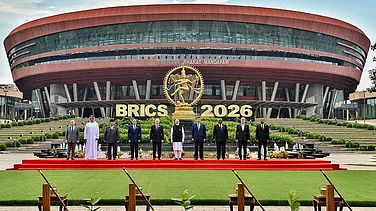
· BRICS’ significance lies not merely in the redistribution of material power, but in creating new spaces through which the Global South can articulate its interests and participate more actively in shaping global governance.
· India’s fourth BRICS chairship in 2026, under the theme “Building for Resilience, Innovation, Cooperation and Sustainability”, reflects the preference for practical, development-oriented and solutions-focused multilateralism.
· Prime Minister Narendra Modi’s 10-point roadmap for global governance, including the proposal for a BRICS Seafarers’ Security Network, reflects India’s growing ambition to shape a more representative, inclusive and effective international order.
The emergence of BRICS represents a transformative development in the changing architecture of global governance and the growing political agency of the Global South. The term BRIC was coined by Goldman Sachs economist Jim O’ Neill in 2001 to identify Brazil, Russia, India and China as emerging economies with the potential to reshape the unequal distribution of global economic power. Its rise can be situated within what scholars such as Dirk Messner described as broader “global power shifts”, characterised by the diffusion of economic and political influence beyond the traditional centres of the international system. What began as a quest for greater autonomy and more equitable access to global public goods, whose provision and governance remained largely dominated by Western powers, gradually acquired diplomatic and political significance. In 2006, the four states initiated formal consultations, followed by the first BRIC summit in Yekaterinburg, Russia, in 2009. South Africa’s entry in 2010 transformed BRIC into BRICS, while the establishment of the New Development Bank and the Contingent Reserve Arrangement in 2014 further institutionalised cooperation and reflected demands for greater representation within global financial governance.
Creating New Spaces
The evolution of BRICS demonstrates what scholars such as Moisés Naím describe as “minilateralism”, alongside the broader trend towards modular multilateralism. Rather than relying solely on sweeping, slow-moving geopolitical blocs or universal institutions such as the United Nations, nations with radically different political systems and interests increasingly use smaller “coalitions of the willing” to address specific challenges and achieve practical outcomes. In other words, BRICS’ significance lies not merely in the redistribution of material power, but in creating new spaces through which the Global South can articulate its interests and participate more actively in shaping global governance.


Its gradual expansion illustrates this complexity. Egypt, Ethiopia, Iran, Saudi Arabia and the United Arab Emirates (UAE) became members in 2024, while Indonesia joined in 2025, taking full membership to eleven. A partner-country framework has further widened engagement with countries including Belarus, Bolivia, Cuba, Kazakhstan, Malaysia, Nigeria, Thailand, Uganda, Uzbekistan and Vietnam. This enlargement is significant not merely because of the aggregate economic weight it adds, but because it makes BRICS a more geographically and demographically representative platform of the Global South. At the same time, its diversity prevents it from becoming a coherent ideological bloc. The interests of India, China, Russia, Iran, Saudi Arabia, Brazil and the UAE cannot be reduced to a single strategic agenda. Precisely because of this heterogeneity, BRICS is better understood as a diplomatic and political platform than as an alliance.
This distinction is particularly important to understand India’s approach. Indian foreign policy has traditionally emphasised strategic autonomy. India’s participation in the Quad alongside the US, Japan and Australia illustrates this issue-specific approach, while BRICS provides a wider platform for engagement with the Global South. India, therefore, uses multilateralism and minilateral arrangements in terms of issue-based and national interests. India’s fourth BRICS chairship in 2026, under the theme “Building for Resilience, Innovation, Cooperation and Sustainability”, reflects this preference for practical, development-oriented and solutions-focused multilateralism.
The contemporary relevance of BRICS stems from global fragmentation, where wars, sanctions, trade weaponisation, and strategic chokepoints reshape geopolitical and economic power. Against this background, BRICS is neither an anti-Western alliance nor a Russia-China-India-led alternative order. India’s fourth BRICS chairship in 2026 reflects a Kautilyan tradition of pragmatic statecraft turning geopolitical challenges into constructive diplomacy. Its high-level engagement with China and Russia demonstrates how New Delhi can use BRICS to facilitate cooperation while managing bilateral differences through separate channels—addressing concerns along the Line of Actual Control (LAC) with China, pursuing the resumption of Delhi-Guangzhou flights, and sustaining strategic and energy ties with Russia amid Western sanctions. Engagement with Iran similarly helps India protect its interests in connectivity and energy, particularly Chabahar, while balancing relations with the US. Economically, rather than pursuing wholesale de-dollarisation that could increase dependence on the Chinese yuan, India favours pragmatic local-currency arrangements such as rupee-ruble trade.
Modi’s 10-point Roadmap
Highlighting the urgency of transforming the “pyramid of privilege” into a “platform of partnership” to empower the powerless in the international order, Prime Minister Narendra Modi, in his address at the New Delhi Summit, has asserted that reform of the United Nations Security Council “cannot be delayed anymore”. His 10-point roadmap for global governance, including the proposal for a BRICS Seafarers’ Security Network, reflects India’s growing ambition to shape a more representative, inclusive and effective international order. Further, the BRICS Joint Declaration, with its condemnation of unilateral wars and the consensus achieved on the Iran war, including the emphasis on ensuring the safety of nuclear facilities during armed conflicts, represents an extraordinary achievement of Indian political and diplomatic leadership. In other words, India’s BRICS’s chairship demonstrate the nation’s resurgent civilisational strength in managing diversity and fostering peace amid a turbulent world order.
(The author is a Senior Visiting Fellow at the Centre for Policy Research, New Delhi, and co-editor with Dirk Messner of Power Shifts and Global Governance: Challenges from South and North)
(Views expressed are personal)