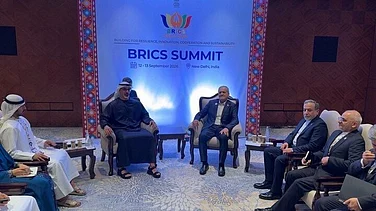
· The 18th BRICS summit in New Delhi on September 12-13 comes at an unusually consequential moment.
· India’s challenge as chair is consequently not to choose between the West and an anti-Western coalition, but to demonstrate that a more representative international order can coexist with engagement across competing power centres.
· The real test for BRICS, therefore, is not whether it can become an anti-Western bloc. It is whether it can help create an international system in which no single power or group of powers monopolises either rule-making or narrative-setting.
The 18th BRICS summit in New Delhi on September 12-13 comes at an unusually consequential moment. The continuing war involving Iran, growing unease over unilateral economic and military measures and disruptions to energy, maritime commerce and supply chains have exposed the vulnerabilities of an interconnected world. They have also revived a larger question: who makes the rules governing the international system and whose perspectives shape its dominant narratives?
BRICS emerged in 2009 with two broad purposes: to strengthen sectoral cooperation among major emerging economies with an objective to have a shared developmental agenda and to promote reform of global governance. Its expansion has greatly increased its demographic, economic and geopolitical weight, but has simultaneously widened its internal diversity. BRICS is, therefore, neither an alliance nor an ideologically homogeneous grouping.
Different Visions Within BRICS
These differences are fundamental. Russia and China increasingly view BRICS as a means of accelerating the transition away from Western predominance. Brazil and South Africa support a stronger political voice for the Global South, but remain reluctant to turn BRICS into an anti-Western coalition. Iran sees considerable value in challenging sanctions and Western economic pressure.



India’s conception is different. It supports multipolarity and reform of existing institutions, but seeks to keep development, economic resilience, strategic autonomy and Global South concerns at the heart of BRICS. India’s challenge as chair is consequently not to choose between the West and an anti-Western coalition, but to demonstrate that a more representative international order can coexist with engagement across competing power centres.
The China Factor
India-China relations remain an important constraint. While both seek greater representation for developing countries, their border dispute, trade imbalance and geopolitical competition limit mutual trust. India’s diplomatic challenge is therefore to keep BRICS pluralistic and multipolar, without allowing any single member to determine its strategic direction. Yet, India and China also share important interests in reforming global governance and strengthening the voice of the Global South. BRICS thus provides a diplomatic space to manage their differences while expanding areas of convergence—cooperation without requiring strategic alignment.
The New Delhi Consensus
Against this background, the unanimous adoption of the New Delhi Declaration is particularly significant. The foreign ministers of BRICS had failed in May to produce a joint statement amid differences over the situation in West Asia, particularly involving Iran and the United Arab Emirates. Building consensus in New Delhi, despite these and other divergent interests therefore represents an important diplomatic achievement for India’s chairmanship. More significantly, it demonstrates that BRICS’ growing diversity need not become a source of paralysis; it can instead be managed through diplomacy to build convergence on larger global concerns.
On West Asia, the declaration expresses deep concern, calls for maximum restraint and emphasises dialogue, consultation and diplomacy. Its carefully balanced language enabled members with sharply differing interests to remain within the consensus. This reflects the distinctive character of BRICS: its strength lies not in enforcing uniformity, but in creating diplomatic space for countries with divergent interests to identify common ground. Its limitation is equally evident—it can accommodate geopolitical differences, but cannot necessarily resolve them.
The declaration also opposes unilateral sanctions and tariff and non-tariff measures, calls for reform of global institutions and reiterates opposition to terrorism. These positions reflect broader dissatisfaction across the Global South: countries that have acquired greater weight in global production, trade and growth still have disproportionately limited influence over institutions and rules created in an earlier era.
From Rule-Takers to Rule-Shapers
Prime Minister Narendra Modi’s call for the Global South to move from “rule-takers to rule-shapers” has a significance that goes beyond institutional reform. For much of the post-war period, Western powers not only shaped global institutions and rules, but also exercised disproportionate influence over the narratives, concepts and priorities that framed international discourse. Greater participation in rule-making would enable the Global South to integrate its own developmental experiences, priorities and perspectives into global narratives, rather than merely responding to frameworks developed elsewhere. The transition from rule-taker to rule-shaper is therefore also a transition from being largely a recipient of global narratives to becoming an active participant in shaping them.
The real test for BRICS, therefore, is not whether it can become an anti-Western bloc. It is whether it can help create an international system in which no single power or group of powers monopolises either rule-making or narrative-setting.
The New Delhi Declaration may mark an important step in that transition—from demanding representation within the existing order to helping shape the rules of the next one.
(The author is a former diplomat)
(Views expressed are personal)