



Years ago, while studying at Delhi University, a few friends and I were regulars at a small eatery near our campus. We went there for the usual student combination of cheap food and generous portions, with very little curiosity about how the food was made. I was particularly fond of its kadhi—the tangy, yoghurt-and-besan-based yellow gravy that is a staple in kitchens across Delhi and Punjab. I could easily put away several servings.
During exams, I was staying at a friend’s hostel, which happened to be right behind our favourite eatery. After pulling an all-nighter, I stepped out on to the balcony at daybreak, where my friend was nursing a cup of tea and a cigarette. There is something about sleep deprivation, impending exams and the first cigarette of the morning that makes young men believe they have begun to understand the world. We settled into a discussion on the three subjects that seemed to contain the universe as we knew it then: life, girls and exams. We understood little about the first, almost nothing about the second, and were desperately trying to understand the third.
Even as my friend was musing on the futility of trying to understand Sylvia Plath a few hours before an exam, my attention drifted towards the street below. A man was standing beside a large tub, with both hands buried up to his elbows in a mound of besan. I watched for a while, trying to work out what he was making. Finally, I asked my friend, “What’s that guy doing?”
He took a sip of tea, passed me the cigarette for one last drag before it went out and said, “He’s making your kadhi.”
There are some things you cannot unsee. This was one of them. For a few seconds, I simply stared at the tub. My friend, clearly enjoying the effect his revelation had produced, smiled and said, “If it hasn’t killed you all these years, it won’t kill you now that you know what goes into it.”




Suddenly, Plath’s preoccupation with death seemed a little less difficult to understand than it had been in all those lectures on her poetry. We laughed out loud. But I could not eat that kadhi again. What my friend described so poetically two decades ago may explain how 1.4 billion Indians survive eating unhygienic food at millions of such eateries. The reality, though, is far less palatable: every year, unsafe food and poor hygiene make millions of Indians sick.
And this isn’t just about the roadside eateries. Over the past couple of months, food safety inspectors have walked into many five-star hotels in metros to find cockroaches in kitchens, spider webs, spoiled food, duplicate date-marking and dirt in drinking water. A couple of these hotels were caught when they were getting ready to welcome Brazil, Russia, India, China and South Africa delegates in the national capital in a few weeks.
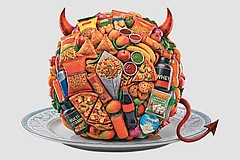
To say that things are going from bad to worse would be an understatement. In 2024 alone, 1,122 people died from food poisoning in India. This was a rise of more than five-fold since 2020. Of the 9,390 confirmed public-health events between 2017 and 2023, close to 50 per cent originated in food-borne or water-borne infection. India accounts for nearly one-fifth of the world’s hepatitis A infections.
Daunting Odds
It is not just about the kind of food we are consuming in restaurants and tea stalls. The problem is much broader. It begins long before the food reaches the kitchen. The fruit and vegetable market is a chemical laboratory of sorts, with farmers and traders under pressure to produce, preserve, transport and sell perishables quickly.
The Food Safety and Standards Authority of India (FSSAI) prohibits calcium carbide for ripening fruits and permits ethylene gas under controlled conditions. Yet, in April 2026, the regulator again had to warn states about the use of calcium carbide, the dipping of fruits in ethephon solutions, synthetic colours and unauthorised coatings.
The harsh and sad truth is Indians have no idea of what is going into our bodies; yet, we have little choice but to keep eating.
The consumer rarely knows what was sprayed on the produce or when. A mango may look perfectly ripe while the process that got it there remains invisible. A shiny apple may signal freshness, or simply a coating. The harsh and sad truth is Indians have no idea of what is going into our bodies; yet, we have little choice but to keep eating. We can’t test every fruit, inspect every kitchen or verify every ingredient. Does anything really protect us?
The numbers are stacked against us. Last financial year, state food authorities analysed 2,23,808 samples. Of those, 40,023 were found non-conforming—close to one in five. Civil penalties were imposed in 31,878 cases. Criminal convictions numbered 1,918. That is one conviction for roughly every 21 failures the system itself detected.
Double Standards
Then there is the question of multinational companies (MNCs). Take Coca-Cola for instance. The company is perfectly entitled to formulate its drinks differently for different markets, but look at what those differences mean. A media investigation recently found that a same-sized Fanta sold in India contained almost three times the sugar in the equivalent drink sold in London. Coca-Cola’s own European business says it has spent years reducing sugar, expanding low- and no-calorie alternatives and putting front-of-pack traffic-light nutrition labels.
Then look at Nestlé. In 2024, an investigation by Swiss watchdog Public Eye and the International Baby Food Action Network tested Nestlé’s Cerelac products sold across developing markets. In India, all 15 variants they tested contained added sugar—nearly three grams per serving on average. In Switzerland, by contrast, equivalent Cerelac products were sold without added sugar. At the time, Nestlé said in its defence that its Indian products complied with the country’s regulatory standards. But legality is a remarkably low bar when the consumer is a six-month-old child. The question is if a company can sell baby food without added sugar in Switzerland, why does a baby in India need to consume added sugar at all?
It is high time we recognise that such double standards don’t just happen with food. India and Indians get a raw deal from MNCs in many ways when it comes to health and safety. Johnson & Johnson has settled lawsuits against its talc-based products in the United States for billions of dollars. Meta settled alleged child-safety violations against it for billions of dollars recently. But we don’t levy the same kind of fines or extract the same kind of penalties. This needs to change.
A country aspiring to greatness must first learn to value the life of its citizens. The measure of a nation is not merely the size of its economy or the scale of its ambitions, but the price it is willing to put on the safety and dignity of its people. Every Indian’s health and well-being must count. Today, we are chasing enormous ambitions like nuclear power, artificial intelligence, data centres, highways and semiconductors. The higher we build, the stronger the guardrails for public safety have to be. There is something deeply tragic about asking a people to become a civilisational power while allowing a system that is slowly making them sick, one meal at a time.



Neeraj Thakur is editor, Outlook















