DRDO will seek an industry partner within six months to take its 30kW laser weapon towards a first-of-production model.
The 30kW system can engage drone swarms, fixed-wing UAVs and surveillance sensors at ranges of up to 5 km.
The move follows completion of the system's final trials in August 2025, with DRDO saying the technology has been proven.
The Defence Research and Development Organisation (DRDO) will begin selecting a production partner for its 30kW-class directed-energy weapon (DEW) within six months, as it moves towards the system’s first-of-production model (FOPM). Built mainly to counter drones, the truck-mounted laser is designed to engage drone swarms, fixed-wing unmanned aerial vehicles (UAVs) and surveillance sensors at ranges of up to 5 km.
Dr BK Das, director general (electronics and communication systems) at DRDO, told Outlook that an expression of interest (EOI) would be issued in that period to identify an industry partner that can take the system to FOPM.
It is the most powerful directed-energy system DRDO has demonstrated so far. Final trials ended in August 2025.
“Technology is proved,” Das said, adding that the system needs a little more time before the next stage is locked in. No decision on FOPM has been taken yet.
Why the need is sharper
The armed forces felt the need for such a system during Operation Sindoor, the military action against Pakistan in May 2025, when both sides used drones heavily. Pakistan used cheap probing drones to locate India's air defence positions and drain expensive interceptors.


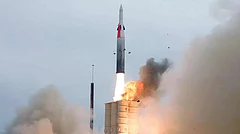

DEWs use high-power beams, such as lasers and microwaves, to disable vulnerable parts of aerial threats, including motors and electronics. Because the beams travel at the speed of light, they can engage targets almost instantly, without the flight-time delay of missiles or projectiles. They are seen as a cost-effective answer to swarm drones and UAVs.
Smaller systems further along
The 2kW DEW is already in production, made by Adani, Astra and Bharat Electronics Limited (BEL). DRDO is also handing over the technology to private firms for a notional fee, Das said.
“Private players face challenges in realizing technologies. Many of them do not do it because of order and investment issues,” he said.
The 10kW version has cleared the acceptance of necessity stage, the first approval in the defence procurement chain and 10-12 units have been ordered. Larsen & Toubro and BEL have been chosen as DCPPs but are yet to submit their FOPM. The system is meant to destroy targets at 1.5-2 km.
“Lots of works are underway. We have offloaded the routine to industries. DRDO is focusing on core issues,” Das said, adding that DEWs are meant to work within the OODA loop - observe, orient, decide and act.
How the OODA loop shapes air defence
Modern air-defence systems run on this four-step cycle to spot a threat and respond quickly.
Sensing: Radar, electro-optical and infrared sensors, spectrum monitors and acoustic equipment watch the airspace and feed data on everything that moves through it.
Identification: Computers sift the feed to separate friendly aircraft from hostile ones and work out what an object is, where it is and where it is headed. Operators, or the system itself, then pick a response.
Response: The choice of weapon depends on the target and the situation. A high-energy laser is one option. The whole cycle is designed to cut the time between detection and response.
DEWs offer a balance between kinetic and non-kinetic responses. During Operation Sindoor, India's response against Pakistan was largely kinetic. With its indigenous development, India has joined the small group of countries with DEW capability, including the US, China, Russia and Israel.