



Narendra Modi and Balendra Shah are meeting for the first time in person as prime ministers, with the visit offering an opportunity to reset ties strained by border disputes and political mistrust.
India and Nepal have strong economic links, with bilateral trade worth around $9.38 billion in 2025-26 and significant potential for cooperation in hydropower, railways, transit and infrastructure.
The China factor, Nepal's concerns over the 1950 treaty and unresolved territorial claims remain major challenges to a more stable and balanced relationship.
In March 2026, when Balendra Shah was sworn in as Nepal's prime minister, Indian Prime Minister Narendra Modi was among the first leaders to congratulate him. Modi said he looked forward to working with Shah to take India-Nepal friendship and cooperation to greater heights. Eight months later, the two leaders are preparing for their first in-person bilateral meeting in New Delhi, with a relationship that carries considerable promise but also a long list of unresolved disagreements.
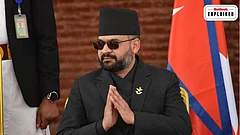
Shah's two-day state visit, which began on November 22, is his first bilateral foreign visit since taking office. His meeting with Modi on November 23 comes at a significant moment for both countries. Nepal is rebuilding after devastating floods, seeking greater economic opportunities and navigating a changing political landscape following the Gen Z-led uprising of 2025.
India, meanwhile, is looking to strengthen its ties with a neighbour whose strategic importance extends beyond their shared border. The question is whether the visit can move the relationship beyond familiar expressions of friendship towards a more durable partnership.




A Relationship Shaped By Geography, Tested By Politics
India and Nepal share an open border, deep cultural and religious connections, and a relationship that has developed through generations of migration, trade and family ties. The 1950 Treaty of Peace and Friendship formalised a special framework for their relationship, providing for close economic and security cooperation and reciprocal privileges for citizens. Yet the closeness has also produced friction. Nepal has periodically questioned whether the relationship reflects the interests of two sovereign countries or the influence of a much larger neighbour.
The political strain has several sources. Nepal's concerns over the 1950 treaty, its dependence on Indian transit routes and the perception of Indian interference in its domestic affairs have repeatedly complicated ties. The 2015 blockade controversy was particularly damaging: even as India denied imposing a blockade, the episode deepened anti-India sentiment in Nepal and encouraged Kathmandu to diversify its external partnerships. A 2023 analysis in Frontline argued that both countries needed to redefine their relationship in response to changing political and economic realities, rather than rely solely on historical sentiment.
The border dispute remains one of the most sensitive issues. Nepal's claims over Kalapani, Lipulekh and Limpiyadhura have periodically brought the two governments into disagreement. The dispute intensified in 2020, when Kathmandu issued a revised political map incorporating the three territories, a move rejected by New Delhi. In May 2026, Shah told Nepal's Parliament that both countries had encroached on each other's territory in certain places and said Kathmandu had received an Indian response proposing discussions involving historians, surveyors and territorial experts. Nepal also objected to India's use of Lipulekh for the Kailash Mansarovar pilgrimage route earlier this year. India maintains that the route has been used for the pilgrimage since 1954 and rejects the involvement of third parties in a bilateral boundary matter.
The disagreement is not simply about territory. It is also tied to questions of national identity and sovereignty. For Nepal, raising the border issue has domestic political significance; for India, territorial claims and the involvement of China or other countries touch on strategic and security concerns.
Amit Ranjan, writing for the National University of Singapore's Institute of South Asian Studies, notes that unresolved territorial claims continue to affect bilateral relations despite the fact that nearly 98 per cent of the boundary has been demarcated. The challenge for Modi and Shah is to prevent the remaining disputed stretches from overshadowing areas where cooperation is both possible and necessary.

Trade, Power And Connectivity: The Stakes Of Cooperation
The economic relationship provides a compelling reason for both governments to seek a reset. India is Nepal's largest trading partner and a major source of foreign investment. Bilateral merchandise trade reached approximately $9.38 billion in the 2025-26 financial year, accounting for more than 60 per cent of Nepal's total external goods trade. India also received more than 80 per cent of Nepal's goods exports during the period.
For a landlocked country, access to Indian markets, ports and transport networks is central to its economic prospects. For India, Nepal is an important neighbour in its northern security and connectivity framework.

Energy is another area where the interests of the two countries converge. Nepal's hydropower potential offers India access to renewable electricity, while cross-border power trade gives Kathmandu an important export market. The 2014 Power Trade Agreement envisages Nepal exporting 10,000 MW of electricity to India over 10 years. The two countries have also agreed to cooperate on hydropower development, transmission infrastructure and coordinated operation of their power grids. Nepal exported around 1,100 MW of electricity to India in the previous year, according to the Indian government's bilateral brief. The arrangement demonstrates how economic interdependence can produce tangible gains for both sides.
Connectivity is likely to feature prominently in the talks. Rail links, roads, integrated check posts and petroleum pipelines have expanded the movement of goods and people across the border. The proposed and ongoing projects are not merely infrastructure announcements: they determine how efficiently Nepal can access markets and how easily communities on both sides can trade and travel. The Ayodhya-Janakpur rail connection, expected to be among the initiatives highlighted during the visit, also draws on the religious and cultural links between the two countries. Kathmandu is separately seeking additional air-entry routes through Indian airspace to improve access to Pokhara and Bhairahawa.
The immediate economic challenge is Nepal's recovery from the catastrophic floods of August 2026, which damaged roads, bridges, power infrastructure, homes and agricultural land. India was among the first countries to respond with assistance. Reuters reported that Kathmandu is seeking additional Indian support for reconstruction, including an economic assistance package, while the two sides are expected to discuss infrastructure, trade and energy cooperation. The scale of the damage gives the visit an urgency beyond diplomatic symbolism: Nepal needs resources and reliable partners, while India has an opportunity to demonstrate that its neighbourhood policy can deliver practical support.

The China Factor And The Test Of A Reset
China's growing engagement with Nepal has added another dimension to the relationship with India. Through infrastructure projects, economic assistance and diplomatic outreach, Beijing has expanded its presence in a country that New Delhi has traditionally regarded as central to its neighbourhood policy. Kathmandu, meanwhile, has sought to diversify its external partnerships and widen its economic options, while maintaining its longstanding ties with India. For Nepal, engagement with both neighbours is also a way of preserving strategic autonomy. For India, China's expanding presence in Nepal has implications for its regional influence and security interests.
But treating Nepal's engagement with China only as a challenge to Indian influence risks overlooking Kathmandu's own priorities. A 2021 analysis by former Indian foreign secretary Vijay Gokhale for Carnegie India argued that New Delhi's approach had often been shaped by an inadequate understanding of Nepal's historical and political relationship with China. It also pointed to the damage caused by perceptions of Indian interference in Nepal's internal affairs. The implication is that India cannot rely on historical ties alone to sustain its influence; it must also respond to Nepal's expectations as an independent country.
The 1950 treaty is another issue that may require attention. In Nepal, sections of the political establishment and public opinion have long argued that some provisions reflect an unequal relationship and should be updated. The Himalayan Times, in an opinion article published ahead of Shah's visit, argued that both countries should modernise outdated arrangements, improve project delivery and focus on practical cooperation rather than symbolism. It also called for sustained dialogue on the border, trade, water resources and security. Such proposals point towards a more institutional approach: disputes need mechanisms for discussion, while projects need deadlines and accountability.
Modi and Shah therefore face a relationship that is simultaneously close and complicated. Their countries share geography, economic interests and social ties that neither can easily replace. But a reset will require more than a joint statement or a fresh set of agreements. It will depend on whether India can engage Nepal with greater sensitivity to its sovereignty, and whether Nepal can address India's security concerns without allowing every disagreement to become a diplomatic confrontation.








