Lionel Messi's international career has officially concluded following an exhausting, heartbreaking run to the World Cup 2026 final in New Jersey
His twenty-year journey evolved from early struggles into historic redemption with consecutive Copa América titles and the 2022 World Cup
Though he chased one final miracle in his twilight, time and circumstance ultimately closed the book on the sport's greatest legacy
Lionel Messi walking off the pitch in tears at the MetLife Stadium in New Jersey marks the definitive end of a legacy that may never be touched again. Following an exhausting, frantic run at the 2026 FIFA World Cup, the Argentine icon’s international career concluded under the heavy weight of a heartbreaking final defeat.
It was a teary-eyed farewell that proved not all fairy tales finish with a happy ending, closing the book on an extraordinary two-decade journey that redefined the sport.
Moments after the final whistle sounded in the summer heat of New Jersey, the magnitude of the moment settled over the stadium. Taking to social media to share his final goodbye with millions of grieving and grateful fans worldwide, Messi released an emotionally raw farewell note that stripped away the mythos to reveal the weary man beneath the crown.
"After all the time that has passed since the final, and after giving it a lot of thought, I want to let everyone know that I am retiring from the National Team,” he wrote, his words carrying the heavy finality of a chapter forever sealed.



A Heart-Wrenching Decision
The final retirement decision was born out of the crushing emotional aftermath of a World Cup final loss, compounded heavily by his father Jorge’s declining health at the time he was making up his mind, with his eventual passing sealing a profound personal grief.
The mental and physical strength required to force his body through elite training camps, intense schedules, and grueling global travel had finally run out. Carrying the expectations of an entire nation for twenty years took an immense toll, transforming what was once purely a joyful pursuit into an exhausting, soul-searching battle against time and circumstance.
The Dreams Born In Rosario
His journey began far from the global spotlight on the dusty, unforgiving pitches of Rosario, driven by an unshakeable, boyhood dream to wear the light blue and white of Argentina.
Even as a fragile child standing head-and-shoulders below his peers, his supernatural control of the ball left coaches and older opponents entirely awestruck, turning every local gravel pitch into a stage for his astonishing gifts.
That jaw-dropping natural brilliance quickly became the worst-kept secret in Argentina, dazzling everyone who watched him weave through defenders twice his size with a breathtaking, effortless mastery.
When a severe growth hormone deficiency threatened to derail his career before it even started, threatening to cut short his potential, Barcelona arrived as his ultimate salvation.
Whisking a young Messi away to La Masia, the Catalan club nurtured a fragile, quiet prodigy into a footballing phenomenon, providing the medical and footballing sanctuary where his otherworldly talent could finally take root.
New Family, New Learnings
By the time he made his landmark World Cup debut in 2006, his development was accelerating at a breathtaking pace, shaped heavily by the protective mentorship of manager Frank Rijkaard and a tight-knit bond with Ronaldinho at club level.
Hand-in-hand with the midfield orchestration of Xavi and Iniesta, Messi evolved into a tactical marvel at Barcelona. Though that club synergy existed thousands of miles away from international duty, Argentina ultimately reaped the rewards after he famously rejected advances from the Spanish federation to pledge his absolute international allegiance to his homeland.
A Cinematic Collaboration
The 2010 FIFA World Cup in South Africa arrived draped in a layer of profound, almost cinematic destiny, pairing a twenty-two-year-old Lionel Messi directly with his ultimate boyhood idol and national mentor, Diego Maradona.
When the mercurial genius of Argentina’s past stepped into the dugout as head coach, an electrifying wave of romanticism swept across the footballing world. Maradona wrapped his protective, paternal arms around a young Messi, famously anointing him as his true successor on the global stage, openly nurturing a close, deeply emotional bond that fueled dreams of a nation reasserting its divine right to world supremacy.
Yet, behind the mythic embrace and the overwhelming public euphoria lay a tactical reality that was tragically unsuited to unlocking Messi's full potential. Maradona’s eccentric, free-wheeling management style lacked the structural rigor that Messi enjoyed at Barcelona. As Argentina crashed out in a brutal 4-0 quarterfinal defeat to Germany, the dream of a fairytale triumph under Maradona evaporated into bitter disappointment. Messi finished the tournament without scoring a single goal.
Are You The One?
A scoreless tournament in 2010 sparked ruthless domestic criticism, forcing a hyper-critical Argentine public to question whether he was merely a system product fueled entirely by his extraterrestrial Barcelona teammates rather than a true national talisman.
That mounting domestic skepticism reached a boiling point on the grandest stage of all during the 2014 FIFA World Cup in Brazil, transforming into an epic crusade of redemption and ultimate heartbreak.
Messi put the hopes of a football-obsessed nation entirely on his shoulders. With moments of breathtaking individual brilliance—threading a needle against Bosnia, curling a last-minute winner past Iran, and orchestrating a masterclass against Nigeria—he carried the Albiceleste through the knockout rounds past Switzerland, Belgium, and the Netherlands.
Albiceleste through the knockout rounds past Switzerland, Belgium, and the Netherlands. Though he was awarded the Golden Ball as the tournament's best player, the ultimate prize slipped through his exhausted fingers under the floodlights of the Maracanã.
An agonizing extra-time winner by Germany's Mario Götze shattered Argentina's dreams, leaving Messi staring blankly at the golden trophy he had come within a hair's breadth of claiming, cementing a wound that time could never fully heal.
Crushed Farewell
Year after year, the weight grew heavier as Argentina returned to continental battle, only to suffer heartbreak on the exact same knife-edge. At the 2015 Copa América in Chile, Messi watched in agony as the hosts triumphed in a penalty shootout, snatching the trophy away after another grueling 120-minute battle.
Just twelve months later, at the Centennial Copa América Centenario in the United States, the exact same nightmare repeated itself: another punishing scoreless draw against Chile, another heart-stopping penalty shootout, and another devastating defeat in the final.
For a man who had conquered every possible summit in club football, the burden of carrying a cursed national jersey became an unbearable psychological prison.
Overcome by exhaustion, despair, and an overwhelming feeling of inadequacy on the international stage, a utterly broken Messi walked into the bowels of the MetLife Stadium pitch in New Jersey on June 26, 2016, and dropped a bombshell that shocked the global game.
In an emotional post-match interview, he announced his immediate and definitive retirement from international football, famously declaring with raw vulnerability that the national team shirt was simply not meant for him and that he had tried his hardest, but failing to win a title for Argentina meant his time was up.
The Master's Arrival And Sky Touched
Driven by an insatiable, haunting hunger, he engineered a determined return, shouldering immense public skepticism as Argentina continued to misfire until Lionel Scaloni took the helm. As age naturally caught up with his explosive, blistering pace, Messi adapted tactically, dropping deeper to evolve into the ultimate hybrid of a creative playmaker and a lethal scorer.
Scaloni completely re-engineered the national setup, building a hard-working, suffocatingly tight collective designed to protect Messi at all costs, run themselves into the ground for him, and finally deliver the international trophy he so desperately craved.
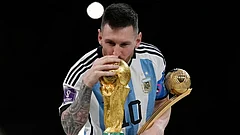
Combined with the emotional spark reignited by childhood idol Pablo Aimar joining the coaching staff, the historic transformation was complete: back-to-back Copa América triumphs followed by the crowning glory of the 2022 FIFA World Cup at the Lusail Stadium. Surrounded by teammates willing to die for him on the pitch, Messi finally captured the elusive global prize that had slipped through his fingers for over a decade.
He scored in every single stage of the tournament—threading a crucial opener against Mexico, breaking the deadlock against Australia in the knockouts, carving open the Netherlands with a physics-defying no-look assist, and ripping a thunderous penalty past Croatia in the semis. When the ultimate test arrived in the final against France, Messi rose to the occasion in cinematic fashion, bagging a brilliant brace and converting his spot-kick in the shootout to seal immortality.
What....If?
By conquering international football, he permanently settled the eternal GOAT debate, winning every conceivable team and individual trophy while offering a profound emotional gift to millions of fans living in poverty-stricken favelas, war-torn regions, and corners of the globe where people didn't even speak the same language yet shared a universal tongue through Lionel Messi. He became a cultural unifier, representing the pure, unadulterated art of football at its absolute zenith.
He could have walked away on top of the world under the lights of Lusail, but his relentless competitive fire kept him going long enough to endure the brutal heartbreak of New Jersey against Spain at the 2026 World Cup.
It was a tournament where he played arguably some of his finest, most visionary football yet, chasing one final, impossible miracle that ultimately proved a bridge too far against a surging Spanish generation. A teary-eyed, unforgettable farewell that cemented his status as football's greatest tragic hero—proving once and for all that even gods must eventually bow to time.