Delhi Police has defended its response to the July 20 Sansad Chalo protest.
In its affidavit, the police said around 5,000 personnel were deployed to manage more than 30,000 protesters.
The police also defended the presence of plainclothes personnel and use of facial-recognition technology.
The Delhi Police has defended its use of force against student protesters during the July 20 “Sansad Chalo” march, telling the Supreme Court that it adopted a “graded” response only after the gathering allegedly ceased to remain peaceful. According to Livelaw, in a counter-affidavit filed before the top court, Deputy Commissioner of Police Sachin Sharma said sections of the crowd breached successive layers of barricades and attempted to move towards Parliament despite not having permission to hold a march to the building.
The affidavit was filed in response to petitions seeking a court-monitored investigation into allegations of police excesses during the protest. It is intended as a common response to four connected petitions before the Supreme Court.

Police Says 30,000 Protesters Were Met By 5,000 Personnel
According to the affidavit, around 5,000 police personnel were deployed to manage more than 30,000 protesters spread across nearly three kilometres. The police claimed the confrontation resulted in injuries to more than 240 police and uniformed personnel and around 200 protesters and members of the public.

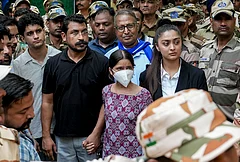
The police said its personnel initially attempted to regulate and contain the gathering. However, it claimed the situation escalated after protesters breached successive barricades and attempted to proceed towards Parliament.
The affidavit argues that the gathering consequently assumed the character of an unlawful assembly and that the attempt to move towards Parliament was itself unlawful.
The police has also challenged the petitioners’ reliance on photographs, videos and media and social-media reports to allege excessive force. It said such material was “selective” and “incomplete” and had not been independently verified, arguing that it presented only one side of the confrontation without showing the measures taken by police to control the crowd.
Police Denies Using Nail-Studded Lathis
Responding to allegations that police personnel used lathis fitted with nails, the Delhi Police said examination of available video footage showed one instance involving such an object. However, it claimed the object was in the hands of a protester rather than a police officer.
The police also disputed the description of the object as a nail-studded police lathi, saying it was a stick carrying the National Flag.
According to the affidavit, lathis are part of permissible crowd-control equipment and were used to contain groups of protesters only after, the police alleges, they began attacking personnel.
The police further claimed that videos showed groups of protesters targeting individual officers, pulling off their protective equipment, dragging them and pushing them onto stone pavements.
The affidavit also said that 2,873 people present at the protest site had criminal cases registered against them. It claimed the cases included allegations of murder, attempt to murder, dacoity, rape and offences under the POCSO Act.
According to the police, the antecedents of these individuals will be examined by the Special Investigation Team constituted by the Delhi Police Commissioner.
At the same time, the Delhi Police has told the Supreme Court that the question of whether the force used during the protest was excessive could appropriately be examined by a committee proposed to be constituted by the Court. The police said it would cooperate with such an exercise.

Why Were Plainclothes Police Carrying Lathis Present?
The affidavit also addresses the presence of plainclothes personnel carrying lathis during the protest.
The Delhi Police said these personnel were “spotters” drawn from the Special Branch, Special Cell, Crime Branch and local police. According to the police, they had strategically merged with the crowd because of the urgency of the situation.
The police maintained that deploying plainclothes personnel in such circumstances was neither illegal nor unusual. It said similar arrangements are used during major public gatherings, including Independence Day and Republic Day events.
According to the affidavit, the plainclothes personnel were part of the overall crowd-control operation and were not deployed as an independent force against protesters.
Delhi Police Defends Facial Recognition At Protest Site
The Delhi Police has also defended its use of facial-recognition technology during the protest, describing it as a “proportionate policing measure” rather than indiscriminate surveillance.
According to the affidavit, the software was not used to automatically create profiles of everyone present at the protest or to indiscriminately collect personal information of peaceful protesters.
The police said the technology was used to identify people with previous criminal records involving serious offences, while petty violations such as traffic challans were excluded.
The affidavit further states that no action was taken solely on the basis of a facial-recognition match. Instead, field-level verification was conducted to determine whether the person identified by the software was actually present at the protest site.
Police Cites Rules Governing Protests Near Parliament
The Delhi Police has also relied on the regulatory framework governing demonstrations at Jantar Mantar and areas around Central Vista to justify its response.
According to the affidavit, the Delhi Police Standing Order requires prior permission for demonstrations at Jantar Mantar, limits the number of participants to 1,000 and prohibits marches from the designated protest site, except for a limited symbolic march that has received prior permission.
The police therefore argued that the protesters’ attempt to move towards Parliament could not be treated as a continuation of a permitted demonstration. Instead, it characterised the move as a departure from the conditions governing the protest.
The affidavit ultimately leaves the question of whether the force used by the police crossed permissible limits to the fact-finding mechanism proposed by the Supreme Court. However, the Delhi Police maintains that its response was necessary, proportionate and adopted only after the situation escalated.
The Chief Justice of India-led bench is expected to consider the police's response, including the allegations concerning the use of force, deployment of plainclothes personnel and facial-recognition technology.