



The chimneys of Kelam are still burning.
Three days after militants shot dead two migrant labourers at a brick kiln here—the first such killing in Kashmir in nearly 22 months—the kilns have not gone cold. Stacks of fresh brick rise beside them, and workers still move between the fire and the makeshift shelters where they live, along the same paths they walked before.
On July 31, Deepak Kumar, 24, and Bhupinder Singh, 28, both from Chhattisgarh, were shot dead at a kiln in Kelam village, Kulgam district. It was the first attack on migrant workers in the Valley in nearly two years. After the Pahalgam terror attack in April 2025, militant activity had largely subsided—until a police constable was shot dead in Anantnag on July 23. Eight days later, militants struck again in Kulgam, killing Deepak and Bhupinder.
The latest killings have unsettled the workers, but the kilns have not fallen silent. Many workers live within the kiln compounds; some even bringing their families along. Sridharan, 40, who arrived from Uttar Pradesh (UP) this year, spent two days deciding whether to leave. “Then we realised there was no option. We live hand to mouth. If we stop working, our families stop eating.” He says that the owners of the kilns are ensuring their safety. Since the killing, he has stopped stepping out after work.
A Courtyard that Empties by Six
Eight kilometres north, in Wanpoh, a settlement locals call ‘Chhota Bihar’ for the thousands of migrant labourers who pass through it each year, the evening arrives early at the courtyard of a labourers’ hostel these days. By six, it begins to fill with men returning from work. The early finish has become routine since the Kelam killing, with police and paramilitary forces urging labourers to be indoors before dusk.

The 30-plus rooms at the hostel serve as home to over 300 migrant labourers from March until construction slows with the onset of winter. Eight to 15 men share a room, paying Rs 500-700 each a month. At the outdoor tap, men wash off the day’s dust while others gather around a mud stove where dinner is cooking.
Mahanand, 40, from Bihar, flips chapatis while another worker stirs a pot of vegetables. One by one, their co-workers return, and the streets empty as they disappear into their buildings. “We heard about the killing the next morning,” Mahanand says. “Everyone was scared. But by 8.30 we had picked up our tools and gone to work. If we don’t work, how will our families survive?”
The fear, he says, has changed their habits more than their routines. “Earlier we would go to the market after work. Now, we come straight back. The police tell us not to stay out after 6 pm.”
Investigators believe two militants carried out the Kelam attack—one firing while the other provided cover, before both fled. Several suspects have been detained as police trace the over-ground workers believed to have facilitated the assault.
The killing fits a pattern. The last major strike on migrant workers came in October 2024, when six labourers and a local doctor were killed at a tunnel-construction camp in Gagangir, Ganderbal. Days before that, a Bihari labourer was shot dead in Shopian. These marked a return to targeted violence after months of relative calm.
Coming Back, Again and Again
Mahanand has seen this before. On October 17, 2021, two labourers were shot dead and another critically wounded, just a few metres from this same building. “Many went home after that,” he says, “but returned the next year.”
He returned, too. “It happened as the working season was ending, so some went home early. But most came back the following spring.”
“We live hand to mouth. If we stop working, our families stop eating.”
For 14 years running, Mahanand has travelled to Kashmir every March, heading home to Bihar only when winter slows down construction work. Today he leads a crew of nearly 70 masons and labourers. “People think we come because the wages are higher,” he says. “That’s not the reason. I can earn similar money elsewhere. What keeps us here is regular work.” He earns between Rs 1,000 and Rs 1,500 a day; the workers under him make Rs 500-900, depending on the job. His brother-in-law, Aakash Kumar, 27, arrived from Jharkhand last year, after months of irregular work at home. “Akash brought me here,” he says. “Back home, there was no certainty of work. Here, whatever I save goes to my parents, my wife and our two children.”
For Mahanand, there is no dilemma in sight. “When your family is waiting for your earnings,” he says, “fear comes later.” Muhammad Javaid, 55, also from Bihar, has returned every year since 1993 to work as a tile-and-marble mason. “I come because the work is regular,” he says. “The weather is better, and I earn between Rs 1,000 and Rs 1,500 a day.” He goes home only for the three winter months. “My family stays there. I earn here for them. The recent attack created fear, but not enough to make me leave.”
Another migrant, Muhammad Munawar, 50, has run a tea stall in Wanpoh since 1996, serving tea and snacks to labourers and locals. “I rented this shop nearly 30 years ago,” he says. “It has fed my family ever since.” The attacks have changed the rhythm of his day.
“Whenever migrant workers are attacked, the police ask us to shut early. Before 2019, my shop stayed open till midnight. Now I close before dusk. Business has suffered.” As daylight fades, Munawar packs up the last of the snacks and lowers the shutters before the evening patrol arrives.
An Economy Built on Migrants
Mahanand’s story is one among hundreds of thousands that unfold across Kashmir every working season. For more than three decades, migrant workers from Bihar, UP, West Bengal, Jharkhand, Punjab, Rajasthan, Madhya Pradesh and Chhattisgarh have become integral to the Valley’s economy.
There are no official estimates of their numbers. Trade bodies and economists place the seasonal migrant workforce in Kashmir at more than four lakh, with over 12 lakh working across Jammu and Kashmir, and Ladakh combined.
“Almost every sector depends on workers from outside,” says Qazi Tauseef, spokesperson for the Kashmir Traders and Manufacturers Federation (KTMF). “Around 80 per cent of the skilled construction workforce comes from outside Jammu and Kashmir.”
That dependence reaches far beyond construction sites now—into orchards, markets, workshops, roadside eateries. Migrant labour fills shortages that local industries have long struggled to bridge: building homes, laying marble and tile, painting walls, working as masons and carpenters, labouring at brick kilns and cold-storage units, harvesting apples and paddy. Others run tea stalls, barber shops and roadside kiosks selling bhelpuri, golgappas and fresh fruit juice.

Soft Targets
That same visibility has made migrant workers vulnerable. Since the Centre revoked Jammu and Kashmir’s special status and split the erstwhile state into the Union Territories of Jammu and Kashmir, and Ladakh on August 5, 2019, more than 30 migrant workers have been killed in militant attacks, with several others injured.
Security agencies say overall terror-related fatalities have fallen sharply since 2019, alongside a decline in local recruitment and the dismantling of much of the militant support network. “Barring the April 22, 2025 Pahalgam attack, which left 25 tourists and a local pony operator dead while trying to save visitors, terrorists have largely avoided mass-casualty strikes,” says a police officer , “relying instead on targeted killings of migrant workers, minorities, off-duty police and other ‘soft targets’.”
Migrant labourers remain exposed because of how and where they live—rented accommodation, predictable routes, scattered work sites with little protection. Investigators say The Resistance Front (TRF), identified by security agencies as a shadow outfit of the Pakistan-based Lashkar-e-Taiba (LeT), has explicitly linked the presence of non-local workers to the post-2019 domicile and land laws. The outfit has described the settlement of outsiders as “settler colonialism” and cast the attacks as resistance.
“Almost all attacks on migrant workers and minorities have been carried out by TRF,” a senior police officer involved in counter-insurgency operations says. “Those behind earlier killings have been eliminated, the support network dismantled, and recruitment of local terrorists has declined sharply. We believe the ecosystem involving the over-ground worker network has largely weakened.” Even so, officials say, the recent attacks have renewed concern—the aim, they believe, is to spread fear and disrupt sectors that depend on migrant labour, from construction to brick kilns to infrastructure projects. In the wake of the killings, forces demolished the houses of two active militants in south Kashmir after the constable’s killing, even as police said CCTV footage had identified the attacker as a Pakistani terrorist. More than 3,000 suspected over-ground workers were detained across Kashmir.
The response drew criticism from CM Omar Abdullah, the National Conference (NC), the Peoples Democratic Party, the Peoples Conference, Communist Party of India (Marxist) leader M.Y. Tarigami, NC leader Aga Syed Ruhullah Mehdi and the Valley’s chief cleric, Mirwaiz Umar Farooq. All condemned the killings strongly, but also opposed the demolitions and mass detentions, calling them collective punishment that violated Supreme Court guidelines and due process. A similar debate had followed the Pahalgam attack in April 2025, after which security forces demolished more than 10 houses, mostly in south Kashmir, belonging to active militants. The National Investigation Agency later concluded that the Pahalgam attack was carried out by three Pakistani nationals affiliated with the LeT, who were killed in a security operation on the outskirts of Srinagar barely three months later.
Unlikely to Disrupt Migration
Despite it all, experts believe the violence will do little to alter the annual rhythm of migration. Nisar Ali, former head of the department of economics at the University of Kashmir, says that Kashmir has a persistent shortage of skilled, semi-skilled and unskilled workers, while states such as Bihar, UP and Jharkhand have a surplus workforce. “Earlier, migrant workers were concentrated in towns,” he adds. “Today they are part of the workforce here even in remote villages.” He says their number has grown from around 70,000 in the late 1960s to nearly 12 lakh across the erstwhile state, including Ladakh: “Nearly five lakh work in Kashmir alone.” He notes that the flow of labour continued even through the peak years of insurgency in the 1990s.
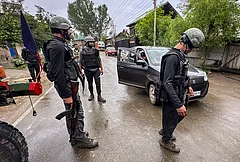
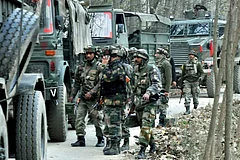
Meanwhile, security has been tightened across the brick-kiln belt of Kulgam and Anantnag. Police and paramilitary personnel now patrol all day, check vehicles entering the kiln clusters and keep watch around workers’ accommodation. “Our immediate priority is to ensure migrant workers feel secure enough to continue their work,” a police officer associated with the security arrangements says.
The workers measure security differently. At dawn, they walk to the kilns to start work. By evening, they return coated in brick dust, cook together, and call families hundreds of kilometres away before sending home another month’s earnings.
Khalid Gul is a journalist based in Kashmir

MORE FROM THIS ISSUE


(This story appeared in Outlook magazine’s August 31 issue, 'Whose Idea of India?', in which India’s noted public intellectuals, policymakers, cultural practitioners, political leaders, scholars and economists write in detail about the idea of India they believe can best secure the nation’s future as we celebrate 80 years of independence.)















