



Mahatma Gandhi’s idea of India was that the country should be one family in which everyone belonged, without exception. Recall Gandhi’s words on November 12, 1947, when he was in New Delhi on Diwali day, amid the communal violence that followed Partition. Millions of families were living in fear. In his All India Radio broadcast, Gandhi asked Indians: “Can every one of you place your hand on your heart and say that every Sikh is your own brother, every Hindu your brother, every Muslim your brother and every Christian your brother or sister?”
For Gandhi, this was the real test of India’s nationhood. Political freedom alone was not enough. India could succeed only if its people genuinely regarded one another as members of a common family. The true idea of India was not merely political independence, but whether Indians could see one another as one family, sharing both the burden and joy, without exception.
For him, patriotism was never narrow or exclusive. His love for India was immense, but it was matched by an equally deep concern for humanity. For Gandhi, ethics and politics could never be separated. Politics had to be guided by moral principles and public life had to be rooted in justice, compassion and service. He expected elected representatives to not merely hold office, but to provide practical and ethical leadership. Leadership, for him, was not simply about being elected, it was about providing moral direction and genuine service to the people.
Much of what troubles this vision today is a kind of silence, a reluctance to speak out against oppression, especially when it carries the weight of popular sentiment. Consider, for instance, the case of a young Muslim boy slapped by his teacher, who then instructed his classmates to do the same—a video of which was seen by millions. When cruelty of this kind occurs, authorities and institutions must speak up. When such acts happen in silence and when the government itself stays quiet, it is precisely the kind of failure that would have deeply troubled Gandhi.
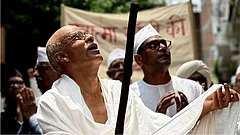
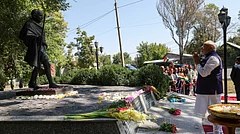


Gandhi wanted people to move beyond religious boundaries in everyday life. For example, we feel comfortable sending our sons and daughters to the Gulf or Christian-majority countries in the West for jobs and studies, yet within India, many are conditioned to view Muslims and Christians as threats or victimisers. Some fall for the absurd propaganda that these communities intend to convert or ‘take away’ their children. Much of today’s distrust is sustained by exactly this kind of propaganda, which encourages communities to see one another as separate and suspicious. Gandhi’s vision directly challenges this mindset. India can remain united only when people stop thinking in terms of isolated religious identities and instead recognise one another as fellow citizens sharing a common future.
Gandhi would have welcomed the strengthening of democratic institutions, wider access to health care and education and the fact that ordinary citizens continue to participate actively in public life. It would have pleased him to see that people are no longer dying of hunger on the scale they once did.
At the same time, he would have been deeply troubled by the concentration of vast favours in the hands of a select few, rising social divisions, the spread of hatred and propaganda and the erosion of trust between communities. Gandhi would have wanted India to remain a democracy in which minorities felt secure and every citizen was treated with equal dignity.
Gandhi would have celebrated any achievement that genuinely improved the lives of ordinary people, rather than one that merely showcased national progress. He would have appreciated advances that expanded health care, education, democratic participation and the well-being of villages. For Gandhi, development was meaningful only if it reduced suffering, strengthened communities and reached out to those who were the most vulnerable. We have forgotten our duty to our neighbour. This becomes visible, for instance, when a neighbour is in trouble, such as when people are struck off electoral rolls and no one intervenes on their behalf. It’s worth remembering that on January 27, 1948, just 10 days before he was killed, Gandhi wrote a note suggesting that those in the Congress who wished to continue in public service should form a ‘Lok Sevak Sangh’, a servants-of-the-people organisation. This reflects one of Gandhi’s most fundamental teachings: that citizenship carries responsibilities, not merely rights.
Truth remains the foundation of satyagraha. In an age of misinformation, resisting falsehood peacefully is itself a form of satyagraha. In an age of misinformation, propaganda and political polarisation, satyagraha means an uncompromising commitment to truth. It means refusing to spread falsehood, resisting hatred without hatred and relying on moral persuasion rather than coercion. Truth remains the most powerful force available to citizens and democracy ultimately depends on people having the courage to stand by it.
Gandhi wanted everyone to be a producer, not merely a consumer. He would not have opposed technology or industry simply for being modern. His concern would have been whether economic growth strengthened human dignity or merely expanded consumption. He would have asked whether development made people producers rather than passive consumers, whether it empowered villages and whether it reduced inequality instead of concentrating wealth. He would not have approved of a model in which only a handful of rich businessmen prosper while the rest remain on the sidelines.
Indians must move beyond the categories of caste, religion and community and recognise one another, first and foremost, as fellow human beings. Democracy cannot survive on elections alone. It depends on citizens building trust, empathy and shared responsibility. Gandhi’s idea of India was, ultimately, about learning to live together with respect, compassion and equal dignity.
(As told to Fozia Yasin)
(Views expressed are personal)
Rajmohan Gandhi Biographer, Historian And Peace Activist

MORE FROM THIS ISSUE


(This story appeared in Outlook magazine’s August 31 issue, 'Whose Idea of India?', in which India’s noted public intellectuals, policymakers, cultural practitioners, political leaders, scholars and economists write in detail about the idea of India they believe can best secure the nation’s future as we celebrate 80 years of independence.)















