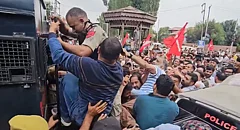
For hours, the chase zigzagged across north Kashmir. A suspected drug peddler switched from a cab to a train, then back to another vehicle, changing routes often to try and evade police surveillance. But his every move was being watched. When he finally stepped onto a quiet stretch of road in Baramulla district, officers waiting at a naka (checkpoint) moved in. He sprinted towards a stream and dived in and the officers plunged in after him. They recovered 168 grams of cannabis resin and arrest him. The amount of cannabis was relatively small, but this was part of a bigger effort to curb drug peddling. Some drugs are grown in Kashmir and some are peddled through big smuggling chains across the borders, as per the Jammu and Kashmir (J&K) police.
“From such cases, we manage to establish both forward and backward linkages, and identify the smugglers and kingpins,” says Arif Hameed, a police officer involved in the effort to stop drug peddling in north Kashmir, a region close to the Line of Control (LoC). During the process, the finances of peddlers are investigated along with their networks and other links in order to reach the smugglers and in some cases, the kingpins.
Almost every day, police teams in J&K act on intelligence, set up checkpoints, track suspected peddlers and conduct searches as part of an expanding campaign against narcotics. At the same time, hospitals have expanded de-addiction services, non-profits are working with recovering users, counsellors are available at schools and colleges and awareness campaigns have intensified. Yet, the crisis continues to deepen, with drug use among young people showing little signs of slowing.


Official estimates say that more than 13.5 lakh people in J&K are living with substance-use disorders, more than double the roughly six lakh estimated in 2022. Earlier this year, the government told the J&K Legislative Assembly that a 2022 survey across the Kashmir Valley had identified around 70,000 people affected by substance use, including nearly 50,000 heroin users. Experts, however, caution that such surveys largely capture those who seek treatment and are likely to understate the true scale of addiction. Heroin now accounts for an estimated 90–95 per cent of dependency cases in the Valley, while more than half of users in some studies report injecting the drug, exposing them to HIV, Hepatitis C and other blood-borne infections through shared needles. Alongside heroin, cannabis, prescription sedatives and newer synthetic drugs continue to fuel the crisis. Cannabis remains the region’s most readily available narcotic, growing wild along roadsides and on unattended government and forest land.
Across the Valley, nearly every district hospital now houses an addiction treatment facility.
“A 25-gram packet of cannabis, worth around Rs 3,000 initially, can fetch nearly Rs 5,000 on the street once it’s broken into smaller quantities and sold to individual users,” says Hameed, adding that many street-level peddlers are addicts themselves. They purchase small quantities not only to feed their own habit but also to finance it, selling the drug in tiny packets or even cannabis-filled cigarettes to an ever-expanding pool of young users, each transaction drawing more people into the cycle of addiction.
Modus Operandi
Kashmir’s drug economy is sustained by the oldest rule of any illicit market: supply and demand. Thousands of people already dependent on narcotics continue to sustain the market, even as government agencies, hospitals and civil society groups expand awareness campaigns and de-addiction programmes across the Valley. According to a senior police officer based in Srinagar, the contours of Kashmir’s drug trade have shifted significantly over the past two decades. Between 1999 and 2005, he says, the supply chain was largely driven by two factors: heroin flowing in through the “Golden Triangle” of Pakistan-occupied Kashmir, Pakistan and Afghanistan, and Kashmir’s own favourable climate for cultivating opium. Once the narcotics entered Kashmir, they travelled along a well-established network. Heroin was allegedly smuggled across the LoC by “militants and peddlers”, while some consignments crossed through streams and other vulnerable stretches along the border. North Kashmir districts, particularly Kupwara and Baramulla, were key entry points before the drugs were moved to Srinagar and then to markets across India, including Jammu, Delhi, Chandigarh, Kolkata and Chennai. As the distance from the source increased, so did the price. “For instance, one kilo of drugs would cost Rs 50 lakh while getting delivered from Pakistan to Srinagar,” he says. “It would cost a crore in Chandigarh and Rs 3 crore in Mumbai.”
The trade, the officer says, “operated in the form of a nexus through which Pakistan converts drugs into money.” According to him, nearly 20 per cent of the proceeds eventually found their way back into Kashmir or were routed through the Gulf countries before being channelled into India via the hawala system, an informal mechanism for transferring money without physical cash crossing borders or leaving a conventional banking trail.
Since 2021, the officer says that heightened border security has significantly disrupted traditional smuggling routes from Pakistan into J&K. “But now they are using drones and tunnels to keep the trade alive, particularly along the Kathua, Samba and Punjab sectors,” he adds.
The Cost of Addiction
Once drugs enter the Valley, Srinagar remains the principal consumption hub, while districts such as Baramulla, Kupwara, Anantnag and Pulwama continue to emerge both as trafficking corridors and major markets. As police intensify their crackdown, the capital has become the epicentre of the anti-narcotics campaign.
Data accessed by Outlook shows that between January 1 and July 9, 2026, Srinagar registered 146 NDPS cases and arrested 213 people, with 89 cases already chargesheeted. During the same period, police seized over 281 kg of narcotics, including heroin, cannabis and brown sugar, along with over 16,200 psychotropic tablets and capsules. Authorities also invoked the stringent Prevention of Illicit Traffic in Narcotic Drugs and Psychotropic Substances Act in 14 cases, allowing the preventive detention of suspected drug traffickers for up to a year.
Across the Valley, nearly every district hospital now houses an addiction treatment facility. Even so, wards built for 10 to 15 patients struggle to keep pace with demand. To bridge the gap, non-profits, alongside the J&K Police, have set up rehabilitation centres that now shoulder a growing share of the treatment burden. Patients point to emotional distress, fractured family ties, financial hardship and above all, the easy availability of drugs through friends as the reasons they first began using. “One addict tells another where drugs are available,” says Amir Ahmed, a medical officer. “The information spreads almost like a viral infection.” By the time many seek treatment, addiction has already left visible marks on their bodies. “It’s easy to become a user, but it’s not easy to come out of it,” says Shahid*, who has been sober for three months. “Seeing your close friends die is what finally pushes you to stop.”
(*Names have been changed on request)

MORE FROM THIS ISSUE


Zenaira Bakhsh is an Assistant Editor at Outlook