The Allahabad High Court rejected a schoolgirl’s plea to wear a hijab with her uniform
The court said she had not established that wearing the hijab was an essential religious practice
The ruling upholds the school’s uniform policy while the broader hijab question remains pending before the Supreme Court
The Allahabad High Court has dismissed a petition by Sukaina Rizvi, a Muslim student seeking permission to wear a hijab with her school uniform, holding that she had failed to establish that wearing the headscarf was an essential religious practice protected under Article 25. A Division Bench of Justices J.J. Munir and Indrajeet Shukla also upheld the school's authority to enforce its prescribed uniform. The judgment came last week. The ruling comes amid a still-unresolved Supreme Court debate over religious attire in educational institutions. Congress leader Salman Khurshid said on Wednesday that he did not expect the Allahabad judgment to have significant consequences, arguing that the Supreme Court had already provided indications on the issue.
The Student's Plea
Sukaina Rizvi, a minor, sought admission to Class XI at Tagore Public School in Prayagraj. Through her mother, she requested the court to direct the school to permit her to wear a headscarf with her uniform. Rizvi had attended the school from Class VI to X without prior objection to her scarf. She produced ID cards and photographs as evidence of her longstanding practice. However, the school denied her admission to Class XI, insisting she adhere to the prescribed uniform without additions. The school is a private, unaided institution affiliated with the Central Board of Secondary Education (CBSE).

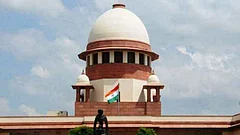


The school's principal, in a statement recorded by the Assistant District Inspector of Schools, said the school is a co-educational institution where students from all communities study. The prescribed uniform is adhered to by all students, including girls from the same religious community as the petitioner. The principal argued that granting an exemption to one student would affect the administration of the school.

The Essential Religious Practice Test
At the heart of the case lies the constitutional question of whether wearing a hijab qualifies as an "essential religious practice" under Article 25. The Supreme Court has consistently held that only practices that are "essential" to a religion — those that go to the very core of the faith — are constitutionally protected. The test requires courts to examine whether the practice is obligatory for adherents and whether its non-observance would fundamentally alter the character of the faith. This test was established in a catena of Supreme Court judgments, including Shirur Mutt (1954) and A.S. Narayana Deekshitulu v. State of A.P. (1996).
The Allahabad High Court found that Rizvi had failed to meet this threshold. Her assertion that wearing a headscarf was an essential religious practice was, in the court's words, "a bare assertion." She had not placed on record any authoritative religious texts, expert affidavits from Islamic scholars, or historic evidence to demonstrate that the practice is obligatory upon her. The court also noted the absence of any explanation as to why she had given an undertaking at the time of admission to abide by school discipline, if her religious practice was inviolable.
The School's Authority And Uniformity
The court affirmed the school's authority to enforce a uniform dress code as part of institutional discipline. It ruled that a prescribed uniform fosters equality, institutional identity, and a religion-neutral atmosphere. The court reasoned that allowing individual additions to the uniform would create "social separateness" and undermine its purpose. The court observed that if individual students were permitted to add or depart from the prescribed uniform, "the rule requiring a uniform would virtually cease to exist."
The court cited the Kerala High Court's judgment in Fathima Thasneem v. State of Kerala (2018), which held that individual rights must yield to an institution's larger right to manage its affairs. The Kerala High Court had observed: "The dominant interest, in this case, is the management of the institution. If the management is not given a free hand to administer and manage the institution, that would denude their fundamental right."
The court also held that the school's previous inaction regarding Rizvi's headscarf did not create a vested or enforceable right. The court noted that the school could enforce its uniform policy at any time, and previous non-enforcement did not give rise to an estoppel.

Context of Precedents
The judgment relies heavily on the Full Bench decision of the Karnataka High Court in Resham v. State of Karnataka (2022), which similarly held that wearing a hijab was not an essential religious practice in the circumstances of that case. The Karnataka Full Bench had observed that "the material before us is extremely meager" and that "there is absolutely no material placed on record to prima facie show that wearing of hijab is a part of an essential religious practice in Islam."
The Allahabad High Court also references the Bombay High Court rulings in Fathema Hussain Sayed v. Bharat Education Society (2002) and Zainab Abdul Qayyum Choudhary v. Chembur Trombay Education Society (2024). In Fathema Hussain Sayed, the Bombay High Court held that directing a student not to wear a headscarf does not violate Article 25. The court observed: "It is not an obligatory overt act enjoined by Muslim religion that a girl studying in all girl section must wear head-covering."
In Zainab Abdul Qayyum Choudhary, the Bombay High Court upheld the institution's power to prescribe a dress code in the interest of discipline. The Supreme Court passed an interim order in August 2024 staying the clause that prohibited hijabs, but the final verdict remains pending.
The Allahabad court also noted the split verdict in Aishat Shifa v. State of Karnataka (2023), where Justices Hemant Gupta and Sudhanshu Dhulia delivered differing opinions. The matter has been referred to a larger bench, leaving no authoritative Supreme Court ruling.

What This Means
For now, the Allahabad High Court has reaffirmed that school uniform policies can, in the absence of proof of an essential religious practice, lawfully restrict individual expressions of religious identity. This means students seeking to wear religious attire to school must be prepared to establish, through pleadings and evidence, that the practice is essential to their faith. The court's emphasis on the need for factual foundation and evidence suggests that bare assertions will not suffice.
The issue remains pending before a larger bench of the Supreme Court, leaving the broader constitutional question unresolved. Until a definitive ruling is delivered, the legal position remains contested, with students and schools awaiting clarity on the boundaries of religious freedom in academic settings. The Supreme Court's verdict will ultimately settle the law across India.