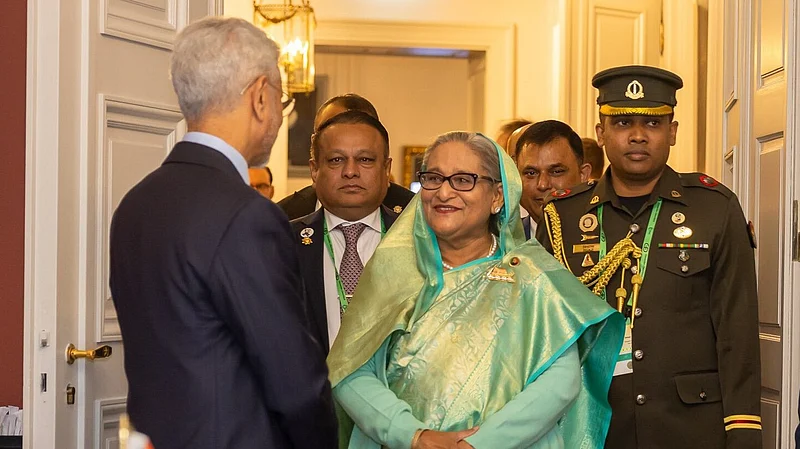
India says Sheikh Hasina's proposed voluntary return to Bangladesh and Dhaka's formal extradition request are separate matters.
Hasina wants to return on December 16, but Bangladesh insists she must be brought back through extradition after being sentenced to death in absentia.
Reports that Awami League leaders have explored possible border routes have added to questions over how, and under what legal arrangements, Hasina could return.
For more than two years, Sheikh Hasina's future has remained suspended between two countries: the one she left and the one where she has been living since.
Now, as the Former Bangladesh Prime Minister signals that she wants to return to Dhaka on December 16, India has drawn a distinction that could shape the next stage of the diplomatic standoff. New Delhi says her voluntary return with valid travel documents and Bangladesh's formal request for her extradition are two separate matters. It has maintained that the extradition request is being examined through established procedures, while declining to say whether it will facilitate her proposed journey home.

The distinction was articulated by Ministry of External Affairs spokesperson Randhir Jaiswal at a briefing in New Delhi on Wednesday.
“The extradition request is being examined in line with our established process,” he said, adding that “the case of a citizen willing to return voluntarily to her country on a travel document is a matter separate from the extradition request”. Asked whether India was playing a facilitating role, Jaiswal said the matter was between Hasina and the Bangladesh government, adding that he had nothing more to say.



A Proposed Return Meets Dhaka's Demand For Extradition
Hasina, who fled Bangladesh on August 5, 2024, after a student-led uprising brought an end to her 15-year rule, has been living in India since. According to her spokesperson, Syed Mozammel Ali, she wants to return on December 16, which Bangladesh observes as Victory Day, marking its 1971 liberation from Pakistan. She has reportedly asked Dhaka to arrange an aircraft operated by Biman Bangladesh Airlines to bring her from Delhi. The proposed date gives the journey a symbolic significance, but the route back remains politically and legally contested.
Dhaka has rejected the idea that Hasina can simply return as an ordinary traveller. She was sentenced to death in absentia by Bangladesh's International Crimes Tribunal in November 2025 in a case concerning crimes against humanity during the crackdown on the July 2024 uprising. Hasina has rejected the charges.
The Bangladesh government has repeatedly sought her extradition from India under the bilateral treaty and maintains that she must be brought back through that process. State Minister for Foreign Affairs Humaiun Kobir said she could return only in custody or under strict surveillance.
The passport question has added another complication. Hasina's lawyers had approached the Bangladesh High Commission in New Delhi seeking a fresh passport and national identity card to facilitate her return. Reuters reported that Dhaka had rejected her passport request, sharpening the uncertainty around how she might travel. India's statement does not resolve this problem: it separates the possibility of voluntary travel on a valid document from the extradition request, without confirming that the necessary travel document or flight arrangements will be available.

Border Visits Add Another Layer To The Standoff
The question of how Hasina might return has also moved beyond diplomatic statements. Four senior Awami League leaders currently staying in India reportedly visited the Petrapole border crossing in West Bengal on November 22 to explore possible routes for her journey.
The Agartala-Akhaura crossing has also emerged as another possible route. Asked whether India was facilitating these efforts, Jaiswal did not directly answer, reiterating that the matter concerned Hasina and the Bangladesh government. The Daily Star also reported that Awami League leaders had discussed visiting other land border crossings to assess the possibilities.
For New Delhi, the distinction allows it to reiterate that the formal extradition request remains under examination without publicly committing itself to Hasina's proposed return. For Dhaka, however, the issue is not merely one of travel arrangements: the government wants her brought back to face the consequences of the tribunal's verdict.
With December 16 approaching, the two positions leave a central question unanswered — whether Hasina can return on her own terms, or whether her journey will be determined by the extradition process that Bangladesh continues to demand.