Taiwan's November 28 local elections will test the DPP and KMT's political strength ahead of the 2028 presidential election.
Allegations of Chinese interference, disinformation campaigns and pressure on Taiwan have added a geopolitical dimension to the local polls.
The Taipei mayoral contest and nuclear power referendum are among the key issues shaping Taiwan's 2026 elections.
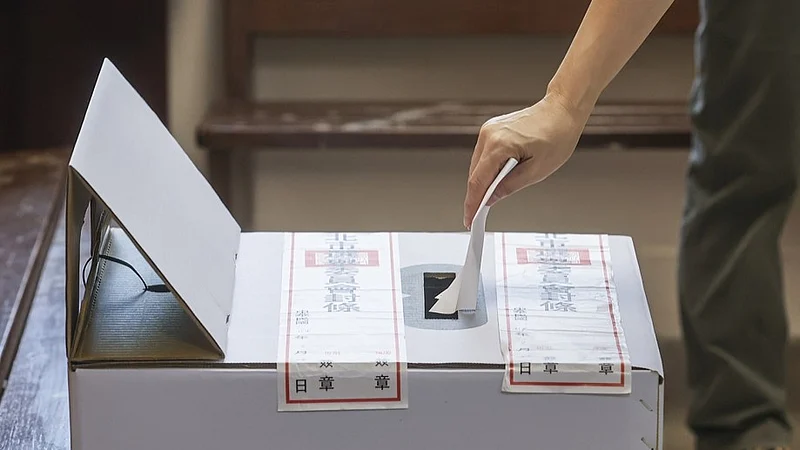
Nearly 19.6 million people in Taiwan are eligible to vote in mayoral and county magistrate elections on November 28, while more than 20 million can participate in a separate national referendum on nuclear power. The elections will see the ruling Democratic Progressive Party (DPP) and the opposition Kuomintang (KMT) compete for control of local governments across the island, with the results also carrying implications for the parties ahead of the 2028 national elections.
The elections are not a direct vote on Taiwan's China policy. However, they come amid allegations of Chinese disinformation campaigns targeting Taiwanese voters, making the contest significant beyond local governance. A separate referendum on nuclear power will add another dimension to the vote, bringing energy security and the government's nuclear-free policy into the campaign.

What Are Taiwan's Local Elections And Who Is Contesting?
Held every four years, Taiwan's local elections, commonly known as the 'nine-in-one' elections, cover nine categories of local government positions. Voters across all 22 cities and counties will elect mayors, county magistrates, councillors, township officials and other local representatives. According to Taiwan's Central Election Commission, 11,051 positions are up for election.


The main contest is between the DPP, led nationally by President Lai Ching-te, and the KMT, Taiwan's principal opposition party. The Taiwan People's Party (TPP) is also contesting several local seats and has joined the KMT in backing its candidate in the Taipei mayoral race.
The parties have focused largely on domestic issues rather than making relations with China the centre of their campaigns. Transport, environmental concerns and energy policy have featured prominently. One point of disagreement has been the installation of solar panels in water reservoirs, with the KMT questioning whether DPP-backed plans could affect water quality.
The Associated Press (AP), in its report on the elections, quoted political science professor Wei-hao Huang as saying candidates had "talked more about policy" to attract swing voters. Huang also said the Chinese Communist Party had "not much" direct importance in the local election campaign.
The elections will also include a national referendum on nuclear power. Voters will be asked whether they support reviving nuclear energy to boost the economy and abandoning Taiwan's nuclear-free homeland policy. Taiwan's final operating nuclear reactor was shut down in May 2025, completing the island's phaseout of nuclear power generation. The government has since indicated that it is open to restarting nuclear power plants, subject to safety assessments and regulatory approval. However, the referendum does not itself authorise the immediate reopening of any plant.
According to Reuters, the referendum was pushed by the opposition and reflects the continuing debate over Taiwan's energy supply. It also brings questions about energy security into an election otherwise dominated by local governance.
The 2022 local election results provide an indication of the parties' electoral positions. The KMT won 14 of the 22 cities and counties, compared with five for the DPP, two for the TPP and one for an independent candidate.

Why Does China Matter In An Election Focused On Local Issues?
China claims Taiwan as part of its territory and has not ruled out using force to bring the island under its control. Taiwan, however, has its own democratically elected government, military and political institutions and has never been governed by the People's Republic of China.
The DPP generally emphasises Taiwan's separate political identity and opposes Beijing's sovereignty claims over the island. The KMT, meanwhile, traditionally favours closer engagement and dialogue with China, while rejecting the People's Republic of China's claim to govern Taiwan. Their approaches to cross-strait relations differ, although the local election campaign has focused largely on domestic issues.
Beijing has repeatedly criticised the DPP, particularly its position on Taiwan's sovereignty, while maintaining greater political engagement with the KMT.
However, local elections do not determine Taiwan's national China policy. Mayors, county magistrates and councillors are not directly responsible for relations with Beijing, and a victory for either party would not automatically indicate public support for independence or unification.
The political significance lies partly in the momentum the results could give the parties before the 2028 national elections. Reuters reported that the vote would provide an updated picture of party support and could influence the process of selecting presidential candidates. President Lai is expected to seek a second term, while the KMT has yet to confirm its candidate.
Taipei Mayoral Race Puts The Spotlight On China
Among the most closely watched contests is the mayoral election in Taipei, where incumbent KMT mayor Chiang Wan-an is facing DPP candidate Puma Shen, an academic-turned-lawmaker known for his work on Chinese disinformation.
The DPP last held the mayor's office under Chen Shui-bian, from 1994 to 1998. A victory for Shen would mark the party's return to the capital's mayoral office after 28 years.
Shen's candidacy has also attracted attention from Beijing. Chinese authorities have accused him of separatism and described him as a traitor, while Chinese police have issued a wanted notice against him. Reuters reported that Shen has not made China a major focus of his mayoral campaign, concentrating instead on issues such as urban renewal.
In October, China imposed sanctions on Shen's father's business in the country, adding to sanctions already imposed on Shen.


The candidate has faced a separate surveillance controversy. In October, Taipei prosecutors indicted four people over the alleged placement of monitoring devices on a scooter parked outside Shen's home. Prosecutors also issued arrest warrants for two people from Hong Kong whom they said were behind the operation.
Taiwan's Mainland Affairs Council chief Chiu Chui-cheng told Reuters that Chinese interference would "only backfire and deepen resentment" towards Beijing among Taiwanese people.
Chinese Disinformation And What The Results Could Mean
Concerns about foreign interference have become another feature of Taiwan's election campaign. Taipei has repeatedly accused Beijing of using disinformation, cyberattacks and military pressure to influence public opinion on the island. Beijing has rejected allegations that it interferes in Taiwan's elections.
Reuters reported that Taiwanese officials had flagged nearly 2,700 social media accounts to Meta over suspected Chinese influence operations ahead of the elections. Officials identified the accounts on Threads, a Meta-owned platform. A government report reviewed by Reuters gave details on 2,400 flagged Threads accounts: 74% listed China as their location, around 25% gave no location and 1% listed Russia. The accounts were organised into 27 clusters.
Taiwan also told Meta that around 260 accounts had disseminated more than 2,150 AI-generated videos, which received approximately 2.35 million interactions, including comments and shares. The videos largely targeted DPP politicians and policies, including Taipei mayoral candidate Puma Shen. Some accused Shen of bullying when he was a student; he has denied the allegations.
However, Meta said it had removed the flagged accounts, many of which had already been disabled by its systems. The company also said none had posted election-related content and most had no followers.
In a separate case, Taiwanese prosecutors indicted Chou Hsiao-yun, a Taiwan People's Party candidate for Taoyuan City Council, on November 20, alleging that she accepted Chinese funding and campaign support and helped provide photographs of Taiwanese people for fake online accounts, according to Focus Taiwan. Chou has denied wrongdoing, and the allegations have not been tested in court.
The November 28 vote will not settle Taiwan's dispute with Beijing or determine the island's political status. It will, however, show how the DPP and KMT are positioned ahead of the 2028 national elections, while offering Beijing another indication of the political mood across the Taiwan Strait.