



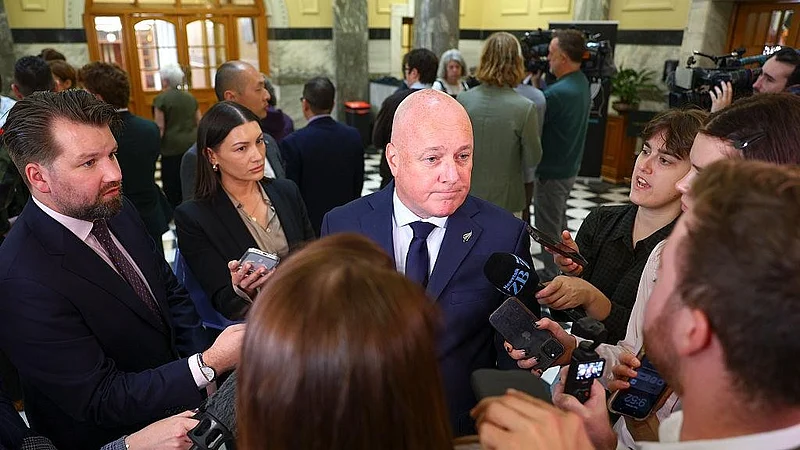
Christopher Luxon's National-led coalition has secured 65 of 130 parliamentary seats
Qiulae Wong's seven-member Opportunity Party could provide the support needed for a majority
Five policy demands and Wong's opposition to Winston Peters as Foreign Minister complicate negotiations
New Zealand Prime Minister Christopher Luxon's centre-right coalition has lost its parliamentary majority after the final count of votes in the November 7 general election left it with 65 seats in the 130-member Parliament, one short of the 66 needed to govern with an outright majority.
The Electoral Commission declared the official results on Friday, with National losing two seats from its election-night tally to finish with 40. Its existing partners, ACT and New Zealand First, retained 13 and 12 seats respectively. The special-vote count, which accounted for 16.5% of votes cast, also gave the Greens an additional seat, taking their tally to 17.
The seven MPs of the Opportunity Party, led by Qiulae Wong, could now provide the support Luxon needs to form a majority government. The party won 6.06% of the vote, securing parliamentary representation for the first time.
Interestingly, Labour received the largest share of the party vote at 29.88%, ahead of National's 28.35%, but finished with 36 seats against National's 40. Under New Zealand's Mixed Member Proportional (MMP) system, parliamentary representation is determined through a combination of party-list and electorate seats. A 10-seat overhang, resulting from electorate victories by National and Te Pāti Māori, has expanded the House beyond its usual 120 members.



Opportunity's Five Conditions
Opportunity has made five policy commitments non-negotiable for any party seeking its support. These include giving the Commerce Commission stronger powers to intervene against anti-competitive businesses, introducing a mandatory lobbyist register and caps on political donations, and establishing a 10-year cross-party healthcare plan.
The party also wants an immediate end to bottom trawling in the most damaged inshore areas, followed by a wider phase-out, and has called for New Zealand to recommit to the Paris Agreement while protecting the role of the Climate Change Commission. It has additionally said that upholding the Treaty of Waitangi framework would guide its approach to government negotiations.
These demands could prove difficult for National's existing coalition partners, particularly ACT and New Zealand First, whose positions on regulation, climate policy and environmental restrictions differ from Opportunity's agenda.
The Winston Peters Question
A further obstacle is Wong's opposition to New Zealand First leader Winston Peters continuing as Foreign Minister. She has said Opportunity would not support a government that retains Peters in the role.
Wong said on Friday that she intended to meet National first, but had not held formal negotiations with any party. She has also declined to rule out another election if the parties fail to reach an agreement. Luxon, meanwhile, has said he wants to negotiate with Opportunity alongside his existing partners and prioritise a stable government over a rushed deal.
The arithmetic also leaves Labour, the Greens and Te Pāti Māori with only 58 seats. Even with Opportunity's seven MPs, the grouping would reach 65, one short of a majority, requiring support from another party to form an alternative government.
Economic pressures will form part of the negotiations. New Zealand recorded quarterly GDP growth of 0.2% in June, annual inflation of 3.7% in September and unemployment of 5.7% in the September quarter.
Until a new administration is appointed, Luxon's government will remain in office under the caretaker convention, with significant policy decisions generally deferred or handled in consultation with other parties. The final count has therefore made Opportunity central to the next government's formation, with its policy demands and the future of Peters' ministerial role likely to shape the negotiations.








