



Dmitry Medvedev says Ukraine and NATO have created conditions that could prompt Russia to launch a preventive nuclear attack.
The Russian Security Council deputy chairman claims Moscow has the right, and in some circumstances an obligation, to use nuclear weapons.
Medvedev argues that Russia’s nuclear doctrine and international law provide grounds for a nuclear response under certain conditions.
Russia has warned that it could resort to a preventive nuclear strike under certain circumstances, with former President and Security Council Deputy Chairman Dmitry Medvedev arguing that Ukraine and its Western allies have already created conditions that could prompt Moscow to consider using nuclear weapons.
In an article published on Monday, Medvedev said Russia had both the right and, in certain situations, the obligation to use nuclear weapons. He identified catastrophic attacks using conventional weapons and the possible transfer of nuclear arms from Western countries to Ukraine as scenarios that could trigger such a response. However, he maintained that the final decision rests with President Vladimir Putin, who weighs the potential damage against the consequences of retaliation.
According to Fox News, Medvedev made the remarks in an article titled State Sovereignty and Nuclear Weapons: International Legal Aspects of Ensuring National Security, published in the Moscow Journal of International Law and excerpted by Russian state news agency TASS.


"The massive use of non-nuclear means that cause catastrophes makes a preventive nuclear attack by the Russian Federation possible," Medvedev wrote.
He also warned that "secret or hidden supplies of nuclear weapons from the West to Kyiv will provoke a legitimate preventive nuclear attack by Russia."
"Kyiv and its allies must remember that the Russian Federation not only has the right, but in various situations has the obligation to use nuclear weapons," he added.


Medvedev Says Ukraine, NATO Have Created Conditions For Nuclear Strike
Medvedev argued that Ukraine and its Western supporters had already brought the conflict to a point where Russia could consider deploying its nuclear arsenal. He said the possibility of such a strike was not merely theoretical, although Putin continued to assess the circumstances before taking any decision.
"Formally, in a number of cases, the parties collectively opposing us (Ukraine, NATO countries, and several Western countries outside the alliance) have already created situations in which Russia considers the possibility of launching a nuclear strike," he wrote.
Despite these claims, Medvedev said Russia had not used nuclear weapons during the war because the situation had not yet reached a point of direct necessity. He also maintained that the country's decision-making process took into account the scale of damage inflicted and the proportionality of any response.
"Obviously, so far the course of events in the Ukrainian crisis has not created a state of direct necessity to use nuclear weapons," he wrote.
"The decision on Russia's use of nuclear weapons during the special military operation was not taken due to the lack of a direct necessity to do so," he added, referring to the war using the Kremlin's preferred description.
Fox News reported that Medvedev acknowledged that Russia's nuclear doctrine did not explicitly provide for preventive nuclear strikes. However, he argued that certain circumstances, including catastrophic conventional attacks and the transfer of nuclear weapons to Ukraine, could provide grounds for pre-emptive action.
Russia's 2024 nuclear doctrine identifies circumstances in which Moscow could consider using nuclear weapons, including conventional aggression posing a critical threat to the country's sovereignty or territorial integrity. However, it does not explicitly establish a general provision for preventive nuclear strikes.


He reiterated that the Russian President alone would decide whether such a response was necessary.
"In making such decisions, the Russian president is always guided by a complete analysis of all factors and the proportionality between the actual damage caused and the retaliatory measures," Medvedev wrote.
"The Kyiv regime and its sponsors must not harbor dangerous illusions," he warned.
"If the scenarios mentioned above were to occur, the head of state not only has the right, but also the obligation to use nuclear weapons. All those who are currently fanning the flames must fully realize this".
Nuclear Warnings Amid US-Russia-China Talks
Medvedev's comments came amid continuing tensions between Russia and Western countries over the nearly five-year war in Ukraine and NATO's military assistance to Kyiv.
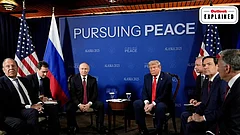
The remarks also followed a November 19 meeting between US President Donald Trump, Russian President Vladimir Putin and Chinese President Xi Jinping in Shenzhen, China. According to Fox News, the leaders of the three nuclear powers agreed to pursue discussions aimed at reducing nuclear risks and preventing the spread of nuclear weapons.
The meeting did not produce a major breakthrough on arms reductions. However, the leaders reaffirmed in a joint declaration that a nuclear war cannot be won and must never be fought.
Medvedev Cites International Court Of Justice Opinion
Citing a 1996 advisory opinion by the International Court of Justice (ICJ), Medvedev argued that international law did not categorically prohibit the use of nuclear weapons in extreme circumstances where a state's survival was at stake.
The ICJ had concluded that the threat or use of nuclear weapons would generally be contrary to international humanitarian law. However, it did not reach a definitive conclusion on whether their use could be lawful in extreme circumstances involving a state's right to self-defence and its survival.


Medvedev served as Russia's President from 2008 to 2012 before becoming Prime Minister under Putin. He has since emerged as one of the Kremlin's most vocal figures on nuclear escalation following Russia's invasion of Ukraine.
Medvedev accused NATO members of undermining international non-proliferation efforts, criticising Germany's participation in NATO's nuclear-sharing arrangements despite not possessing nuclear weapons. He argued that the alliance's nuclear-sharing policies were not based on a universally accepted interpretation of the Nuclear Non-Proliferation Treaty (NPT).
Medvedev also accused the United States of applying double standards over Iran's nuclear programme, alleging that Washington had used non-proliferation concerns to justify military action against Tehran while pursuing its own geopolitical interests.








