



Trump has backed IMEC as the Iran war disrupts shipping through the Strait of Hormuz and Red Sea.
IMEC was launched at the 2023 G20 to connect India, the Gulf and Europe through ports, rail, shipping and digital links.
The corridor is still incomplete, but India, Gulf and European partners have continued work on its infrastructure and connectivity.
US President Donald Trump has renewed attention on the India-Middle East-Europe Economic Corridor (IMEC), saying his administration “strongly supports” the project as the US-Iran conflict disrupts shipping through key West Asian routes and raises concerns over energy supplies.
Trump made the remarks on Tuesday during a meeting with Gulf Cooperation Council and Arab leaders on the sidelines of the United Nations General Assembly in New York. He said attacks on commercial shipping had demonstrated the need to move Middle East energy infrastructure away from what he called Iranian “checkpoints”, and linked that to support for IMEC as well as other ways of transporting oil, including pipelines.
The timing matters. IMEC was announced at the G20 summit in New Delhi in September 2023 as a proposed network connecting India with the Gulf and the Gulf with Europe. It was designed to combine shipping, railways, ports, electricity and digital connectivity, as well as clean-hydrogen infrastructure.
Less than a month later, the October 7 Hamas attack on Israel and the ensuing Gaza war changed the political environment around the proposed route. Since then, attacks affecting Red Sea shipping and the current disruption around the Strait of Hormuz have highlighted the risks faced by trade and energy routes in the region. Reuters reported that only two commodity vessels crossed Hormuz on September 21, compared with a pre-conflict average of about 125 large commercial vessels a day.
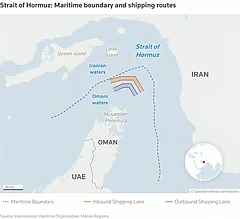


That is why IMEC matters again: a project initially promoted mainly as a trade and connectivity network is now also being discussed in the context of route diversification, energy security and resilience.
How did IMEC come about in 2023?
IMEC did not originate at the G20 summit itself. The proposal developed through discussions involving India, the US, Saudi Arabia and the UAE before it was formally unveiled in New Delhi.
Those discussions followed then-US President Joe Biden's 2022 Middle East visit, with work continuing in the months before the G20. Leaders formally announced the project on September 9, 2023.
The memorandum of understanding was signed by India, the US, Saudi Arabia, the UAE, the European Union, France, Germany and Italy. Jordan and Israel were not signatories to that MoU, but were included in the proposed geographical network.
The project has two broad sections: an Eastern Corridor linking India with the Arabian Gulf and a Northern Corridor linking the Gulf with Europe.
It is important to understand that IMEC is not one continuous railway from India to Europe. The 2023 MoU envisaged a combination of rail and ship-to-rail transport, alongside existing maritime and road networks. It also included plans for electricity and digital cables and pipelines for clean hydrogen.
In simple terms, cargo could travel by sea from India to a Gulf port, move by rail across parts of the Arabian Peninsula and then reach the Mediterranean before continuing towards Europe by sea.
The economic objective was to improve connectivity and potentially reduce the time and cost of moving goods between India and Europe.
There was also a geopolitical dimension. AP reported at the time that the project was seen partly as a potential counterweight to China's Belt and Road Initiative. But that was not its only purpose: trade, logistics, energy and digital connectivity were all part of the formal proposal.
Why did IMEC become geopolitically important?
The geography of the corridor explains much of its significance.
India has major economic relationships with the Gulf and Europe. Saudi Arabia and the UAE are important energy, investment and logistics partners, while Europe is a major market for Indian exports. A functioning corridor could link those relationships through a combination of sea and land transport.
For the Gulf states, IMEC could support their efforts to develop ports and logistics infrastructure and expand their role as trade hubs. For India, it offers a proposed additional route towards Europe while deepening connectivity with the Gulf. For Europe, it could provide another physical connection with India and the Middle East.
The political environment of 2023 was also relevant. Saudi Arabia and Israel did not have diplomatic relations, but the Biden administration was pursuing possible Saudi-Israeli normalisation. The prospect of greater regional cooperation formed part of the political context in which IMEC was announced.
The distinction matters because IMEC did not legally depend on a Saudi-Israeli agreement. But its proposed route does require countries across West Asia to cooperate on infrastructure, logistics and security.
The October 7, 2023 Hamas attack exposed how vulnerable that political environment was.
The Indian Express reported after the outbreak of the Israel-Hamas war that IMEC already faced logistical and geopolitical challenges, while the conflict created additional difficulties for a corridor whose proposed route passes through a highly contested region.
The war also disrupted the broader diplomatic environment surrounding Saudi-Israeli normalisation. IMEC was not cancelled, but its implementation became more difficult.
What has actually happened since 2023?
IMEC has not become a completed, end-to-end India-Europe trade corridor.
That distinction is important. The project exists as a political and infrastructure framework, with some components and agreements moving forward, but there is no continuous IMEC railway carrying cargo from India through the Gulf and West Asia into Europe.
One concrete step came in February 2024, when India and the UAE signed an inter-governmental framework agreement on cooperation for the development and operation of IMEC. India's Cabinet approved the agreement in March that year. The framework covers ports, maritime and logistics cooperation and provides for exploring future investment and collaboration.
There has also been continued diplomatic work on the European side.
In August 2025, India hosted officials and envoys from the US, UAE, Saudi Arabia, France, Italy, Germany, Israel, Jordan and the EU in New Delhi to review progress on the corridor. During Prime Minister Narendra Modi's June 2025 visit to Cyprus, India and Cyprus highlighted IMEC and discussed Cyprus's potential role as a gateway into Europe and a regional transhipment and logistics hub. Their joint declaration described Cyprus as potentially serving as a gateway for Indian connectivity into Europe.
Some digital infrastructure associated with the wider IMEC framework has also moved forward. The European Commission has described the EU-Africa-India Digital Corridor, centred on the Blue Raman submarine cable system, as a concrete delivery under the wider IMEC framework. The project is intended to provide high-capacity digital connectivity linking Europe, Africa, the Middle East and India.
So it would be wrong to say that nothing has happened since the 2023 announcement.
At the same time, the core physical corridor remains incomplete. Additional cross-border rail and logistics connections, financing arrangements, customs coordination and political agreements are still required for the proposed network to operate as an integrated India-Europe route.
The progress so far is therefore best described as partial implementation and continued planning, rather than completion.
Why is Trump supporting it now?
Trump's remarks place greater emphasis on the energy-security dimension of IMEC.
The immediate backdrop is the disruption around the Strait of Hormuz. Reuters reported on September 22 that vessel traffic through the strait had fallen sharply during the conflict, while attacks on ships had further raised concerns about the security of energy supplies.
The Red Sea is another part of the picture. Reuters reported last week that Italy was calling for a stronger naval presence to protect shipping in the Red Sea as fighting involving Iran-backed Houthi forces increased pressure around the Bab el-Mandeb Strait.
Trump's reference to IMEC therefore needs to be understood in the context of multiple vulnerable routes, rather than as a claim that IMEC can immediately replace one particular chokepoint. IMEC was not designed as a substitute for the Strait of Hormuz. It is a multimodal trade and connectivity network, and much of the infrastructure required to make the entire route operational is still under development.
Even if completed, the corridor would not remove the region's geopolitical risks. Its proposed route still depends on infrastructure and cooperation across the Gulf and through Jordan and Israel before reaching the Mediterranean. Its value, therefore, lies less in replacing Hormuz outright than in creating additional transport and connectivity options across the wider region.
But its proposed infrastructure could become part of a broader strategy of creating additional options for moving goods, electricity, clean hydrogen and data.
There is also an important link between the original proposal and Trump's current argument. Energy infrastructure was already part of the 2023 IMEC design through proposed electricity and clean-hydrogen connections. What has changed is the security context in which that infrastructure is now being discussed.
In 2023, the emphasis was on connecting India, the Gulf and Europe and improving trade, logistics, energy and digital links.
In 2026, those same connections are being considered against a backdrop of disrupted shipping, attacks on energy infrastructure and the vulnerability of major regional chokepoints.
For India, IMEC could provide another route towards European markets and strengthen economic links with Gulf states. For Gulf countries, it could support their ambitions as logistics and investment hubs. For Europe, it could deepen connectivity with India and the Middle East. For the US, the project also fits broader efforts to deepen economic links among India, Gulf states and European partners.
But the central obstacle remains the same: the corridor crosses a politically volatile region.
The proposed northern route continues to depend on cooperation across a region marked by ongoing conflict and unresolved political questions involving Israel and neighbouring states.
Trump's endorsement does not mean IMEC has suddenly become operational, nor does it remove the political and infrastructure problems that have slowed the project since 2023.
What it does show is why a corridor conceived as a long-term trade project has acquired a new strategic relevance.
The question in 2023 was largely how to connect India, the Gulf and Europe more efficiently.
In 2026, another question has become equally important: how to maintain those connections when war and geopolitical confrontation put existing trade and energy routes at risk.


.png?auto=format%2Ccompress&fit=max&format=webp&w=376&dpr=2.0)












