India’s strategic interests extend beyond its coastline to key maritime chokepoints from Hormuz to Malacca.
Aircraft carriers give India the ability to project air power and sustain a presence far from home waters.
Each chokepoint carries distinct strategic importance for India’s trade, energy security and maritime interests.
India’s strategic perimeter stretches well beyond its coastline, encompassing vital maritime chokepoints such as the Strait of Hormuz, Bab el-Mandeb and Strait of Malacca, thousands of kilometres from Indian shores and outside New Delhi’s direct control. Securing this extended perimeter requires a unique capability: the aircraft carrier.
Unlike submarines or shore-based missiles, carriers can remain on station off a foreign coast for weeks, project air power without relying on another country’s airbase, and reposition rapidly without triggering the complications of establishing a permanent military presence.
The three strategic chokepoints matter for different reasons.
Importance of three strategic chokepoints
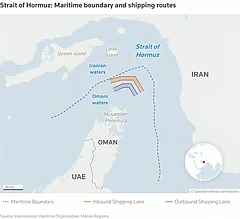
Strait of Hormuz carries the bulk of India’s crude imports. The Strait of Hormuz is a narrow, winding waterway connecting the Persian Gulf with the Gulf of Oman. At its narrowest point, it is only about 33 kilometres (21 miles) wide, making it one of the world’s most strategically important maritime chokepoints.
Although Iran and Oman control parts of the strait, it is widely regarded as an international passage used by vessels from around the world. Beyond the strait lie major global shipping routes, while the United Arab Emirates, including the major commercial hub of Dubai, sits nearby.



The Bab el-Mandeb, whose name translates to “Gate of Tears,” is a narrow maritime passage linking the Red Sea with the Indian Ocean. It is bordered by Yemen to the northeast and Eritrea and Djibouti to the southwest, with Perim Island dividing it into two channels.
The strait is a critical link in the trade route between Europe and Asia. Ships carrying goods between the two regions, along with Middle Eastern oil destined for Europe and North America, rely on the Bab el-Mandeb when transiting the Suez Canal. Its strategic importance has also made it a potential tool for economic warfare. During the Yom Kippur War, for example, Egyptian forces blocked the strait, disrupting Israel’s access to vital trade routes.
The Strait of Malacca is a roughly 900-kilometre (550-mile) waterway between Indonesia, Malaysia, Thailand and Singapore. It provides the shortest sea route connecting East Asia with the Middle East and Europe, making it one of the world’s busiest maritime corridors and a vital artery for global trade and energy shipments. A carrier strike group is the only asset that can sit at any one of these points, deter threats and pivot to evacuation or humanitarian relief within the same deployment.

India’s Dependence on Crude
The exposure is direct. India’s dependence on imported crude has climbed to a record high of over 88 per cent, even as Gulf producers’ share of that basket has slipped somewhat with Russian crude entering the mix. The Gulf still supplies over half of India’s oil, and any disruption in the Strait of Hormuz moves prices at Indian pumps within weeks. Add an Indian diaspora of close to 9 million people across the six Gulf Cooperation Council countries, sending home a large share of India’s remittances, and the Navy’s job stops looking like coastal defence and starts looking like an insurance policy for the economy.
Evacuations have already tested this. When conflict has flared in West Asia – Yemen in 2015, Sudan in 2023, Iran and Israel repeatedly since 2025 – the Navy has worked with the Air Force and the external affairs ministry to move Indian nationals out. These operations go faster when ships are already positioned nearby rather than sent only after a crisis begins.
The undersea dimension gets less attention but matters just as much. India’s international data traffic runs largely through undersea fibre-optic cables that pass through the same chokepoints as its oil imports. Offshore energy assets on India’s own continental shelf need the same steady naval attention.
The Navy has expanded its presence across the Indian Ocean region over the past decade, rotating frigates and destroyers through the Gulf of Aden for anti-piracy patrols and maintaining a standing presence near Malacca. What the service lacks, according to officials, is the fleet size to sustain that presence without gaps, particularly as the Navy’s shipbuilding pipeline competes for the same shipyard capacity needed to build submarines and a prospective third aircraft carrier.
Former Indian Navy officer and defence analyst Commodore Arun P Golaya (Retd) told Outlook, “A third aircraft carrier is not a vanity project but a strategic imperative for India. In an era of intensifying great-power competition in the Indian Ocean Region, a three-carrier force can guarantee continuous presence, credible deterrence and the ability to project power across both our eastern and western seaboards.”
“The character of war has shifted to multi-domain, multi-theatre and sustained conflict. Contrary to what some people believe, an aircraft carrier can become an indispensable tool for continuous sea control and power projection even in the era of unmanned systems and MUMT (Manned Unmanned Teaming). Certainly, the carrier operations will need to evolve. I am sure they will… However, the feeling that low-cost unmanned systems will replace capital warships may be misplaced,” Golaya said.
The financial stakes sharpen the case. A crude price spike triggered by a Gulf shipping disruption feeds straight into India’s current account deficit and its currency, a pattern the Reserve Bank of India has flagged repeatedly. A navy able to maintain presence near that risk isn’t a discretionary extra; it's already priced into the country’s macroeconomic stability, whether policymakers say so or not.
Former Indian Navy spokesperson Captain DK Sharma (Retd) said, “Every power that has claimed a serious voice in Indo-Pacific security, be it Washington, Beijing, even a resurgent London and Paris, it has done so with the vocabulary of carrier presence. A third carrier is not about fighting the next war; it is about giving India’s leadership the standing option to reassure a partner, warn a rival, or answer a crisis without waiting for permission from anyone else's coastline.”
The Navy’s own plan calls for a fleet of 175 to 200 ships by 2035. It currently operates 140 to 150. Meeting that target and building the carriers that let fewer ships cover more ocean will decide whether India’s navy protects the sea lanes its economy depends on – or keeps reacting to disruptions it wasn’t positioned to prevent.

Why US Carriers Mattered in the Iran Conflict
The deployment of US aircraft carriers to the Middle East was considered a decisive step of Washington’s strategy during the conflict with Iran. It provided a mobile airbase capable of launching sustained air operations without relying on regional land bases. Carrier strike groups enabled rapid power projection, protected maritime trade routes, deterred Iranian escalation in the Persian Gulf and offered flexibility to support allies across the region.
However, the conflict also exposed significant vulnerabilities, with Tehran’s arsenal of ballistic missiles, anti-ship cruise missiles, drones and long-range surveillance systems forcing carriers to operate farther from the Iranian coastline.
The Iran and Israel-US conflict showed that the aircraft carriers remain indispensable tools of deterrence and power projection, but at the same time they are also increasingly challenged by precision-strike weapons.