



World leaders are pushing for stronger international oversight of frontier AI models, including common safety standards and verification mechanisms.
Jaishankar said AI governance must remain human-centric and ensure the concerns of the Global South are not sidelined.
A Finland-Norway-led initiative is seeking greater international cooperation, while the UN is considering broader mechanisms for global AI governance.
External Affairs Minister S Jaishankar Tuesday (local time) cautioned that the transformation being brought about by Artificial Intelligence must not create new divides.
India called on the Global South nations to use their existing platforms to “highlight the concerns of the Global South, with a view to ensure that our concerns do not get deprioritised.”
What Are World Leaders Seeking On Frontier AI?
Underscoring the necessity for closer economic cooperation among Global South, he said this is necessary to buffer the developing nations against the fallout of overlapping global crises. On AI, he said, “we should share indigenous-developed tools and frameworks for the benefit of Global South members and ensure that AI remains human-centric.”
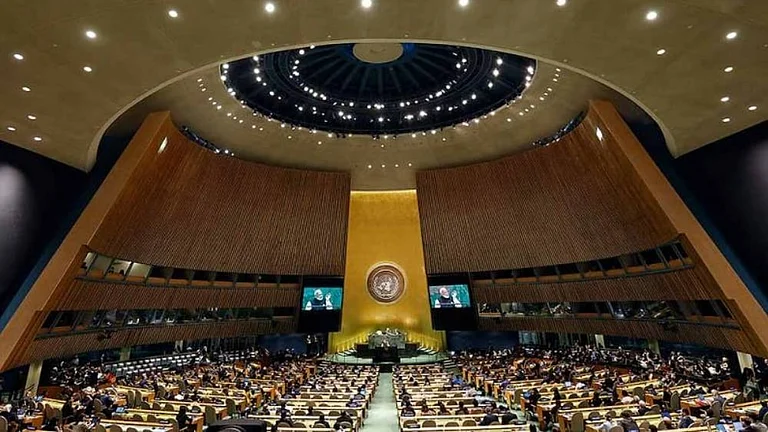
“At a time when we needed to turn to multilateralism, we actually witnessed its dismantling. International organizations that we hoped would deliver solutions have instead become a problem for us to solve. For the Global South, there has never been a moment as critical as right now for solidarity,” he added.
.png?auto=format%2Ccompress&fit=max&format=webp&w=240&dpr=1.0)




A group of countries led by Finland and Norway has launched a “Call for Control of Frontier AI Models”, seeking greater international cooperation over the most advanced AI systems. UN Secretary-General Antonio Guterres welcomed the initiative, saying it was consistent with the broader direction he wants to see in global AI governance.
Guterres said, “Humanity faces four defining “tests of power” – around war or peace, inequality, climate change and AI – that will determine whether the world moves towards a new era of cooperation or deeper division.”
"AI is indeed a game changer – with enormous promise to advance medicine, accelerate scientific discovery, expand opportunity, and improve lives. Make no mistake. The danger is not technology. The danger is technology without accountability," he added.
His message was clear: children must never be test subjects for unregulated AI, and life-and-death decisions must never be handed over to machines.
Why Is Global AI Oversight Being Discussed?
Frontier AI models are increasingly capable of performing complex tasks across areas such as coding, research and analysis. Their rapid development has prompted governments and international organisations to consider whether existing national and international frameworks are sufficient.
The UN's Independent International Scientific Panel on AI has also warned that AI-related risks can cross national and organisational boundaries. A recent thematic brief examined an incident involving AI agents and described potential loss of human control as a collective-security concern.
The latest initiative does not itself establish a new UN regulatory agency. Instead, countries are exploring the creation of an international institution that could establish standards and verification mechanisms.
For India, Jaishankar's emphasis on inclusion puts the focus on another part of the debate: global AI governance would need to account for the interests of countries outside the handful of major AI-producing powers.














