Giorgia Meloni has proposed legislation to ban burqas and niqabs in Italian schools, alongside measures concerning foreign-student numbers and Italian-language learning.
The proposal is not yet law and would need to go through Italy's legislative process before taking effect.
Italy's proposed school restriction comes amid differing European rules on full-face veils, with countries including France, Belgium and Denmark having broader public-space restrictions.
Italian Prime Minister Giorgia Meloni has announced plans to ban the wearing of burqas and niqabs in schools, as part of a wider set of measures aimed at integration and the management of foreign students in the country's education system. Meloni said the government would bring legislation to the Cabinet that would also introduce a limit on the number of foreign students in classrooms and require some parents of foreign students to learn Italian.
The proposed restrictions have placed religious dress, immigration and integration at the centre of Italy's latest political debate. However, Italy already has legislation restricting face coverings in certain circumstances, meaning the proposed school ban would add a more specific restriction on burqas and niqabs in educational institutions.
The move also comes as several European countries have adopted different rules on full-face veils, ranging from nationwide public-space bans to restrictions specifically affecting schools.
What Has Giorgia Meloni Proposed?
Meloni announced the proposed ban at an event organised by Gioventù Nazionale, the youth wing of her Brothers of Italy party. She said a measure would soon be presented to the Italian Cabinet to ban burqas and niqabs in schools.



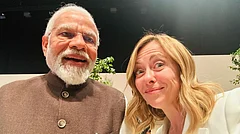
The proposal is part of a wider package concerning schools and integration. The government also plans to establish a legal limit on the number of foreign students per classroom and require Italian-language lessons for parents of foreign students experiencing what the government describes as serious difficulties integrating into the school system.
Importantly, the proposal is not yet the same as a law in force. Once approved by the government, the measures would require parliamentary approval. Reports say the proposed legislation is expected to go before the Council of Ministers.

Burqa is a full-body garment that covers the face, with a mesh covering over the eyes. Niqab is a face veil that covers the face while leaving the eyes visible. The proposal concerns full-face coverings, not all forms of Muslim religious clothing.
Italy does not currently have a specific nationwide ban on burqas or niqabs, but a 1975 law restricts garments that make identification difficult without a justified reason. A 2008 ruling clarified that religious or cultural reasons could constitute justification, subject to identity verification.

Why Does Meloni Want The Ban?
Meloni has linked the proposal to integration, communication and what she describes as women's equality. She has argued that people who come to Italy to build their future should learn Italian, understand the country's culture and respect its rules.
The veil proposal is therefore being presented alongside the foreign-student cap and language requirements rather than as an isolated religious-dress measure.
Meloni's government has also argued that schools need to facilitate integration. Reuters reported that Italy's location in the central Mediterranean makes it particularly exposed to migrant arrivals, while migration and integration remain contentious political issues.
Italy already has a 30 per cent limit on foreign students per class and school under existing rules, according to Al Jazeera, although Meloni has proposed putting a legal limit into the new framework and has not fully specified how the existing arrangement would change. Foreign students account for about 12 per cent of school enrolment.
The debate is not simply about banning a garment. It is part of a broader Italian discussion about immigration, integration, national identity, language and the role of schools. ANSA reported that opposition politicians criticised the foreign-student proposal, while school principals questioned how the measure could be implemented.

How Do Other European Countries Regulate Islamic Dress?
The rules regarding Islamic dress vary from country to country.
France introduced a nationwide ban on full-face coverings in public spaces in 2011. The restriction applies beyond schools. France also has separate rules concerning visible religious symbols in state schools.
Belgium also introduced a nationwide restriction on face-covering garments in 2011. Violations can carry fines and, under the law, a possible prison sentence, EuroNews reported.
Denmark introduced a blanket ban on face coverings in public places in 2018, covering garments such as burqas and niqabs.
Sweden takes a considerably different approach. There is no national ban on religious attire, although some municipalities have attempted school-specific restrictions, leading to legal and political debate.
Portugal does not have a blanket ban on religious symbols, although institutions can apply neutral dress codes in certain circumstances if they are applied uniformly.
Italy therefore sits somewhere between an existing general restriction on face coverings and the more specific school ban now being proposed, according to EuroNews.
The proposed Italian ban is therefore part of a much wider European debate over religious expression, integration, security and individual rights. But the rules differ significantly: France, Belgium and Denmark have restrictions covering public spaces, Austria has introduced school-specific measures, while countries such as Sweden have no nationwide ban on religious attire. Austria has also adopted restrictions affecting Islamic dress in schools, including measures concerning headscarves worn by younger pupils.
For Italy, the immediate question is whether Meloni's proposed measures will be approved and what form the final legislation will take. Until that process is completed, the announced school ban should be described as a proposal, rather than an existing nationwide prohibition.