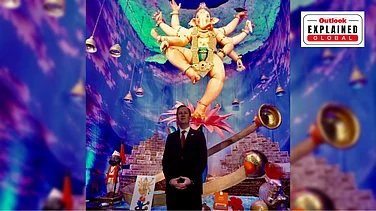
London's first Ganga Aarti on the Thames drew thousands, but its name has prompted questions over whether a ritual associated with the sacred Ganga can be transplanted to another river.
Organisers say the ceremony was symbolic, carrying the Ganga's traditions of gratitude, reverence for nature and the “flow of knowledge” to the Thames.
The decision to keep lamps and offerings out of the river has become another point of discussion, splitting online reactions between cultural celebration and concerns about dilution.
A ritual traditionally associated with the banks of the Ganga has travelled thousands of kilometres — but not everyone is happy about the journey. A “Ganga Aarti” held on the Thames in London has triggered an online debate over whether the name and symbolism of the sacred ceremony can be carried over to another river.
While critics have questioned the use of the term for a ceremony that did not take place on the Ganga and did not replicate all elements of the traditional ritual, organisers have defended it as a symbolic celebration of nature, knowledge and Indian cultural heritage.
Why Is The Thames Ceremony Being Called ‘Ganga Aarti’?
Ganga Aarti is traditionally associated with worship of the Ganga, particularly the elaborate ceremonies at places such as Varanasi, Haridwar and Rishikesh. But, in the case at point, the ceremony took place on the Thames, not the Ganga.
Critics therefore argued that calling it “Ganga Aarti” gives the event a religious/cultural meaning it does not literally possess. The issue isn't simply where it happened; it's whether a ritual specifically associated with a particular sacred river can be transplanted to another waterway while retaining the same name.

What Do Organisers Say The Ritual Represents?
Chinmaya Mission UK, the organizers say they are dedicated to spreading the timeless wisdom of Vedanta and serving humanity through spiritual education and community service. As a part of the Ganga Aarti ceremony, they aimed to honour the spirit of reverence for water that lies at the heart of this tradition by respecting the River Thames.

The mission organized 'Ganga Aarti on the Thames: A Ceremony of Light' in collaboration with the annual 'Totally Thames' festival, as part of the global celebrations marking 75 years of the charity. Recreating ethos of the world-famous aarti by the River Ganges in India, the event in London was conceived as a symbol of the life-giving flow of nature, knowledge and consciousness. Indian High Commissioner to the UK, P Kumaran, joined members of the Indian community and devotees for the event.
"For generations, communities have gathered on the banks of Ganga to offer light in gratitude for the river, for nature and for all that sustains life," said Brahmacharini Shripriya Chaitanya, Resident Teacher of Chinmaya Mission UK, as quoted by PTI.
"When we have a common altar of devotion, dedication, we all leave aside our differences and come together to express what lies deep in our heart, and that is the spirit of oneness, spirit of love, spirit of harmony which Guru Dev Swami Chinmayananda, inspired by Mother Ganga, brought as the knowledge from the heights of the Himalayas.
Accompanied by music and chanting against the backdrop of the historic Old Royal Naval College in Greenwich, the event brought together senior spiritual leaders and representatives from Hindu organisations and communities across the UK.
The organizers didn’t claim that the Thames is literally the Ganga. Instead, the ceremony is being presented as a symbolic representation of nature, knowledge, spirituality and the civilisational values associated with the Ganga.
Today, the Mission has more than 350 locations worldwide, supporting communities through spiritual education, cultural programmes, academic institutions and service initiatives.
In the UK, Chinmaya Mission UK offers programmes for every stage of life - from children and teenagers to young adults, families and senior citizens.

Why Are The Missing Floating Lamps A Point Of Contention?
Traditionally in Varanasi, lamps/earthen diyas are used as offerings during the evening aarti, with the ritual taking place on the riverfront and, in some traditions, lamps being floated on the water afterwards. The Thames ceremony did not replicate that aspect. Critics therefore argue that if important elements of the traditional ritual are absent, why call it a Ganga Aarti at all?
Supporters counter that rituals evolve when practised in different cultural or environmental settings and that reproducing every element isn't necessarily the purpose of a symbolic ceremony abroad. In fact, the Chinmaya Mission UK’s website read, “In line with our commitment to protecting the environment, no items, including flowers, idols, or offerings — will be placed in the River Thames during or after the ceremony. We ask all attendees to join us in celebrating with care for this historic waterway and not to place anything in the river.” The aarti itself is much broader than the floating-diya practice and floating lamps are not an indispensable part of every Ganga Aarti.
The sell-out first-ever Ganga aarti event as part of its programme this year is likely to lead to a more regular feature annually, PTI reported.
Netizens were broadly divided in support and criticism of the aarti.
Supporters saw the event as a way of taking Indian culture abroad, creating visibility for Hindu/Indian traditions and celebrating a connection between Indian heritage and the diaspora. Critics argued that using the name “Ganga Aarti” for a ceremony on the Thames detaches a sacred term from its geographical and religious context, potentially turning a specific tradition into a generic cultural performance.