Akash Anand’s repeated exits have revived questions over Mayawati’s succession plans within the BSP.
Mayawati has repeatedly questioned Anand’s political maturity, organisational approach and commitment to BSP.
His latest exit comes as BSP faces electoral decline and growing challenges before 2027 UP assembly elections.
Mayawati has once again cut nephew Akash Anand loose from the Bahujan Samaj Party (BSP), ending his latest stint in the organisation and raising fresh questions about his political future.
The BSP chief took the decision on Thursday, days after removing Anand as the party’s national coordinator. This time, Mayawati linked his exit to his decision not to repost one of her X posts about his father-in-law, Ashok Siddharth, a former Rajya Sabha member and father in law of Anand.
Mayawati said Anand had now been completely freed from the party after choosing not to share the post.
The latest decision marks Anand’s third major setback in less than three years. It also reflects Mayawati’s continuing concerns over his political maturity and his ability to function within the BSP’s tightly controlled organisational structure.

Why Mayawati Removed Akash Anand Again?
The immediate trigger was Anand’s decision not to repost Mayawati’s X post concerning Siddharth. Siddharth had announced his retirement from active politics. Reacting to the decision, Mayawati described it as “better late than never” and indicated that an earlier exit might have avoided several difficult decisions she later had to take in relation to him.
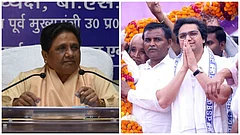



Mayawati also pointed to Anand’s conduct on social media. She said Anand had earlier reposted her X posts to demonstrate his loyalty, but did not repost the post concerning Siddharth, even though she said it was in his own interest and for his welfare.
Mayawati argued that this suggested a deeper conflict, saying Anand could be placing family ties above the BSP and the Bahujan movement. She also questioned how he could work for the party while being in a “double mind” over the issue.

What Has Happened To Anand Since 2023?
Anand’s political journey within the BSP has seen repeated reversals. On December 10, 2023, Mayawati named him her successor and appointed him national coordinator. Less than five months later, on May 7, 2024, during the Lok Sabha election campaign, she removed him from all responsibilities and described him as politically immature.
The decision was reversed on June 23, 2024, when Mayawati restored Anand as her successor and national coordinator.
The rift reopened in March 2025. Mayawati removed him from all responsibilities on March 2 and expelled him from the party the next day. She accused Anand of becoming self-centred and arrogant under the influence of Siddharth.
Mayawati later forgave him on April 13, 2025, but made clear that he would not return as her successor. Even so, Anand returned to the organisation. Mayawati appointed him chief national coordinator on May 18, 2025, and later gave him the newly created post of national coordinator on August 29, 2025.
The latest removal came on September 3. At the BSP’s national executive meeting earlier this month, Mayawati said Anand still needed greater political maturity.
She also said it would not be appropriate to hand him a major role with elections approaching when he was not fully equipped to deal with the tactics of political opponents.
How Did Anand’s Political Style Differ From Mayawati’s?
Anand’s political style has increasingly become an issue within the BSP. Unlike Mayawati’s tightly controlled political approach, Anand has adopted a more aggressive line in public. He referred to Congress leader Rahul Gandhi and Samajwadi Party chief Akhilesh Yadav as “uncles”, attacked leaders at a rally in Jewar over attempts to end reservation and also targeted the RSS.
As per BSP sources quoted by Moneycontrol, one of Anand’s recent speeches, in which he sharply attacked both the BJP government in Uttar Pradesh and the Central government, further upset the party leadership.
The differences, however, were not limited to his public speeches. Anand had also criticised inactive office-bearers and sought greater accountability from those holding organisational posts. Within a structure built around long-established internal discipline, this approach risked unsettling established leaders.
What Does This Mean For BSP’s Succession?
The latest decision has again brought the question of succession to the centre of the BSP’s politics. With the 2027 Uttar Pradesh Assembly elections approaching, Mayawati’s immediate challenge is to rebuild a BSP that has suffered electoral setbacks and lost ground among sections of its traditional support base.
Mayawati runs the BSP with tight organisational control, disciplined messaging and closely managed positioning. Anand, by contrast, has sought a younger and more combative image, using sharper language and direct attacks on political rivals.
Mayawati has sought to present the latest decision as a matter of organisational discipline rather than family succession. She said the interests of the Bahujan community mattered more than family ties. Recalling Kanshi Ram’s decision to devote his life to the movement, she said she did not believe in giving party posts to relatives simply because they belonged to her family.
That has shifted attention to Anand’s younger brother, Ishan Anand. Ishan attended the national executive meeting along with their father, BSP national vice-president Anand Kumar. Akash was absent in the meeting. Ishan’s presence has fuelled speculation over whether Mayawati could look to another member of the next generation for an organisational role.
BSP’s Electoral Decline
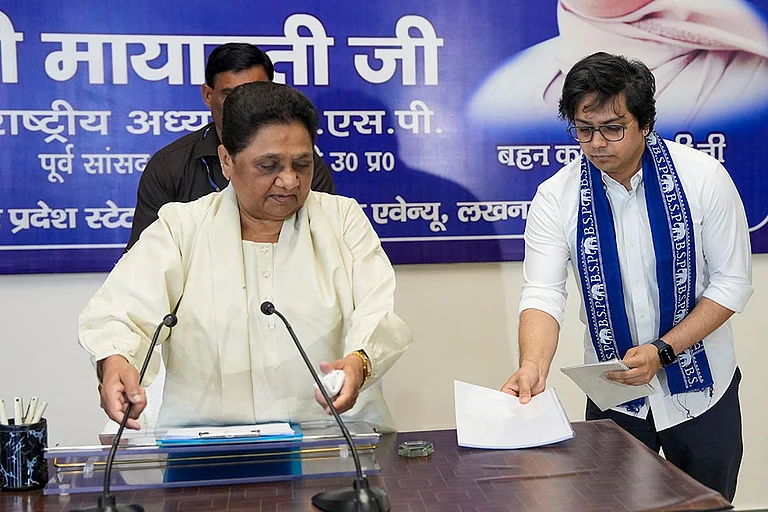
Akash Anand’s repeated reversals within the BSP come against the backdrop of the party’s prolonged electoral decline and the emergence of new challengers to Mayawati’s hold over Dalit politics in Uttar Pradesh.
The BSP lost power to the Samajwadi Party in the 2012 Assembly elections and failed to win a Lok Sabha seat in 2014. It returned to Parliament with 10 seats in 2019 after allying with the SP, but Mayawati chose to go solo in 2024. The BSP failed to open its account, with its vote share falling from 19.42% in 2019 to 9.39%.
The decline has been visible in the Assembly elections too. From 80 seats in 2012, the BSP fell to 19 in 2017 and just one in 2022. Its vote share dropped from 25.95% in 2012 to 12.88% in 2022.