The Mecca Joint Defence Agreement signed by Saudi Arabia, Pakistan and Türkiye on August 7 is simultaneously a mutual-security pledge, an experiment in regional burden-sharing and a sign that the US-dominated security architecture in West Asia is losing credibility. For India, its significance lies less in the improbable prospect of Saudi forces joining a future India-Pakistan war than in the political protection, military technology and strategic leverage the agreement could confer on Islamabad.
What the Pact Says
The agreement was signed by the prime minister of Saudi Arabia, Mohammed bin Salman, the president of Türkiye, Recep Tayyip Erdoğan, and the prime minister of Pakistan, Shehbaz Sharif. Its central undertaking is clear: an armed attack against any one of the three countries would be regarded as an attack against all three, according to their joint statement.
The formulation invited comparisons with Article 5 of the North Atlantic Treaty Organisation (Nato), but the full legal text has not been published. Questions remain about what constitutes aggression, whether attacks by non-state groups are covered and how far the commitment extends beyond West Asia.
Türkiye’s foreign minister, Hakan Fidan, later explained that an attacked member would have to request assistance and specify what it needed—support could range from intelligence, logistics and ammunition to the deployment of military units, making consultation, rather than automatic intervention, the pact’s operating principle.
The partners plan political and military committees involving foreign and defence ministers and senior commanders, backed by a secretariat in Saudi Arabia, along with joint exercises, intelligence-sharing and greater interoperability across land, sea and air operations.


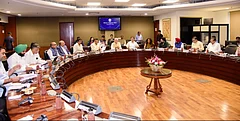
The new triangle links the Saudi-Pakistani relationship with Türkiye’s defence industry and its position as NATO’s second-largest military.
The defence-industrial agenda could eventually matter more than the mutual-defence declaration itself. Türkiye’s defence ministry has flagged unmanned systems, air defence, electronic warfare and artificial intelligence as priorities, alongside joint production and technology transfer.
Anil Trigunayat, a former diplomat who served in Jordan and Libya, says Pakistan’s role as a provider of military personnel and expertise to Gulf monarchies long predated the Mecca agreement. “Pakistan has from the beginning been involved in the security domain in most Gulf countries because it is a rentier state, it is ready to deploy people in return for money and project itself as an Islamic power,” he tells Outlook.
Saudi Arabia and Pakistan had already signed their Strategic Mutual Defence Agreement on September 17 last year, formalising a security relationship extending over several decades. Pakistani troops have been stationed in the kingdom, Saudi personnel have trained in Pakistan and General Raheel Sharif, a former Pakistan Army chief, has led the Riyadh-based Islamic Military Counter Terrorism Coalition.
The new triangle links this Saudi-Pakistani relationship with Türkiye’s defence industry and its position as Nato’s second-largest military. Saudi Arabia supplies capital and strategic geography, Pakistan contributes military manpower and Türkiye offers drones, naval platforms, missiles and Nato’s planning experience.
Pakistan’s nuclear status adds psychological weight, but there is no public evidence that Islamabad has extended a nuclear guarantee to either partner—no consultation, deployment or shared-command arrangement has been disclosed, though Trigunayat says that Pakistan’s nuclear capability would remain part of long-term regional calculations.
Looking Beyond Washington
The immediate backdrop is the Iran-Israel-US confrontation, attacks on Gulf infrastructure, renewed Houthi operations and diminishing confidence in American protection. Gulf states have spent heavily on Western weapons, but remain vulnerable to comparatively cheap missiles and drones threatening cities, refineries and ports.
“They would have wanted us to be a security provider in the region, which somehow we have not been able to shoulder,” says Trigunayat, adding that doubts about the US, combined with China and Russia’s limited appetite for the role, had pushed Gulf states to seek partners able to supply military capacity.
The pact’s first practical test came when the Houthis claimed a drone strike on a Saudi Aramco refinery in Jazan shortly after its signing, but Riyadh did not publicly invoke collective defence—underlining uncertainty over whether an attack by a non-state group crosses the treaty threshold or merely triggers intelligence and logistical cooperation.
Calling the arrangement an ‘Islamic Nato’ therefore overstates its present military content. Nato has integrated commands, common standards and established operational plans; Saudi Arabia, Pakistan and Türkiye have different threat perceptions and are only beginning to institutionalise coordination.
Saudi Arabia is focused on Iran, the Houthis and Gulf infrastructure; Türkiye on Israel, Syria and Kurdish armed groups; and Pakistan’s central conventional adversary remains India. These divergences could limit collective action if one partner confronts a country with whom the other two want stable relations.
“The Mecca pact is essentially Saudi Arabia’s response to the end of America’s role as the historical security guarantor for the Persian Gulf... That is why it brought in Pakistan, a long-standing defence partner whose relationship centres largely on its nuclear arsenal, and Türkiye, which has long-standing enmity with Israel and a fairly capable military,” says Pramit Pal Chaudhuri, India practice head of the Eurasia Group.
The agreement captures an unusual feature of the present regional order. “One of our strategic partners, Israel, attacked another strategic partner, Qatar, and our third strategic partner, Saudi Arabia, signed a strategic mutual-defence agreement with our adversary, Pakistan,” says Trigunayat, referring to the sequence that preceded the trilateral pact.
The development is better read as strategic diversification than a rejection of the US. US President Donald Trump welcomed the agreement as a “big, bold and important first step”, suggesting that Washington sees regional burden-sharing as compatible with its interests. Saudi Arabia will, in any event, remain dependent on the US for advanced aircraft, intelligence, and air and missile defence.
The same drive for strategic autonomy is reflected in Gulf countries’ closer economic engagement with India, China, Japan and South Korea. The West remains important, but these countries are avoiding exclusive dependence on any single external power.
The agreement is open to expansion, with Egypt, Jordan, Qatar and Kuwait among the possible participants. Trigunayat also anticipates a possible Saudi-Iranian non-aggression arrangement, which would let Pakistan support Gulf security without openly choosing between Riyadh and Tehran.

Not Inconsequential
India’s initial reaction has been measured. The Ministry of External Affairs said New Delhi was examining the pact’s implications for national security and regional stability and would take necessary measures to protect Indian interests. India’s position in West Asia is far stronger than two decades ago. Trigunayat says New Delhi has moved from a transactional approach to “a truly strategic” regional policy from 2008 onwards—a shift that became more pronounced under Prime Minister Narendra Modi. Central to that transformation was dehyphenation—treating India’s relations with Israel, Iran, Saudi Arabia and the UAE as independent partnerships, which has substantially reduced Pakistan’s ability to shape how Gulf countries deal with India.
Saudi Arabia has strong reasons to preserve that autonomy. India is its second-largest trading partner, while Saudi Arabia is India’s fifth-largest, with bilateral trade reaching $41.88 billion in 2024-25; the kingdom also supplied 13.58 per cent of India’s crude-oil imports that year. The relationship now spans energy, investment, counterterrorism, maritime cooperation and a defence dialogue under the India-Saudi Arabia Strategic Partnership Council. Saudi Arabia has bought Indian artillery ammunition and held bilateral exercises with the Indian Navy—interests that cannot be subordinated easily to its older ties with Pakistan.
“It is not directly anti-India, but from Pakistan’s and Türkiye’s point of view, it is quite possible,” says Trigunayat. Saudi forces will not fight alongside Pakistan, but Islamabad could gain access to training, financial support and knowledge of sophisticated US-origin equipment held by the kingdom.
A future India-Pakistan confrontation would, therefore, test political positioning more than the collective-defence clause itself; Trigunayat expects Gulf states to press for an immediate end to hostilities rather than support Indian military action.
Türkiye represents the more direct problem, since its defence partnership with Pakistan is operational as well as political, covering warships, submarine modernisation, targeting pods, electronic warfare, joint exercises and technology transfer, with Turkish assistance to Pakistan during Operation Sindoor having deepened Indian mistrust.
Saudi investment could now reinforce this relationship by financing Turkish systems produced or operated with Pakistan. Better drones, air defence, precision munitions and maritime surveillance would have a more concrete effect on India’s security than declarations of Islamic solidarity.
The Indian Ocean dimension also needs scrutiny, since coordinated surveillance, logistics and naval operations could extend Pakistan’s reach from the Gulf and the Red Sea to the Arabian Sea. India’s larger concern was the Sino-Pakistan axis, requiring New Delhi to assess how Chinese systems could interact indirectly with Turkish technology and Saudi financing.
India should nevertheless avoid turning its differences with Türkiye into a diplomatic shutdown. “Closing down completely to Türkiye may be counterproductive,” says Trigunayat, arguing that foreign-office consultations, think-tank exchanges and economic engagement should be used to convey New Delhi’s concerns about cross-border terrorism.
New Delhi should seek quiet assurances from Riyadh on the pact’s territorial scope and consultation procedures while deepening bilateral defence, investment and maritime cooperation. It should track integrated commands, contingency plans concerning South Asia, joint air and missile defence, permanent deployments, pre-positioned weapons and any expansion of Pakistani nuclear signalling.
India should be concerned enough to prepare, but not worried enough to overreact. The Mecca agreement is principally a West Asian hedge against regional disorder and uncertain American protection, yet its financing, technology and political consequences could strengthen Pakistan and complicate India’s freedom of military and diplomatic action. Its ultimate importance will be determined by implementation rather than rhetoric: if it remains a consultative framework for exercises, arms production and crisis management, India can manage it through diplomacy and preparedness. If it evolves into an integrated planning covering an India-Pakistan conflict, it will mark a substantive change in India’s strategic environment.

MORE FROM THIS ISSUE


Anish Kumar is the strategic affairs editor, Outlook