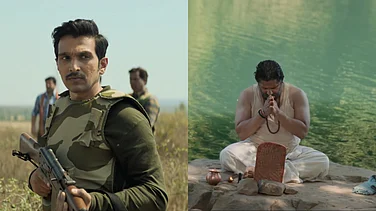
Last Man In Tower is directed by Ben Rekhi.
The film is an adaptation of Aravind Adiga's 2011 novel.
Manoj Bajpayee, Divya Dutta and Boman Irani star in a succint but safe big-screen adaptation.
What does it take to plough on even in the face of overwhelming opposition? In Ben Rekhi’s Last Man In Tower, the retired schoolteacher, Yogesh Mishra/Masterji (Manoj Bajpayee), finds himself sanded into a corner. He had supporters but the small number dwindled. This adaptation of Aravind Adiga’s eponymous 2011 novel spins around Mumbai’s Vishram apartment block. It’s one of the many old buildings that real-estate hawks have their eyes on as redevelopment razes the country. Masterji is the polar opposite of the smarmy builder, Dharmen Shah (Boman Irani), who insists everything in Mumbai is for sale. There are still some who fight tooth and nail to preserve those places that are receptacles of their memories, a record of their lives’ intimate tapestries.
Shah swoops in, offering to mow down the housing society to make way for a fancier high-rise. Every resident is promised a deal over two times the market value. The proposition tosses itself as eminently lucrative, a way out of current miseries for many. It’s so immediately tempting that few halt to ask questions. The narrative encompasses a smattering across the two camps. Mrs Puri’s (Divya Dutta) lights instantly light up at Mr Shah’s bait. She envisages an interruption of the monotony and low expectations that have tailed her while raising a special child, Bittu. Shah lures them with big, bright dreams. The snare is set, most promptly walking right into it. Adding that he’s actually honouring the residents’ rights, he declares a three-month ultimatum. Even if one holds back from accepting the deal, it’ll be nipped in the bud. But Mrs Puri won’t allow her life’s “biggest miracle” be stymied, come whatever ethical cost.


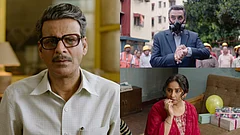


Masterji leads a small pack that’s not as easily sold on the offer. Some neighbours, the Pintos and the single mother Ms Rego (Swaroopa Ghosh), initially stand by him, sharing his concern and alarm. However, their apprehensions are ironed out after ample manipulation and coercion from the builder and a broker. A string of blackmailing erupts, flitting from casual reminders to heightened danger.
Masterji, though, is unswerving. Many can see him as foolish, delusional and a real killjoy. He clutches onto his apartment as the single remaining space that houses the memories of his late wife, raising his son who’s turned frosty. Masterji is remarkably open-minded, projecting a high regard for unflappable principles. He has no taste for the nosiness of people like Mrs Puri, who questions single women tenants.

Bajpayee brings quiet dignity and ache into this intractable man. Rekhi demonstrates a fine grasp over humiliation and what it takes to hold onto your ground. Masterji is like an impenetrable wall. He exasperates and alienates everyone around him with his stubbornness. Even his lawyers advise him not to fight against human nature. As all around Masterji fall away after initial flutters of resistance, he stays indomitable, undeterred. Nothing, neither bribes, threats nor the insistence of his family and friends, suffice in getting him to bend. He’s certain for as long as even one, him, refuses to sign along, the project will be stalled. But how long can he prevent it? The stakes turn intense. Bajpayee is a moving portrait of defiance.

However, it is Dutta who almost runs away with the film. Fierce and wrenching, Dutta burns brightly as a woman who feels that she has a genuine stab at a life that seemed elusive. Mrs Puri has spent day in and day out attending to her special child’s needs. Her own wishes and desires have been stymied as a constant caregiver. She’s worn out and sees the redevelopment as a chance to turn her bleak life round. Dutta is devastating in the latter stretches. A standout scene where her character confesses that women like her don’t dare to dream segues neatly into a moment as her face hardens in unapologetic assertion. It’s the ultimate realisation, one final desperate bid for Mrs Puri to reinstate control over her destiny. Dutta summons a lifetime of denied opportunity in Mrs Puri’s seething act of striking out and snatching her sole chance.

Yet, there are times when the film sails a tad too stately for its own good. It required a bit of caustic edge. The drama has a tendency of setting into a certain predictable template of social realism. You look for spare openings where it could show a more admirable jaggedness, a wicked wit, a bracing satiric touch. Those are replaced by a firm strain of overtly respectable bearings. The adaptation risks being overly polite and sedate to the point of unevocative. The level-headed competence also renders it antithetical to stylistic risk.
Last Man In Tower also rushes most of the supporting characters and their dilemmas, flattening them to very few instances wherein which they shift their stance. Neither is the father-son chafing allowed to sit for the final emotional payoff to land. It’s a pity because this film could have exerted a sharper grip.