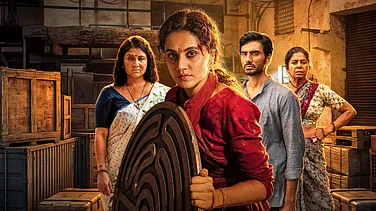
Manoj Bajpayee plays Ajay Nirvit, a compromised Delhi police officer in this 120-minute thriller.
Gajab Raat follows a high-pressure investigation involving a woman and powerful institutions.
Divya Dutta, Nushrratt Bharuccha and Rajiv Gupta support the Netflix crime thriller.
Delhi is a city where a crime can become a public spectacle within minutes. A video circulates, people demand answers and the police find themselves under pressure to act. In Gajab Raat, a case involving an injured woman sets off a chain of events that draws the Delhi Police into a dangerous contest involving powerful people and competing agencies. The film begins with a familiar crime-thriller set-up, but its most compelling subject is the machinery of corruption and the people who keep it running.
Manoj Bajpayee plays Ajay Nirvit, a Delhi Police investigating officer nicknamed ‘Girgit’ (Chamaeleon) for his ability to change colours. He is a womaniser, a man hungry for money and someone who has made his peace with the everyday compromises of police work. But when a hotel raid leads him to a badly injured woman who appears to have escaped from a car, the case quickly grows beyond his control.
A crowd gathers, the news spreads and the case begins to attract attention. Who is this woman? What happened to her? And why does a case that should belong to the police so quickly become a matter of interest for the CBI, the NIA and people with considerably more power than Ajay? Gajab Raat keeps adding questions, building a web of suspicion around a case whose real stakes take time to emerge.


The film’s most interesting thread is its depiction of a police officer who is part of the rot he is expected to confront. Ajay is not introduced as a principled man waiting for the right case to reveal his conscience. He is already accustomed to taking money and making compromises. When the investigation becomes politically sensitive, he is forced to negotiate with people who can dictate the course of his career and, potentially, his future. The question is whether he can protect himself while doing his job, particularly when the people issuing instructions seem to have their own reasons for wanting the matter handled a certain way.
There is a telling line in which Ajay asks, “Unki duty karu toh main barbaad hoon, apni duty karu toh main barbaad hoon, main karu toh karu kya?” (If I do their duty, I’m ruined. If I do my own duty, I’m ruined. What am I supposed to do?) It is one of the film’s most effective moments because it captures the predicament of someone caught inside a system where accountability rarely travels upwards. Ajay understands that he could be blamed for the outcome regardless of whose instructions he follows. His frustration is recognisable to anyone who has watched institutions protect their own interests while leaving those at the bottom to face the consequences. The irony, of course, is that Ajay has spent much of his career benefiting from the same culture of compromise.
Bajpayee gives this contradiction its weight. There is a lived-in quality to his performance, particularly in the way he handles the character's calculations and his attempts to stay ahead of people who know more than they let on. He does not make the character instantly likeable, and that is to the film’s advantage. Ajay’s greed is an essential part of his personality, not an inconvenient trait the screenplay can discard when it needs him to become heroic. Watching him negotiate the distance between a profitable deal and his professional responsibility gives Bajpayee some of the film’s best material. The writing does not always earn the turns in Ajay’s journey, but the actor makes the internal conflict worth following.
The case also raises an uncomfortable question about how violence against women is handled once it enters the public domain. The initial response to the injured woman is shaped by the familiar spectacle of a crowd gathering around a victim, followed by the rapid circulation of information. Social media can force institutions to respond when they might otherwise prefer to look away. Yet the film is also interested in how quickly the woman herself risks becoming secondary to the political consequences of the case. Who is responsible? Which agency gets to claim the investigation? Who will take the blame if the case becomes a public embarrassment? These questions consume the people around her, while her own safety becomes entangled in their calculations.

That is potentially the most disturbing idea in Gajab Raat is a woman who has suffered violence becomes a liability to be managed by the state. The film recognises how institutional reputation and political convenience can shape the response to a crime. However, it does not always give the woman enough room to exist beyond the circumstances that make her important to the plot. Her story is the reason everyone is scrambling, yet the investigation’s many moving parts often command more attention than the person at its centre.
Divya Dutta brings an imposing presence to her role as Madame, a woman whose position in this world raises further questions about who is pulling the strings. Dutta knows how to hold a scene without making every gesture conspicuous, and her performance adds an intriguing dimension to the film’s network of influence.

Nushrratt Bharuccha is also central to the story, while Akshay Oberoi and Saqib Saleem contribute to a narrative in which information is carefully guarded. Rajiv Gupta is a welcome presence, bringing comic relief to his exchanges with Bajpayee. There is a sizeable ensemble here, though some characters are left with little beyond their place in the plot.

The film’s plotting is where its ambitions begin to get the better of it. Every answer seems to open another line of inquiry, bringing more agencies, names and competing interests into the frame. The involvement of the CBI and the NIA creates a sense of institutional rivalry, but the film does not always make the connections between these players easy to follow. Its single-night framework gives the story urgency, although the relentless stream of revelations can make it difficult to absorb what each new development means. At times, the mystery feels as though it is being prolonged through information withheld from the audience rather than through genuinely persuasive suspense.
Neeraj Pandey and Ritesh Shah have chosen a subject that could sustain a sharp political thriller. Corruption rarely survives through one person’s greed alone; it depends on a chain of people who protect one another, follow orders, or decide that looking away is more profitable. Gajab Raat understands this, and Ajay’s gradual shift in priorities gives the film a reason to exist beyond the mechanics of its investigation. But the screenplay has too many moving pieces and not enough patience with some of its characters. The result is a film that raises questions about power, duty and women’s safety without always giving those questions the attention they deserve.

Gajab Raat remains a watchable crime thriller, largely because Bajpayee gives its compromised protagonist the complexity the writing sometimes lacks. Its portrait of a system in which everyone has something to gain is worth engaging with, even when the investigation gets tangled in its own machinery.