Yami Gautam Dhar headlines Balaji Mohan’s supernatural comedy releasing in 2026.
The film attempts to blend horror, mythology and family drama.
Despite an intriguing premise, the comedy struggles to find its footing.
A woman who has opinions of her own refuses to fit neatly into the family’s expectations and dares to live on her terms. Surely, that cannot be normal. At least, that seems to be the logic of Nayyi Navelli, a horror-comedy that turns a seemingly perfect new bride into an object of suspicion while wrapping its story in religious symbolism and a caricature of North Indian family life. Directed by Balaji Mohan and starring Yami Gautam Dhar, the film wants to be a supernatural comedy, a story about family values and a modern retelling of ideas drawn from the Ramayan. The result is a film that struggles to understand any of these things.
The biggest problem with Nayyi Navelli is not that it invokes religion or draws from mythology. It is that these elements feel less like meaningful parts of the story and more like a promotional exercise designed to appeal to a particular audience. By the time the film finishes invoking Ram, leaning heavily on the Hanuman Chalisa and forcing connections to the Ramayan, the experience begins to resemble an extended advertisement for Nitesh Tiwari’s upcoming Ramayana.
The story is set in Meerut, where Mohini (Yami Gautam Dhar), a seemingly ideal new bride, transforms a chaotic household into a picture of domestic harmony. Her brother-in-law begins to suspect that there is something unnatural about her perfection. Could she be a daayan (because that's what feminists are apparently) rather than the blessing the family believes her to be?


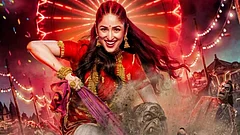
There is an interesting premise buried here. Why does a woman who appears to have everything under control immediately invite suspicion? Why is a woman who is confident, independent, and capable of challenging the people around her so easily cast as a threat? The film could have used the supernatural premise to examine the ways patriarchal households react to women who refuse to conform.


Instead, it seems caught between wanting Mohini to be an empowered woman and treating that very independence as something suspicious. The film flirts with a feminist reading of its central character without developing it into a coherent argument. Her brother-in-law becomes the familiar patriarchal figure who believes he can see through a woman who does not behave as he expects. Yet the script never digs deep enough into what makes this dynamic compelling. It gestures towards an idea and then abandons it for the next plot contrivance.
The first half occasionally feels as though the film is setting up a story about how progressive women are misunderstood by conservative families. But what exactly is it trying to say? Is Mohini being punished for stepping outside traditional expectations, or is the film simply using the familiar image of the dangerous woman to manufacture a supernatural mystery? By the time the answers arrive, the premise has lost much of its potential.

The film's treatment of Hindu mythology is even more frustrating. Ram, Hanuman and the Ramayan are invoked so insistently that the references begin to feel like a substitute for storytelling. Religious imagery can be a powerful cinematic tool, particularly when it is used to explore questions of morality, desire, ego and the nature of evil. Here, it is repeatedly brought in without enough thought about what it means within the narrative.
The handling of Ravan is particularly disappointing. In the Valmiki Ramayan, Ravan is not only an embodiment of evil. He is a formidable scholar and a devotee of Shiva whose knowledge and abilities exist alongside his arrogance, ego and destructive choices. His downfall carries meaning because his strengths do not protect him from his own flaws. His character offers a way to examine how pride and insecurity can corrupt even someone of immense ability.
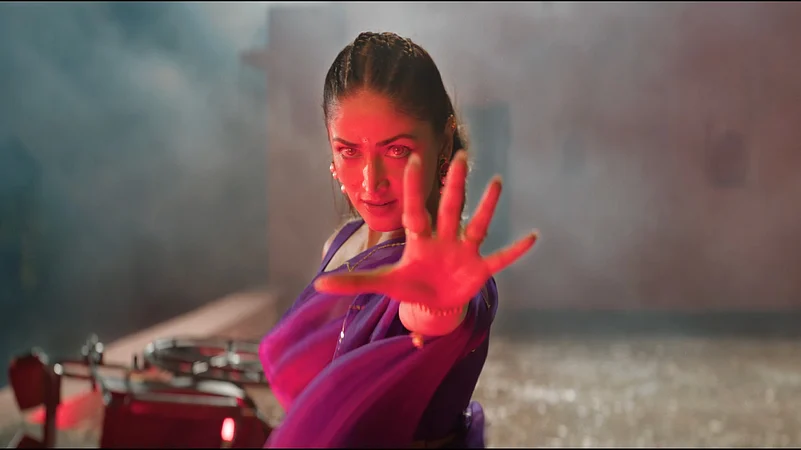
Nayyi Navelli reduces this complexity to a Macguffin device that feels closer to a generic magical object from a Hollywood adventure film than an idea rooted in the epic it invokes. The film appears more interested in borrowing the visual and symbolic vocabulary of the Ramayan than in understanding its characters. Ram and Ravan become caricatures, stripped of the contradictions that make their stories worth revisiting.
The incessant invocations of Ram and the Hanuman Chalisa only make the problem more obvious. Devotional elements are not inherently out of place in a story about supernatural forces, but they need to serve a dramatic purpose. Here, they often feel like emphatic reminders of the film’s religious positioning. The result is a crude form of saffronisation that seems designed to flatter a presumed audience rather than trust viewers to engage with a story on its own terms.
The film’s idea of family is just as dated. Its joint household resembles a Hum Saath-Saath Hain-style fantasy in which traditional family structures are treated as the natural centre of life, with everyone expected to fall into familiar roles. Nostalgia for the 1990s is not a problem in itself. The problem is presenting this idealised version of a North Indian household as though it still represents the aspirations and realities of an entire audience.
Families have changed. So have the people living in them. The Hindi-speaking audience the film appears to court is not a monolith waiting to be reassured that traditional domestic arrangements are the only route to happiness. The film's broad characterisation leaves little room for that reality, reducing family conflict to a set of predictable reactions rather than examining the complicated ways people negotiate power and affection at home.

There is also the troubling suggestion that a middle-aged woman needs a husband to complete her life. The film makes this worse by suggesting that she must somehow be transformed into a younger, Jacqueline Fernandez-like figure to remain desirable to her partner. What does this say about how the film sees women as they age? Why must a woman’s romantic worth depend on looking younger rather than being accepted as the person she is?
These ideas might have been worth exploring if the film had approached them critically. Instead, they sit awkwardly within a story that appears to want the comfort of traditional values and the appeal of a modern, independent heroine without reckoning with the contradictions between them.
Yami's is the film's biggest draw, and she brings a visible commitment to Mohini’s shifts between domestic warmth, mystery and supernatural spectacle. The character gives her room to move between different registers, but the writing rarely provides enough substance to make those changes feel meaningful. A strong performance can make an underwritten character watchable; it cannot supply an entire film with a coherent point of view.
Addinath M Kothare plays Raja, Mohini’s seemingly loving and devoted husband, who takes pride in keeping his family together. Kothare brings a gentle warmth to the character, whose affection for his family sits alongside a side he appears unaware of. The wider ensemble, including Sunita Rajwar, Mita Vashisth, Aaditya Kulshreshth and Sushmita Mukherjee, adds to the bustling family setting, yet the writing does not give these characters enough individuality to lift the material. The household feels populated rather than inhabited.

The technical shortcomings do not help. The visual effects are clearly AI slop, weakening the supernatural elements that should give the film its sense of unease and wonder. The horror rarely creates genuine tension, while the comedy struggles to find a rhythm that feels organic. Even the mythological spectacle lacks the visual conviction needed to make its larger-than-life imagery work.
This brings me to the four things the filmmakers have failed to understand: horror, comedy, the Ramayan and family. Horror needs atmosphere and tension. Comedy needs timing and a sense of absurdity. Mythology demands more than recognisable names and symbols. Family drama requires people who feel like human beings rather than representatives of a social ideal. Nayyi Navelli mistakes the appearance of these elements for the substance.

For a film that seems so determined to tell audiences what to believe, it shows remarkably little faith in their intelligence. It has a premise that could have challenged patriarchal assumptions and a leading actor capable of doing more with it. Instead, it settles for religious overstatement, dated family dynamics and effects that fail to convince. Nayyi Navelli is a missed opportunity to tell a more interesting story about women, family and the stories we inherit.