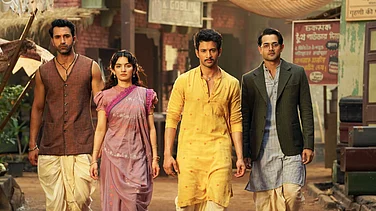
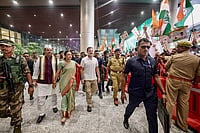
Ghamasaan brings Tigmanshu Dhulia back to the Hindi heartland in 2026.
Arshad Warsi and Pratik Gandhi lead the film's central cat-and-mouse conflict.
The 2.5-hour crime drama struggles with pacing and underdeveloped characters.
Something inherently cinematic about the Hindi heartland runs through Tigmanshu Dhulia's films. The dusty roads, men with guns, local power brokers and the uneasy relationship between the police and those who operate outside the law have been part of his filmmaking vocabulary for years. Ghamasaan returns to that territory, setting its story in the Hindi belt and drawing from the dacoit culture of the late 1990s and early 2000s. It wants to look at caste, politics, power and the changing landscape of the region through a violent game between a dreaded gang and the police officer tasked with stopping it.
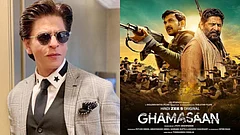
The film begins with a farmer's son getting married when his father, secretly a police informer, puts himself in the gang's crosshairs. That incident gradually pits Maharaj (Arshad Warsi), a feared dacoit, against Aditya (Pratik Gandhi), an IPS officer. Maharaj's gang has enough influence to blur the line between criminal power and government authority. The question running underneath the chase is simple but interesting: who are the real jan sevaks when almost everyone in the system appears to be serving themselves?
That idea gives Ghamasaan some of its strongest moments. The film understands that power in this world is rarely straightforward. Every character seems to be calculating what they can gain from another person, whether through fear, loyalty, information or political influence. There is almost a game-theory quality to the narrative, where every move changes the advantage for someone else. The problem is that the screenplay identifies several social and historical issues without exploring any of them deeply enough.


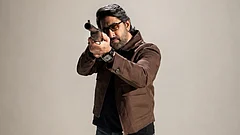


The attempt to portray caste-based gang culture is particularly underdeveloped. The film gestures towards caste discrimination and the social structures that allowed such gangs to flourish in parts of Uttar Pradesh and Bihar, but the commentary remains fairly shallow. Urbanisation also enters the picture, suggesting a region caught between its violent past and a changing social landscape, yet the film leaves this largely unexplored. The film has the material for a much more pointed examination of how caste, crime, politics and development intersect, but it rarely stays with an idea long enough to make it meaningful.
The larger story also feels familiar. The cat-and-mouse chase between a police officer and a powerful criminal, combined with the involvement of people higher up in the public system, occasionally recalls Madras Cafe. The comparison is not about the specific plot but the mechanics of the thriller. Ghamasaan repeatedly suggests the real conflict extends beyond the two men at its centre, yet the screenplay doesn't raise the stakes enough to make those larger forces feel genuinely threatening.

This is also where the character writing suffers. Maharaj is certainly intimidating, but the film never gives enough insight into what made him the man he is. What pushed him towards this life? What does he believe about his own power? Why does he continue down this path beyond survival or greed? These questions matter because a morally grey antagonist can make a crime drama far more compelling. Maharaj has the potential to be that kind of character but remains frustratingly distant.
Aditya fares even worse in terms of development. Pratik Gandhi plays the police officer with control and conviction, but the character barely evolves through the pursuit. The conflict becomes increasingly personal, yet that shift does not lead to enough internal change. For a film built around two men locked in an increasingly personal battle, both characters needed stronger emotional movement.

The performances, however, are consistently good. Warsi is convincing as Maharaj, bringing a restrained menace that fits the world far better than an exaggerated gangster performance would have. His presence gives the character weight, even when the writing doesn't provide enough history. Gandhi brings an equally controlled quality to Aditya, making the officer believable without turning him into a stereotypical action hero. Rajpal Yadav is also a pleasant surprise. His performance fits naturally into the film's world and shows that even the supporting players work harder than the material sometimes allows.

Tigmanshu Dhulia's trademark dry, wry black humour also runs through the film. It occasionally cuts through the bleakness without completely disrupting the atmosphere. These moments are useful because Ghamasaan is otherwise relentlessly grim.
The violence and action are among the film's strongest technical elements. The confrontations feel physical and the brutality carries an uncomfortable realism. The film makes no attempt to make violence look particularly heroic. That approach suits the story and gives the action sequences genuine impact, particularly after the halfway mark when the central conflict becomes more intense.
The trouble is pacing. At around two-and-a-half hours, Ghamasaan feels considerably longer than its story requires. The narrative is cluttered with subplots that do not always feed naturally into the central conflict. A tighter two-hour version could have preserved the atmosphere, violence and political tension while giving the main story far more momentum.
What remains most frustrating is the distance the film maintains from its own subject. It wants to be gritty and realistic, but it often feels strangely aloof from the people and histories it is depicting. The social commentary never cuts deep enough, the characters remain underwritten, and the moral ambiguity that could have driven the story is largely left on the surface.


Ghamasaan has the bones of a compelling crime drama: a troubled region, a dangerous dacoit, a determined police officer, caste and political tensions and a system where everyone appears to be playing for their own benefit. It understands the world it wants to enter. It simply does not spend enough time examining what makes that world so traumatising. The film is streaming on ZEE5.