Haiwaan runs for 164 minutes but struggles to sustain its thriller momentum.
Saif Ali Khan delivers a strong performance as visually impaired Shyam.
Asrani's final film appearance provides some of the film’s funniest moments.
Premchand's Panch Parmeshwar is built around a simple but powerful idea: what happens when the responsibility of delivering justice outweighs personal relationships. In the story, Algu Chaudhary is forced to sit in judgement over his friend Jumman Sheikh and, despite their bond, arrives at a decision that favours what he believes is right. Haiwaan doesn't tell the same story, but it repeatedly brushes against a similar moral question through Boman Irani's judge. Here, justice, punishment and the consequences of an old decision are placed at the centre of a murder thriller. The difference is that Priyadarshan's film rarely lets this potentially interesting conflict develop with the clarity Premchand's story achieves in a few pages.
An adaptation of Priyadarshan's 2016 Malayalam thriller Oppam, Haiwaan follows Shyam (Saif Ali Khan), a visually impaired security manager living in debt but known for helping those around him. His life changes when retired judge Pradhan (Boman Irani) is murdered, and Shyam becomes entangled in a larger conspiracy involving Pradhan's daughter Nandini. At the same time, Parshuram (Akshay Kumar), a psychotic killer with a personal connection to the judge, begins hunting those connected to him. The premise sets up a potentially sharp confrontation between a blind man trying to navigate danger and a predator who seems to know exactly how to exploit fear.

Saif is easily one of the better reasons to stay with the film. Playing a blind character for the first time, he gives Shyam a physicality that doesn't rely on exaggerated gestures. His movements, listening and spatial awareness create a believable sense of how the character negotiates the world. There is a quiet confidence to his performance even when the screenplay gives him absurd situations to survive. Saif is good here, but the film around him does not always know how to use that performance.


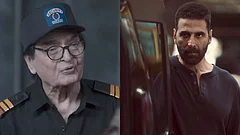
Akshay Kumar is the other major presence. As Parshuram, he is physically controlled and intimidating without constantly announcing himself as the villain. The character has a disturbing quality, particularly in how he moves through ordinary spaces before violence suddenly erupts. Yet Parshuram remains too general as a psychopath. The film gives him a backstory and motivations but does not develop enough psychological detail to make him genuinely unsettling. His presence is stronger than the writing behind him.

The supporting cast is considerably better than the material they are given. Boman Irani brings the required authority to Pradhan, while Saiyami Kher gives the police investigation a grounded presence as Varsha. Shriya Pilgaonkar gets caught in a strange middle ground between the film’s emotional and commercial demands. Her character is involved in a romantic track, investigative material and a wedding sequence that feels less like an organic part of the story and more like a conspicuous attempt to add spectacle.

And then there is Asrani. His appearance carries an unavoidable poignancy because Haiwaan is his final screen performance. Yet his scenes are memorable not for sentimentality. It is the comic timing. He gets some of the film’s funniest moments and lands them with the ease of an actor who understands exactly how long a joke needs to breathe. In a film this heavy, his comic presence is genuinely welcome.

The problem is that Haiwaan cannot decide what kind of thriller it wants to be. The first half moves painfully slowly before the murder investigation begins to gather momentum. Random deaths keep appearing around the central conflict, while side stories involving Nandini, Naina and other characters are introduced without enough dramatic purpose. Nilofar and her sick child enter the narrative only to become another piece of the film’s crowded puzzle. The result is a story that keeps adding information without creating corresponding suspense.

The wedding sequence is perhaps the clearest example of this problem. A large celebration takes place downstairs while violence and murder are unfolding upstairs. Instead of creating a genuinely tense contrast between celebration and danger, the sequence feels awkwardly inserted into the narrative. The film appears more interested in creating a commercial set piece than asking why these two spaces should exist together dramatically. The same problem runs through the use of songs and comic interludes.
The film does have a more interesting idea underneath all this chaos. Its story is partly about how punishment can travel beyond the person who was originally held responsible. One person is punished for a crime or decision, and years later, people with little or nothing to do with it suffer the consequences. Naina and Shyam become caught in this chain of damage. The film also touches on police brutality and the way institutional power can turn vulnerable people into convenient suspects. These ideas could have given Haiwaan a darker moral centre.
Instead, the screenplay keeps looking for shortcuts.

The second half becomes haphazard. Whenever the narrative reaches a complication, another character or revelation is introduced to solve it almost instantly. By the climax, the film even moves into horror territory, with Akshay's increasingly grotesque appearance as Parshuram pushing it into a register it has not properly earned. The nun disguise, in particular, is more unsettling than dramatically effective.
The religious commentary is also more daring than the rest of the screenplay, but it remains underdeveloped. The screenplay raises ideas about belief, punishment, guilt, and how people justify violence, yet Parshuram is written too broadly for those ideas to land with much force.
At 2 hours and 44 minutes, Haiwaan has enough running time to build a genuinely absorbing psychological thriller. Instead, its length exposes how much of the screenplay is unnecessary. The editing and background score occasionally create the required tension, but neither can compensate for a story that keeps veering off course.
What makes the film frustrating is that the ingredients are not bad. Saif gives the central character conviction. Akshay commits to the antagonist's physical menace. Boman brings weight, Saiyami gives the police track some credibility and Shriya navigates a character caught between several competing tones. Asrani is a delight whenever the film allows him to be funny.
But a thriller cannot survive on performances alone. Haiwaan takes the moral machinery of Panch Parmeshwar, the blind-versus-psychopath premise of Oppam and the commercial instincts of mainstream Hindi cinema, then throws them together without finding a stable rhythm. The story becomes a very convenient crime drama instead of a tense study of justice, guilt and consequence.

The actors deserve better, and the premise deserved a film that could do justice to its potential.