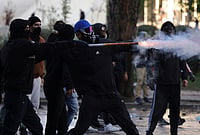
Dominik Moll's Case 137 has released in North American theatres.
The French filmmaker's latest procedural premiered in Cannes Competition last year.
Moll spoke to Outlook about how the film came to be.
With his knotty 2022 true-crime thriller, The Night of the 12th, French director Dominik Moll swept the Césars. The methodical rhythm, the granular focus on procedure extend to his follow-up, Case 137, which premiered in Cannes Competition last year. Led by an indomitable Léa Drucker, the deliberate drama plunges into the detail, patience and rigour investigative work demands. The film trails Stéphanie (Drucker), an investigator at the IGPN, the French police’s internal affairs department, as she parses complaints against the riot squad. Stéphanie’s sincerity doesn’t protect her from the ramifications of her odd position, hemmed between her colleagues who see her as a traitor and the public cynicism about her job’s actual reach. Moll keeps a tight, unwavering focus on her search for truth, even while her faith in what she can achieve corrodes.
For her controlled performance, Drucker landed both the César and the Lumière Awards (the equivalent of Hollywood’s Golden Globes) with best actress gongs. As Case 137 launches its North American release via Film Movement, Moll sat down with Outlook for an exclusive conversation, where he spoke about his affinity for documenting mundane work, the Yellow Vest movement that rocked France in 2018, how mainstream media frames protests and examining police violence.
Edited excerpts…
Could you talk about the IGPN? I’m curious about the public perception of it in France, what’s the degree of awareness that exists regarding its role and scope…


Well, I think before the film, nobody really knew a lot about it, about the way it functioned, so the, it was rather obscure, and, it was being criticized by, let's say, mostly left-wing media, who said that they weren't doing their job properly, which in some cases is true, but the general public wasn't really aware of its existence. One of the things that the film did was to show how this institution works or doesn't work.
There’s a repetitive nature to the work, the grind of same questions and answers to the mundane rounds of interrogation, filing minutes, requisitions. How do you go about trying to find a cinematic rhythm in that?
Yeah, well, I mean, the first step was, of course, to document myself and to understand how it worked. I was lucky to be able to spend a few days with the IGPN. Already in my previous film, I was really interested in procedural nitty-gritties which are often put away in police films, because people think it's boring, but I find it fascinating. I think it's part of the whole process, and so the challenge was to show it, but to make it interesting. The investigators of the IGPN spend a lot of the time watching videos. To watch them at work, witness them scrutinize those videos was something that I felt was very cinematographic and also the fact that they don't always see the same thing. Also, I think because the film is being told from the perspective of the main investigator of Stephanie and the audience knows just as much and as little as she does, it allows the audience to identify with her, and to be interested in all the small things, all the details that will make her investigation progress.
I wanted to talk about representative references. In Indian cinema, there's a mainstream tradition of valorising cops and putting them as exaggerated symbols of oppressive State apparatus. They can also be conflated with vigilantism. Another vein is showing these tortured cops, officers haunted by guilt and trauma. When you were setting out, did you think at all about a broader cinematic paradigm within which you would be situating your characters?
What I was interested in is to show a character who tries take her job seriously and do it in the best possible way. So, I mean, she's not someone who's tormented like in a lot of cop films as you are saying.
She's very clear-headed.
Very much so. I wanted to question the fact if it was possible to do your job in the best possible way. Is it at all possible to achieve a goal? Is there an obstructing political logic?
There's a cutting scene between Stephanie and the chambermaid, the hotel chambermaid, who questions her at some point, whether she'd really push so much if it weren't a white guy, but a black or an Arab. Could you talk about that particular exchange? What does it do to Stephanie's realization? How does she see her own work going forward?
Well, I'm glad you bring this up because that's a very important, part of the film. Before the Yellow Vest Movement, most of the identified police violence happened in the suburbs and against people who were Black or of Arab origin. The Yellow Vest movement was mostly led by white people and they didn't think they could be the targets of police violence. That it happened to them came as a shock. But initially, all this violence developed because of racist prejudice. In the film, the chambermaid is the first one who tells Stephanie like it is, that her pursuit is useless and will not lead to a trial or a condemnation of the cops. She's right. Even in France, there are very few cases in police violence where the police officers are actually convicted.

Just like France, in India too, we are witnessing a huge wave of protests led by the youth, essentially demanding electoral transparency, a lot of other things. Millions of people have had their citizenship status questioned under a new process. There’s a lot of rage against the police who are going overboard to detain, but they have the full blessing of the government. So, there are these immediate parallels your film strikes globally.
Between the 2018 movement in France and the current protests you are observing now, what do you make of the public imagination of protests and the police’s intervention? Do you see any shifts also in how media relays these protests?
Well, it's the same in France. I mean, the way that the protests or demonstrations are being portrayed by mainstream news channels—and some of them are already, you know, far right or extreme right channels like, you know, one which is called CNews is almost the equivalent of Fox News in the US. And so they will always be on the side of the police, and the police is never wrong and always right. As soon as there is in protests—I mean, there's always some violence, you know—but they will portray it in a way as if the violence was everywhere. As soon as there's a car burned somewhere, they will show that over and over and over and over again. What happens is that people who live far from where things happen, in the country or in small cities, see that all day long and have the impression that there is chaos, that all protesters are violent, and so, of course, it allows the news channels and the politicians to minimize what the protest is really about. The people who see that over and over again on TV will feel insecure and end up voting for extreme right parties. So it's really something quite deliberate.
I mean, right now in France, for months now, there have been high school protests against the conditions because they don't have enough staff and teachers. And again, they are being portrayed as not being able to think by themselves, so they're being portrayed as being manipulated by extreme left-wing parties. You know, it's always the same thing, and that's a real problem with the mainstream media because, like in the US, and maybe also like in India, facts don't count anymore. It's just the way you respond to things emotionally, and that is really worrying, really.

These officers can’t show emotion. They have to go strictly through cold facts. Can you talk about working with Lea to locate that neutrality of a front, deciding how much she can reveal, what to hold back?
Most of the work with her was exactly about that. I had organized a meeting between her and some of the internal affairs investigators. She asked them how they handled emotions. For her, as an actress, emotion is her primary tool. She asked how they grappled with tough situations when they're facing someone, a police officer who annoys you because he is obviously lying, or a mother who is distressed because her son was wounded, et cetera. They emphasised no matter what police work you do, you have to stick to the facts, and so you can't allow yourself to be overwhelmed by emotions. The idea was not that she should play like a robot, but that the audience should feel that there are a lot of things, a mesh of contradictory feelings going on inside her. These should be perceived in a very subtle way. Léa is excellent at that.
I am also curious about a breakout success and what that does to an artist. After The Night of the 12th, were you able to cut out the noise easily? How do you avoid not being calculating too much?
Trying to calculate what will succeed is a very dangerous approach for a filmmaker and usually leads to mistakes. When planning your next film, you shouldn't focus on what will work commercially or what the audience expects. Instead, it must stem from a strong personal connection to the story or characters, allowing you to invest something of yourself into the project—that personal resonance should be the only guiding force behind your choices. For instance, following The Night of the 12th, choosing Case 137 wasn't a calculated attempt to repeat a successful police procedural formula. Rather, it came from a genuine curiosity about the work of the IGPN and a desire to explore the issue of police violence. This problem is increasingly critical as it reflects how a democracy functions and highlights how political authority misuse the police as a tool to protect power, rather than serving and protecting the citizens. Ultimately, that premise felt like compelling ground for a narrative.
Though the film steers clear of any binaries, how do you see the film’s parting note yourself? Do you see it as an entirely hopeless one, in terms of French justice structures? Stephanie has this incredible drive, integrity. She’s really committed. But over the course of the film, as she journeys, she gets these blows, the final one from her team itself. Do you reckon she’d still fight as bullishly? Or has something deep within her been destroyed?
I hope she continues her work, as it remains crucial for individuals in leadership positions to believe in the importance of what they do, even if they represent a minority. Had that not been the case, I would have depicted her quitting abruptly in rage. Although accepting what transpired will be difficult for her, I believe she ought to persevere. I do hope there will always be dedicated individuals across various fields who remain genuinely committed to performing their duties properly.