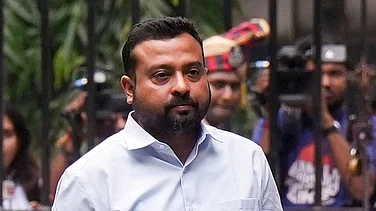
The Supreme Court dismissed gangster Abu Salem's petition seeking premature release, ruling that he has not yet completed his mandated 25-year prison sentence.
A Bench comprising Justices Vikram Nath and Sandeep Mehta upheld the Bombay High Court's ruling that dismissed Salem's release plea as premature and misconceived.
The Centre maintained that the 25-year period commenced upon Salem's extradition from Portugal on November 11, 2005, setting his official release date in November 2030.
The Supreme Court on Thursday dismissed gangster Abu Salem’s plea for premature release, holding that he has not yet completed the 25-year prison term tied to India’s extradition assurance to Portugal. A Bench of Justices Vikram Nath and Sandeep Mehta upheld the Bombay High Court’s April 2026 order, which had rejected Salem’s plea as "premature" and "misconceived."
The Bench delivered only the operative part of its ruling and a detailed verdict is awaited. Pronouncing the order in open court, the Bench said, "The present appeal stands dismissed in limine."
The dispute goes back to Salem’s extradition from Portugal on November 11, 2005, after India assured Portugal on December 17, 2002 that he would neither face the death penalty nor remain in prison for more than 25 years. Salem, arrested in Portugal in 2002 and later convicted in two TADA cases in 2015 and 2017, argued that he had already crossed that limit. The Centre maintains that the 25-year clock runs from his handover to India in 2005, which would take the end point to 2030.




Why Did It Happen?
The case turned on one assurance. During the extradition process, India told Portugal that Salem would not be given the death penalty and would not be imprisoned for more than 25 years. That sovereign assurance became the basis of Salem’s argument that his continued custody after a certain point would violate the terms under which he was sent back to India.
Salem argued that the 2017 life sentence in one of the TADA cases breached that arrangement. In his latest plea, he claimed he had completed 25 years in prison on March 31, 2025 by counting under-trial custody, post-conviction custody and remission earned for good conduct together. His counsel, Senior Advocate Rishi Malhotra, also argued that remission should be added to the imprisonment period, making further custody illegal.
The Bombay High Court did not accept that calculation. In April 2026, it held that the plea had been filed too early and that the 25-year period would end only in 2030. The Supreme Court had already clarified in July 2022 that India was bound by the assurance to Portugal and that Salem could not be held beyond 25 years, but it also made clear that it was not commuting his sentence.
Who Is Abu Salem?
Salem has long figured in major criminal cases. He is a former member of underworld don Dawood Ibrahim’s syndicate. Arrested in Lisbon in September 2002, Salem is the prime suspect in the 1993 Mumbai bombing, which killed 257 people and wounded more than 1,000. He is also wanted in more than 60 cases involving murder, attempted murder, extortion and abduction.
His rise began in Mumbai. Salem left Sarai Mir in Uttar Pradesh’s Azamgarh district and moved to the city, where he worked as a tailor, ran a telephone booth and sold cutlery in the Mumbai suburbs. After a scuffle over protection money, he murdered one man and became a shooter in the Mumbai underworld.
His role then widened. He later came into contact with Anees Ibrahim, Dawood Ibrahim’s brother, and was tasked with supplying guns to contract killers. He also extorted money from Bollywood stars and expanded into film financing, smuggling, arms sales, hawala, fake currency and extortion rackets. He liaised with Karachi-based smugglers Mustafa Majnu and Mohammad Dosa, fled to Karachi with members of Dawood Ibrahim’s organisation, and was believed to have supervised the 1994 assassinations of Maharashtra BJP leaders Ramdas Naik and Prem Singh. In December 1997, he was picked up by Dubai Police in a fraud case involving a car import firm run by his brothers, but fled on a Pakistani passport.

How Did We Get Here?
The legal trail spans more than two decades.
Salem was arrested in Portugal in 2002 and extradited to India on November 11, 2005. The extradition followed India’s assurance that he would not face the death penalty or imprisonment beyond 25 years. The handover took place after his conditional release from a local sentence in Lisbon, and Portuguese authorities transferred him to a 20-member CBI team.
He was then tried in two TADA cases. Courts convicted him and handed down life sentences in judgments dated February 25, 2015 and September 7, 2017. One conviction was in the 1995 murder of Mumbai businessman Pradeep Jain and his driver Mehndi. In the 1993 blasts case, he was found guilty of transporting weapons from Gujarat to Mumbai for use in the serial bombings, which killed 257 people and left more than 700 seriously injured.
The Supreme Court addressed the extradition assurance again in July 2022. It held that India remained bound by the sovereign commitment to Portugal and that Salem could not be detained beyond 25 years. At the same time, the court held that the period he spent in Portugal in a passport fraud case could not be counted towards the 25-year cap. Salem later renewed his effort for release. The Supreme Court first asked him to pursue the matter before the High Court, which rejected his remission plea in April 2026. The apex court heard the matter, completed arguments on July 27 and reserved its decision.
The Bench had already signalled its view during an earlier hearing. It told Salem’s counsel, "Even by simple calculation, from your date of incarceration on November 11, 2005, you have not completed 25 years," the report said.
What Counts Toward Term?
This is the core dispute. The Centre’s position was that the 25-year period started on November 11, 2005, when Portugal extradited Salem to India to face trial in multiple cases. On that calculation, the limit ends in November 2030. The government also argued that Salem’s earlier detention in Portugal was in a passport-related case and had no link to the offences for which India later obtained extradition.
Salem pressed for an earlier date. He argued that the 25-year period should run from September 18, 2002, when he was taken into custody in Portugal after an Interpol Red Corner Notice issued at India’s instance. He also argued that his time as an under-trial and remission earned in prison should be included while computing the total term.
Malhotra raised one more point. He argued that the High Court had not determined which of Salem’s convictions should be used as the basis for calculating when the 25-year term began. The Supreme Court has now rejected Salem’s broader claim for immediate release.