



Rule 240 allows Rajya Sabha members to raise matters of public importance through a Special Mention with the Chair's approval
The provision came into focus after a procedural clash between Mallikarjun Kharge and Kiren Rijiju over a statement from Amit Shah
Unlike Rule 267, Rule 240 does not suspend House business or guarantee an immediate debate, highlighting the growing political importance of parliamentary procedure
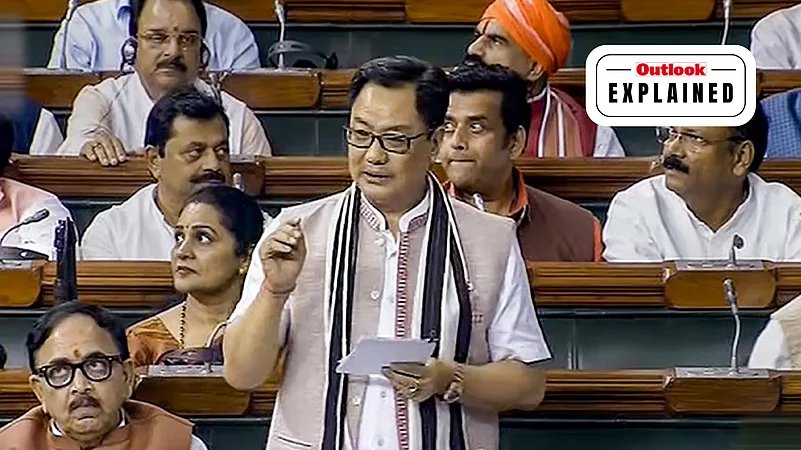
A dispute over parliamentary procedure triggered the latest flashpoint in the Rajya Sabha after Leader of Opposition Mallikarjun Kharge sought a statement from Home Minister Amit Shah on a matter of public importance, prompting a sharp exchange with Parliamentary Affairs Minister Kiren Rijiju.
As per ANI, the disagreement centred on the Opposition's demand for a government response and the manner in which the issue could be raised under the Rajya Sabha's rules of procedure.
The confrontation unfolded against the backdrop of a prolonged standoff between the government and the Opposition over the functioning of Parliament. The impasse had already disrupted legislative business, with Rijiju holding consultations with Congress leader Rahul Gandhi in an attempt to break the deadlock amid demands that the government address contentious issues, including the Foreign Contribution (Regulation) Amendment Bill.
The exchange also underscored the central role played by the Rajya Sabha Chair, who intervened during the proceedings and asked Rijiju to convey the Opposition's sentiments to the Home Minister. While the immediate disagreement was political, it also brought renewed attention to the parliamentary rules governing how members raise issues, the extent of the Chair's discretion and the limits of procedural interventions.



What Is Rule 240?
Rule 240 forms part of the Rajya Sabha Rules of Procedure and Conduct of Business, published by the Rajya Sabha Secretariat. It relates to Special Mentions, a parliamentary mechanism that enables members to bring matters of public importance before the House with the prior permission of the Chair.
Under the rules governing Special Mentions, members must submit a written notice in the prescribed format to the Secretary-General. The notice is examined for admissibility and may be accepted only if it satisfies the conditions laid down in the Rules. The Chairman decides whether permission should be granted.
The rules specify that a Special Mention must concern a matter of recent public importance, should not contain arguments, defamatory statements or allegations, and is subject to a prescribed word limit. The number of Special Mentions admitted on any sitting day is also restricted.
Importantly, a Special Mention does not initiate a debate. It allows a member to place an issue on record and draw the government's attention to it, but it neither obliges a minister to respond immediately nor results in a discussion unless the government or the Chair separately permits one. In that sense, Rule 240 is primarily a procedural mechanism for raising issues rather than securing an immediate parliamentary debate.
Why Did Kharge And Rijiju Clash Over It?
The immediate trigger for the dispute was Kharge's insistence that Home Minister Amit Shah make a statement in the House on a matter the Opposition considered urgent.
The Opposition argued that Parliament should hear directly from the Home Minister and sought to raise the issue through the available parliamentary procedures. The government, represented by Rijiju, maintained that parliamentary business should proceed according to the established agenda and procedures.
The Rajya Sabha Chair intervened during the exchange, asking Rijiju to communicate the Opposition's sentiments to Shah while ensuring that proceedings continued in accordance with the Rules. The intervention reflected the Chair's role as the authority responsible for balancing members' rights to raise matters of public importance with the orderly conduct of the House.
The disagreement therefore extended beyond the immediate political issue and became a debate over how parliamentary rules should be interpreted and applied.
What Powers Does The Rajya Sabha Chair Have?
The authority of the Rajya Sabha Chair is derived from the Rules of Procedure and Conduct of Business as well as the Directions by the Chairman, Rajya Sabha, which provide detailed procedural guidance for the functioning of the House.
Under the Rules, the Chairman has the power to regulate proceedings, preserve order, interpret the Rules and decide procedural questions. The Chair also determines the admissibility of notices submitted by members, including Special Mentions, and may refuse permission if the prescribed conditions are not satisfied.
The Rules further empower the Chair to maintain discipline during proceedings, direct members to discontinue irrelevant or repetitive speeches, decide points of order and regulate matters that are not expressly covered by the Rules through procedural directions.
The Directions by the Chairman supplement the Rules by setting out practical procedures governing the conduct of business, including the submission of notices, regulation of debates and other procedural matters. Together, these provisions give the Chair considerable discretion in managing proceedings while ensuring that parliamentary business is conducted according to established procedure.
How Is Rule 240 Different From Rule 267?
Although both provisions are frequently invoked by Opposition parties, they serve fundamentally different purposes.
Rule 240 enables members to raise a matter of public importance through a Special Mention after obtaining the Chair's permission. It allows the issue to be formally placed before the House but does not suspend scheduled business or automatically lead to a discussion.
Rule 267, by contrast, allows a member to seek the suspension of the House's rules in order to take up a matter that is considered sufficiently urgent. If the Chair admits such a notice and the House agrees, the normal order of business may be set aside so that the issue can be discussed immediately.
Because Rule 267 has the potential to interrupt listed business, it has traditionally been regarded as a more powerful procedural instrument. Opposition parties often invoke it when seeking an immediate debate on politically sensitive matters, while governments generally argue that frequent suspension of business disrupts the legislative agenda and the orderly functioning of Parliament.
The distinction therefore lies in their effect. Rule 240 provides an opportunity to raise an issue within the existing schedule of business, whereas Rule 267 seeks to alter that schedule altogether.
Why Are Parliamentary Rules Becoming Political Tools?
The Kharge-Rijiju confrontation illustrates how parliamentary procedure has become an increasingly important arena of political contest.
Rules governing notices, debates and admissibility determine not only how Parliament functions but also which issues receive attention inside the House. For Opposition parties, procedural devices such as Special Mentions and notices under Rule 267 provide institutional mechanisms to press the government for explanations on matters they consider urgent.
The government, meanwhile, argues that adherence to established procedures is essential to maintain order and ensure that legislative business is completed efficiently. From its perspective, repeated attempts to suspend normal business risk paralysing Parliament and delaying lawmaking.














